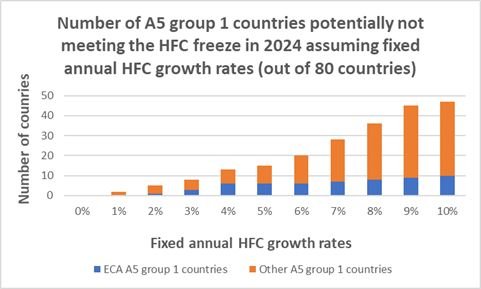
Following an analysis of HFC baseline scenarios for Article 5 group 1 countries in the Europe and Central Asia (ECA) region, it appeared that most countries would not “automatically” meet the HFC freeze in 2024 without putting in place additional HFC policy and legislative measures. If countries allowed a fixed annual HFC growth rate of 10%, the resulting HFC consumptions in 10 out of 11 countries (91%) would exceed the freeze level in 2024. The 10% growth scenario might not even be realistic as several countries witnessed growth rates well above 10% in the past. The year 2020 is a particular year as the Covid-19 pandemic has affected national economies and growth in the heating, refrigeration and air-conditioning sectors.
A similar situation can be observed in Article 5 group 1 countries in general. Out of 80 countries with estimated or reported HFC consumption data for 2019 (or 2018), 47 countries (59%) are not likely to meet the HFC freeze in 2024 if they allowed a fixed annual HFC growth rate of 10%. If they allowed a growth rate of only 5%, 15 countries (19%) would exceed the freeze level. For ECA countries, this figure was 6 out of 11 countries (55%). The message is that countries would need to adopt early HFC policy and legislative measures prior to the freeze.
It is in this context that UNEP OzonAction’s Montreal Protocol Network for Europe and Central Asia (ECA network) dedicated its recent online meeting on 7 October 2020, to the adoption of early HFC policy and legislative measures to meet the HFC freeze. Invited experts included Arno Kaschl of the European Commission’s DG Climate Action, Barbara Gschrey of Oekorecherche and Janusz Kozakiewicz of Poland’s Industrial Chemistry Institute. The experts presented the range of available policy measures and shared their experience from applying such measures in the European Union. The meeting was attended by 45 experts from ECA network and associated CEIT countries as well as bilateral partners, implementing agencies, European Commission, Ozone Secretariat and OzonAction staff from Asia Pacific and West Asia.
During the initial stage of the HFC phase-down strategy, it will be important to identify “low-hanging fruits” in terms of sectors / applications where HFCs can easily and at low cost be replaced by climate-friendly alternatives in new equipment. Prohibitions are easier to implement than a gradual phase-down and they are feasible in several areas. Disposable cylinders should be banned because they cannot completely be emptied and facilitate illegal trade. Restriction and bans should be considered for imports and placing on the market of new high-GWP equipment and products, as well as use bans for specific applications.
At the same time, barriers should be removed and economic incentives provided for new climate-friendly and energy-efficient equipment. Existing equipment might require better servicing and containment practices including the recovery, recycling and reclaim. Green public procurement can facilitate the deployment of new technologies in local markets. Quota systems based on the GWP / CO2-equivalent tonnes for HFC imports will ultimately allow meeting the freeze and should be supported by accompanying measures e.g. labeling of refrigerant cylinders and equipment.
Tax, rebate or fee schemes have proven to be efficient in several countries. It is important to establish effective penalties, reporting and licensing systems, to ensure the qualification of service personnel and sustainable end-of-life treatment, to enforce leakage prevention through mandatory leakage checking and a ban on venting. Other aspects include that exemptions are difficult to monitor and enforce, transit procedures may represent loopholes, licenses for each shipment provide better control, awareness raising and training is crucial. It is also important to monitor the implementation of such measures through the registration of HFC importers/exporters, wholesalers and users of HFC equipment / products, the introduction of mandatory reporting requirements and the establishment of an inventory of HFC equipment.
In conclusion, Article 5 group 1 parties to the Montreal Protocol should elaborate their respective HFC phase-down strategies and adopt HFC policy and legislative measures as early as possible. This requires the ratification of the Kigali Amendment (if not yet done) as a pre-condition to access funding for the strategy preparation, and the timely submission of the strategy for ExCom approval. Hopefully, the funding guidelines for the preparation and implementation of the HFC phase-down strategies can soon be adopted despite the constraints imposed by the Covid-19 pandemic.
Presentations for download:
- EU experience with HFC policy measures and the way forward
- HFC policy and legislative measures to facilitate meeting the HFC freeze
- Statement on recommended policy action