Esta página solo está disponible en inglés. Ir a la portada en español

×

Questa pagina è disponibile solo in inglese. Home page in italiano

×

Diese Seite ist nur auf Englisch verfügbar. Zur deutschen Startseite

×

Cette page est disponible uniquement en anglais. Aller à la page d'accueil en français

×

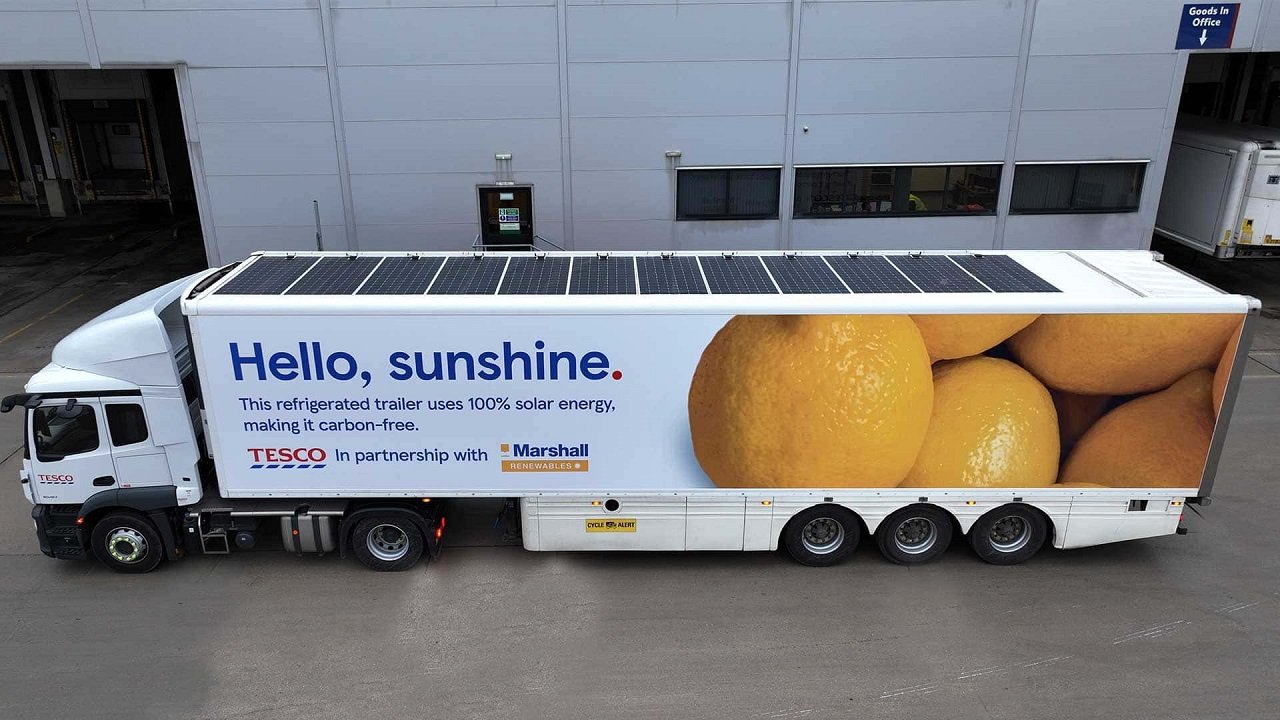
Tesco and Marshall Fleet Solutions are working on a trial of 100% solar powered refrigerated trailers

Tesco and Marshall Fleet Solutions are working on a trial of 100% solar powered refrigerated trailers

In a joint initiative, Tesco and Marshall Fleet Solutions are currently working on a trial of 100% solar powered refrigerated trailers within the Tesco refrigerated trailer fleet as part of Tesco’s long-term commitment to sustainability and reduced carbon footprint targets within its business operations.

The first 100% solar powered trailers fitted with the Titan system from Marshall are now on the road and servicing Tesco distribution centres across the country.

“We’ve got 4,200 trailers in our distribution fleet transporting fresh goods such as fruit, vegetables, ready meals and sandwiches,” says Fleet Engineering Manager Cliff Smith. “Around 3,000 of those are refrigerated and with a goal to bring carbon emissions to net zero by 2035 and the imminent removal of red diesel entitlements, we’ve had to look at the way our food gets to stores and customers.”

Available exclusively from Marshall Fleet Solutions, the Titan system’s independent and autonomous design is capable of providing 100% free power to all makes of on-board refrigeration unit, tail lifts and other vehicle mounted electrically powered applications on all vehicles sizes from LCVs, small trucks, to HCVs, both single temp and multi-temp. Available for both new vehicles as well as for retrofitting to existing vehicles, Titan has the ability to convert fleets to reach zero carbon goals overnight.

According to MFS Managing Director, Mark Howell, “With a significant trailer fleet, the successful use of solar powered refrigerated trailers within the Tesco distribution operation cannot be underestimated, in terms of its significantly positive environmental impact. Both Tesco and MFS share similar sustainability and carbon reduction plans. As a result of MFS’s long association with Tesco as approved suppliers of Thermo King transport refrigeration systems, this initiative builds on the strength of this relationship, whilst helping to deliver on Tesco’s global sustainability goals.”

Get the daily refrigeration briefing

One email a day. Trusted by 3,000+ RACHP professionals.

More on Cold Chain

All on Cold Chain →

Insights

Secop's Solar Direct Drive (SDD) System Earns WHO PQS Approval – The Team Behind It
Article

Secop’s Solar Direct Drive (SDD) System Earns WHO PQS Approval – The Team Behind It

Partner's material In March 2026, Secop’s Solar Direct Drive Power Management Module was granted WHO PQS prequalification and officially listed in the WHO Catalogue of Prequalified Immunization Devices. The WHO IMD-PQS (Immunization Devices Performance, Quality and Safety programme) is the global benchmark for cold chain equipment used in immunisation. Being listed in its catalogue is

22 Jun 2026
Case Study - Effect of Louvers or diffusers on air flow distribution and cooling time on a meat log during Chill cycle
Tech Guide

Case Study – Effect of Louvers or diffusers on air flow distribution and cooling time on a meat log during Chill cycle

By Kushal Aurangabadkar An experimental analysis was conducted on a cooler space measuring 3.66 m × 6.096 m (12.0 ft × 20.0 ft), equipped with an ammonia refrigeration coil, five 30 cm (12 in.) fans, and five diffusers. The study measured airflow patterns, cooling rates, and heat transfer efficiency in meat storage by testing two configurations:

Kushal Aurangabadkar · 21 Jan 2026
Total Cost of Ownership (TCO) for Modular Refrigeration Systems in Life Sciences Distribution Centers
Tech Guide

Total Cost of Ownership (TCO) for Modular Refrigeration Systems in Life Sciences Distribution Centers

by Ramez Naguib, P.E. Introduction Life sciences distribution centers are under immense pressure to deliver consistent temperature control, comply with increasingly stringent regulations, and optimize operational efficiency. Traditional built-up refrigeration systems often prove cumbersome, costly, and slow to implement. In contrast, modular, factory-assembled refrigeration systems have emerged as a compelling alternative. Drawing on lessons from

14 Jan 2026
Everything on Cold Chain: 2,041 articles, 1 case study, 23 insights

Most read this month

All news →