In the digitalisation of industrial processes, growing demands for energy efficiency, cybersecurity, and controllability are confronted with legacy technologies such as serial interfaces, proprietary bus systems, or installations that are difficult to scale. With Single Pair Ethernet (SPE), a new technology is emerging that addresses these challenges. But what exactly is SPE? What specific advantages does it offer manufacturers, mechanical engineers, and operators? And how can the transition to this future-oriented technology succeed?
Single Pair Ethernet (SPE) is a new, globally recognised physical Ethernet standard that enables both data transmission and power supply over a single twisted pair of copper wires. In contrast to conventional Ethernet, which uses four wire pairs, SPE allows for a more compact and resource-efficient infrastructure. The so-called “Power over Data Line” (PoDL) technology also makes it possible to supply connected devices with up to 50 watts of electrical power.
With a range of up to 1,000 metres at 10 Mbit/s (according to IEEE 802.3cg), SPE is particularly well suited for building and process automation. Even higher transmission speeds of up to 1 Gbit/s are possible over shorter distances. The corresponding connectors are defined in IEC 63171 and specifically designed for compact and robust industrial applications.
Why SPE is especially relevant now
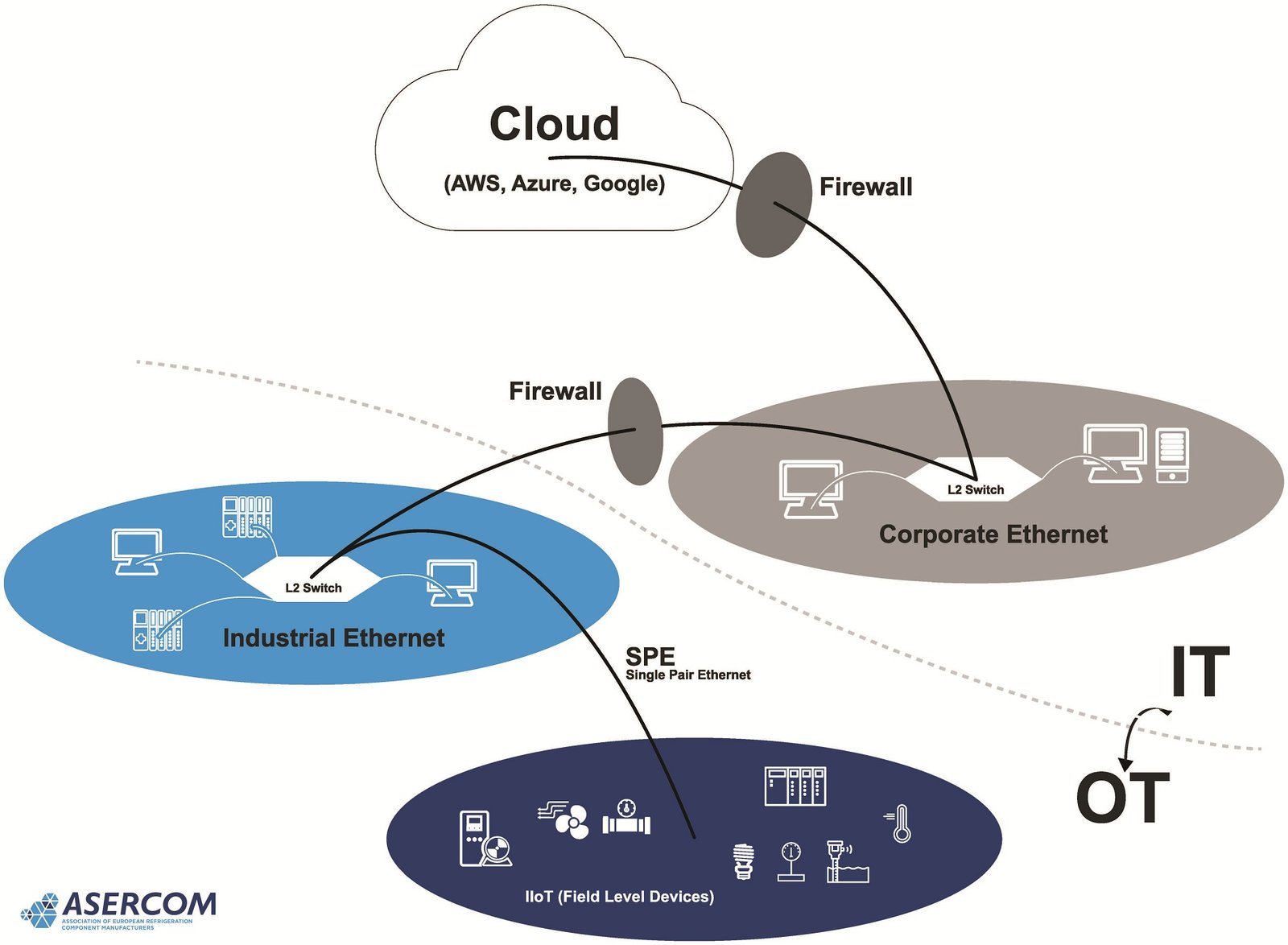
As the networking of intelligent components increases and the desire for seamless IP-based communication grows, traditional fieldbus systems are reaching their limits. A gap often remains between the IT world and the field level, which currently has to be bridged using Remote-IO, media converters, repeaters, gateways, and parallel cable paths. This is precisely where SPE comes in: it eliminates this technical fragmentation and brings Ethernet communication directly to the sensor or actuator – with minimal cabling effort. For the first time, it becomes possible to implement standardised IP structures from the cloud to the inside of the device.
SPE is already indispensable in some sectors of industry. In the automotive sector, for instance, the communication protocol is part of modern wiring system architectures, reducing weight, space requirements, and complexity making autonomous driving possible in the first place.
In robotics, Single Pair Ethernet enables greater freedom of movement and more efficient data flows. Small bending radii and the ability to transmit power via the same cable are clear advantages for collaborative robots (cobots). Smart building solutions also benefit from this technology: SPE enables easier networking of lighting controls, air quality sensors, and access systems.
Even in potentially explosive areas of the process industry, SPE is already being used. In such cases, the Ethernet-APL (Advanced Physical Layer) variant allows safe operation under demanding environmental conditions. These practical examples illustrate the technology’s potential – and indicate the opportunities it could open up for the RACHP sector as well.
Dr Christian Ellwein, Head of the Electronics Working Group at ASERCOM, the Association of European Refrigeration Component Manufacturers, emphasises the strategic significance of SPE: “The technology originally derives from the automotive sector and is already widely used there. The opportunity now lies in unlocking its potential for building automation – and, beyond that, for refrigeration and air conditioning technology.”
ASERCOM and SPESA: cooperation for a common standard
ASERCOM and the Single Pair Ethernet System Alliance (SPESA) – a global network of 90 leading technology companies – have recognised that the introduction of SPE into refrigeration and air conditioning technology cannot be achieved solely on a technical level. They have therefore joined forces in a working group to jointly develop standards, requirements, and recommendations for action. The aim is to establish the conditions necessary for an interoperable, cross-manufacturer implementation.
Ellwein adds: “It’s important to choose the right technology in order to be future-proof and avoid duplicating effort across multiple systems. That is why it is crucial for ASERCOM to get involved at an early stage – this can save a lot of development work.”
This is not only about technical specifications. The ongoing collaboration also addresses communication requirements, data structures, update cycles, and power supply needs. A key point is the evaluation of existing infrastructure: Which cabling can continue to be used? Which interfaces will be relevant in the future? And how can pilot projects be implemented in a sensible and practical way? Initial results will be presented at the SPE Forum in autumn 2025.
Technological benefits in networked systems
A key advantage of SPE is the unification of the communication infrastructure. Instead of a multitude of proprietary fieldbuses, the technology enables the development of a consistent IP network all the way to the lowest level. This not only simplifies planning but also reduces potential sources of error.
Furthermore, many security and communication standards from the IT domain can be applied directly. Certificate-based encryption, role-based access models, and update options via the network are already well established today – and with SPE, they can now also be implemented at the device level. At the same time, smaller connectors and a smaller number of wires enable more compact devices and simplified installations.
Simon Seereiner, Business Development Manager at Weidmüller and spokesperson of the SPE System Alliance, sums it up: “SPE is not just another technology – it is the key to the industrial communication architecture of the next decade. It radically simplifies networks while simultaneously raising security standards to a new level.”
The power supply via PoDL completes the system: many sensors and control units can be operated without additional power cables. This reduces installation time, lowers costs, and reduces fire load in critical environments.
Standardisation and availability
The international standardisation of SPE ensures planning certainty: IEEE 802.3 specifies the data transmission standards, IEC 63171 defines suitable connector faces for industry, buildings and harsh environments. Cables for the various applications are also standardised in IEC 61156-11 to -14. Products with various IEC interfaces are already available on the market today. SPE is also supported by the SPE System Alliance. Its collaborative efforts within the alliance ensure that devices, infrastructure components, and software platforms are compatible and coordinated with one another.
Seereiner also sees the potential for completely new functionalities enabled by SPE: “When power and data are transmitted via the same pair of wires, new possibilities emerge – such as intelligent sensors with additional analysis capabilities or actuators that are directly networked and configurable.”
He adds: “Once electricity and data run through the same slim cable, it’s not only cheaper and more flexible—it also becomes smarter: devices recognise each other, update themselves, and can be controlled in real time. That is how a simple wire becomes a smart data pathway.”
The advantages of SPE are not only technical but also economic and ecological. Reduced use of copper and plastic means lower material costs and a significantly improved environmental balance. According to the SPE System Alliance, cable weight in typical machine wiring can be reduced by up to 60 percent. At the same time, PoDL eliminates the need for separate power supplies in many cases – saving space, energy, and maintenance effort.
In addition, standardisation reduces the variety of components: fewer variants lead to lower storage requirements and simpler training. This means that not only manufacturers, but also integrators and operators benefit from a more efficient, sustainable system architecture.
Conclusion: infrastructure of the future also relevant for operators
Single Pair Ethernet is more than just a new cabling technology—it is a strategic lever for digitalisation, efficiency, and sustainability. For manufacturers in the refrigeration and air conditioning sector, the technology opens up new possibilities in design, integration, and networking. But operators also benefit: systems become more transparent, easier to control, and more maintenance friendly.
For example, in the food retail sector, logistics industry, or among operators of building complexes, this means better data for controlling cooling and air-conditioning systems, easier integration into existing networks, and reduced maintenance effort.
The ongoing cooperation between ASERCOM and
SPESA demonstrates that a structured approach is possible. Those who start
thinking ahead today will be able to act more efficiently tomorrow. After all,
the infrastructure used for communication is the silent backbone of any
successful digitalisation.