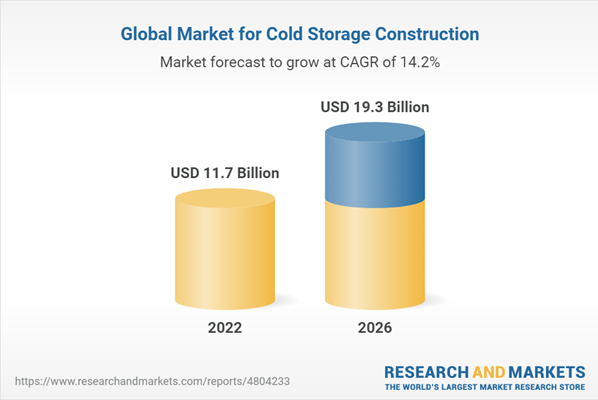
Amid the COVID-19 crisis, the global market for Cold Storage Construction estimated at US$11.7 Billion in the year 2022, is projected to reach a revised size of US$19.3 Billion by 2026, growing at a CAGR of 14.2% over the analysis period. Production Stores, one of the segments analyzed in the report, is projected to grow at a 15% CAGR, while growth in the Bulk Stores segment is readjusted to a revised 13.8%. The cold storage space has been witnessing notable developments over the last several years due to the strong upsurge in demand for online grocery shopping as a result of changing consumer preferences. Cold storage construction has received a major impetus from the COVID-19 crisis that led pharmaceutical companies to come up with novel vaccines requiring storage as well as distribution at ultra-low temperature settings. While cold storage has experienced major uptick in construction activity in the recent months, the trend goes beyond the healthcare demand and attributed to several factors, primary online grocery shopping.
Online shopping for grocery items is a major driver ticking the demand for cold storage upwards even prior to the COVID-19 pandemic. Fueled by increasing popularity and consumer adoption coupled with pandemic-led favorable trends, online orders are estimated to account for about 10%-15% of the overall grocery shopping in 2022. The development is driving various companies to construct new cold storage facilities for preserving perishable food items and reducing spoilage. These facilities are playing an important role in accommodating massive surge in online grocery shopping. The construction activity is buoyed by surge in food sales in the recent years. The shift towards online grocery shopping was further fast-tracked by the COVID-19 crisis that altered consumer preferences and market conditions.
The scenario enabled the online platform in the grocery industry to report exponential growth, leading to increased demand for cold storage facilities. The COVID-19 infection risk prompted a large number of consumers to shun in-store grocery shipping and instead, consider the online channel to get these products directly delivered to their doorsteps. The growth is anticipated to result in construction of 75-100 million square feet of the cold storage space to meet prospective demand. The cold storage space is also benefitting from rising demand for frozen foods, mainly among health-conscious people. Frozen foods have received a major push from various studies that pointed towards the ability of frozen foods to effectively retain nutrients. Consumer uptick in demand for frozen foods, which was further accelerated by the COVID-19 pandemic, is poised to result in significant investments in cold storage facilities. Cold storage demand in the pre-pandemic scenario can be primarily contributed to significant popularity of the online channel for grocery shopping along with rising consumption of frozen foods for their nutritional and health-related benefits. The trend is slated to create huge requirement for warehouses capable of storing foods bought online. Continuous changes in shopping behavior of consumers are anticipated to result in gradual shift from traditional trips to grocery stores towards online platform. These trends have led to cold storage construction projects covering 4.5 million square feet of space, which are either completed or are underway.
Cold storage construction has also received a massive boost from increasing demand for various pharmaceutical products, including new COVID-19 vaccines, which require cold storage for storage and distribution. Driven by evolving consumer habits, industries such as pharmaceutical and food & beverage are facing high requirement of cold storage units for keeping items at cool or ultra-low temperatures. While cold storage facilities have been reporting high demand prior to COVID-19, the pandemic has played a pivotal role in accelerating cold storage development activity. COVID-19 vaccines remain one of the primary drivers of the cold storage demand in various countries. Some of the newly developed and prospective vaccines must be kept at sub-zero temperatures. The need to store and distribute vaccines at ultra-low temperature settings to maintain their efficacy and avoid spoilage has pushed the development of new cold storage units. For instance, the Pfizer-BioNTech COVID-19 vaccine is maintained at an ultra-low temperature of around minus 94 degrees Fahrenheit, while Moderna’s COVID-19 vaccine is kept at minus 4 degrees Fahrenheit. Offered frozen at minus 13 degree F to 5 degree F, the Moderna vaccine is required to be kept at very low temperature till its expiry date. On the other hand, the Pfizer-BioNTech COVID-19 vaccine is offered frozen at minus 112 degree F to minus 76 degrees F.
The vaccine must be kept at ultra-low temperature settings in specialized containers during its distribution and storage. These storage requirements have created strong need for advanced cold storage facilities for supporting vaccine distribution and rollout programs. The inadequate availability of ultra-cold freezer or cold storage units for these vaccines had prompted various contractors to announce new construction projects for satiating the unmet demand. The construction of several new cold storage facilities helped ultra-cold storage of pharmaceutical products and COVID-19 vaccines.
Select Competitors (Total 153 Featured):
- A M King
- AmeriCold Logistics LLC
- Burris Logistics
- Hansen Cold Storage Construction
- Lineage Logistics Holding, LLC
- Nichirei Logistics Group Inc.
- Primus Builders, Inc.
- Stellar
- Tippmann Group
- United States Cold Storage, Inc.