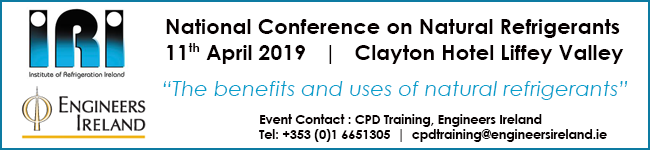
National Conference on Natural Refrigerants
Clayton Hotel, Liffey Valley
Dublin
The Institute of Refrigeration Ireland and Engineers Ireland are presenting a comprehensive one-day conference on Safe Use of Natural Refrigerants.
With the increasing environmental pressure on ‘chemical’ refrigerants, there is increasing interest in the use of ‘natural’ refrigerants for industrial and commercial refrigeration and air-conditioning. These refrigerants offer significant benefits in sustainability, operating cost, reliability and life expectancy.
The three natural refrigerants in use at present are Carbon-dioxide (CO2), Ammonia and Hydrocarbons. All three natural refrigerants have inherent aspects that require care in their use, including flammability, toxicity and pressure. Any refrigeration system will need to include the careful consideration of these hazards in the design and operation of the system throughout its life.
The aim of the Conference is to raise awareness of the benefits and hazards of natural refrigerants and to inform attendees on how best to ensure that such refrigeration systems are designed, installed, operated and maintained safely.
Programme:
The programme includes presentations from specialists and experts in fields relating to application, design, installation, maintenance, inspection, and training. The conference offers attendees the opportunity to hear from and engage with experts in the use and application of natural refrigerants.
The programme will include presentations from specialists and experts on the following topics:
- Hydrocarbons: Where can propane and other hydrocarbons be used and how much is permitted.
- CO2: The benefits and challenges of CO2 in commercial and industrial systems
- Ammonia: Ten things that will make an ammonia refrigeration safer and more efficient.
- Training: Training and competence for installers and operators.
- Retail Refrigeration: Small and medium sized CO2 condensing units for retail refrigeration.
- Adiabatic cooling: Using the evaporation of water to provide useful cooling in warmer weather.
- Chillers: Developments in ammonia, HC and CO2 packaged chillers
- Secondary cooling: Chilled water and glycol systems, glycols, oils, brines / salts,
- Electrical regulations: The electrical regulations in Ireland that apply to refrigeration systems.
- Environmental Impact: Minimising the environmental impact of direct emissions from refrigeration systems.
- Health and Safety: Avoiding incidents and accidents: PPE, sources of contamination, personal care.
Who should attend:
The conference would be of interest to those who already engage with natural refrigerants or who would like to consider the use of natural refrigerants in any commercial, industrial or air-conditioning application.
- Refrigeration system owners / operators (warehouses, cold stores, meat plants, pharmaceutical, food processing, process cooling, chillers)
- Factory engineering managers
- Maintenance engineering personnel
- Refrigeration contractors and installers
- Service and maintenance companies
- Equipment manufacturers / distributors
- Refrigeration system designers and technical support personnel
- Safety consultants / advisors
- Test and inspection service specialists
- Data centre designers
- Supermarket developers
- Building services consultants and contractors
- Those considering natural refrigerant options in the face the phase-down of HFC refrigerants