Esta página solo está disponible en inglés. Ir a la portada en español

×

Questa pagina è disponibile solo in inglese. Home page in italiano

×

Diese Seite ist nur auf Englisch verfügbar. Zur deutschen Startseite

×

Cette page est disponible uniquement en anglais. Aller à la page d'accueil en français

×
Article

Fan for Refrigeration Equipment

Fan for Refrigeration Equipment

In the refrigeration technology, the efficiency of evaporators and condensers heat transferring increases with the help of a fan, and the fastest cooling of products, after loading them into the chamber, is ensured.

In the refrigeration systems, two types of fan are often used:

  • evaporator or condenser fan,
  • compressor blower fan.

The fan of the evaporator or condenser unit

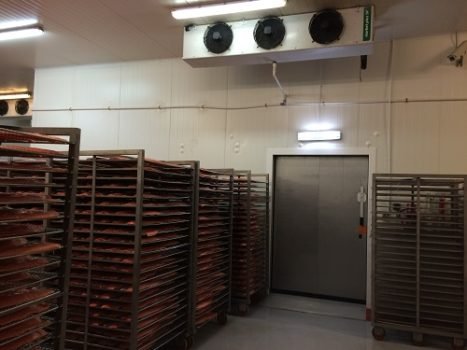
The fan of the evaporator (of an air cooler in the chamber), and of the condenser must meet the highest standards – to be as reliable as possible, effective and have a low noise level during the operation. This is because it must operate for a long period under various conditions of temperature and humidity without additional maintenance.


Most often, designers use axial-flow fans for the refrigeration equipment. They are attached directly to the evaporator or condenser casing. For a correct selection of the fan for the refrigeration system, many parameters must be taken into account. Here, the electric motor power, the evaporator capacity, the blades material, and many other things should be correlated. That is why the most evaporators and condensers are delivered with pre-installed fans, selected for the specific technical conditions.


 An axial-flow fan is a multi-bladed wheel located in the special casing. Blades are fixed at the special sleeve depending on the given angle to the wheel rotation plane. They have a curved shape that allows them to grasp the air when rotating and guide it parallel to the rotation axis. At a sufficiently low noise level, the axial-flow fan can produce in a predetermined direction a powerful air jet that increases the heat exchange of the air and the evaporator and is sent to the refrigerated chamber. Depending on the rotational speed, the power and range of the airflow can be adjusted. Modern fans are equipped with the thermal control systems that shut down the engine in case of overheating, as well as with the control units of different types that allow changing the rotational frequency. One of the latest technological trends is the development and production of fans from plastic and various composite materials. They improve efficiency and reduce noise during the operation.

Compressor Blower Fans

These devices are not needed in all cases, but only under the certain capacities and operating conditions, that create a risk of the compressor overheating. The need to use a blower for cooling the cylinder head, as a rule, is calculated and recommended by the manufacturers of compressors.

When blowing the compressor, the air stream is directed straightly to the piston head, which is very important for such systems, or to cool the oil that enters the crankcase through a special system. These fans can have a lower power and operate in the stationary mode, without additional settings. Blades can be made of plastic or steel and covered with special protective covers.

Get the daily refrigeration briefing

One email a day. Trusted by 3,000+ RACHP professionals.

Related insights

All insights →
Article

When regional performance doesn’t add up

Partner's material Europe is a continent that spans many different climates, from Athens to Oslo, seasonal temperatures vary significantly. The performance of heat rejection equipment can be impacted by the installed environment, which means that the data used for purchase, design and installation decisions must be accurately adapted to different climate zones. If HVACR professionals

23 Feb 2026
Tech Guide

Mitigating Liquid Trapping Risks in Ammonia Recirculation Pump Systems

By Kushal Aurangabadkar In industrial ammonia refrigeration systems, pumps play a vital role in circulating liquid ammonia to maintain cooling efficiency across evaporators and heat exchangers. The choice of pump type directly impacts system reliability, safety, and maintenance requirements. Among the most common options are conventional (mechanical seal) pumps and sealed (hermetic) pumps. Understanding their differences

Kushal Aurangabadkar · 17 Nov 2025
Article

Secop’s Solar Direct Drive (SDD) System Earns WHO PQS Approval – The Team Behind It

Partner's material In March 2026, Secop’s Solar Direct Drive Power Management Module was granted WHO PQS prequalification and officially listed in the WHO Catalogue of Prequalified Immunization Devices. The WHO IMD-PQS (Immunization Devices Performance, Quality and Safety programme) is the global benchmark for cold chain equipment used in immunisation. Being listed in its catalogue is

22 Jun 2026
Article

KARYER Leaves a Strong Impact at MCE 2026

Partner's material KARYER participated in Mostra Convegno 2026, one of the most significant meeting points of the HVAC&R industry, held in Milan, Italy, from March 24-27, 2026. The exhibition showcased the latest innovations and engineering solutions in heating, cooling, ventilation, and air conditioning technologies to industry professionals. Throughout the event, KARYER had the opportunity to

9 Apr 2026
Article

CO2 chiller with heat pump: NOVA FRIGO introduces an unprecedented technology with the contribution of Frascold

NOVA FRIGO introduces a new CO2 chiller with heat pump, created as part of the project promoted by the Lombardy Region “Ricerca & Innova” call for proposals, made possible also thanks to the technological contribution of Frascold, relating to an innovative heat pump with natural CO2 refrigerant and without the use of fossil fuels. This is a novel solution in

24 Nov 2025
Article

Innovations, Regulations, and Market Trends: A Summary of the XXI European Conference on Refrigeration and Air Conditioning Technologies

The XXI European Conference organized by Centro Studi Galileo took place on June 12-13, 2025, at Politecnico di Milano, bringing together industry experts, policymakers, and researchers to discuss advancements, regulatory changes, and technological innovations in refrigeration and air conditioning systems. The conference was held under the auspices of UNEP, IIR, AREA, REI, and ATF. Introduction

15 Jun 2025

Most read insights

All insights →