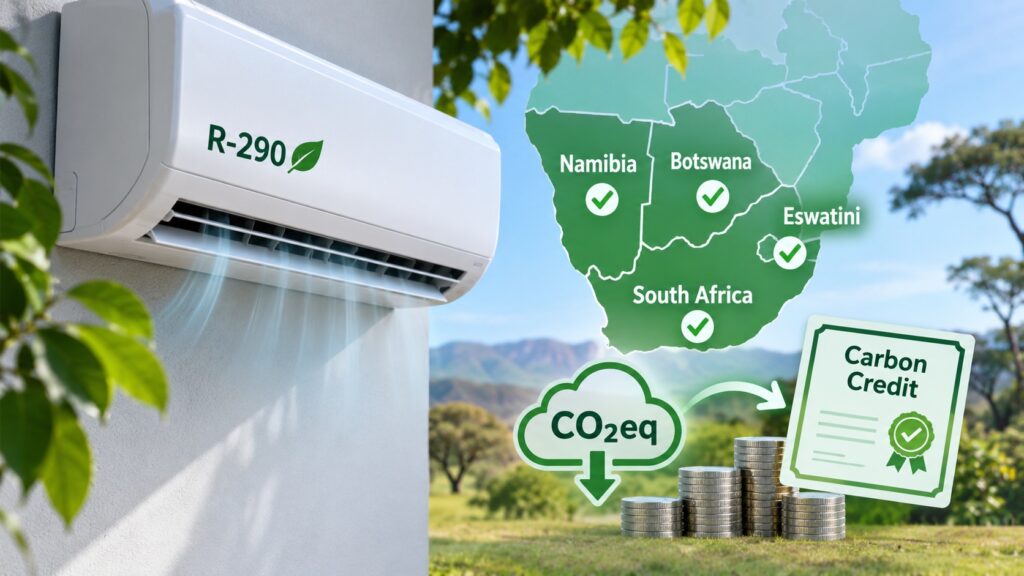
Mitigation Activity Design Documents (MADDs) for Green Cooling projects in Eswatini, Namibia and South Africa have been validated by TÜV Nord. The validation marks a step toward enabling the countries to generate and trade carbon credits under Article 6 of the Paris Agreement.
The Cooling Program for Southern Africa (CooPSA) supports the introduction of R-290 split air conditioners and the replacement of thousands of conventional split AC units. The first R-290 systems will receive financial incentives through a project grant designed to simulate carbon payments. This initial phase will also establish monitoring processes required for a potential national rollout under Article 6.
The validated MADDs provide a basis for implementing projects under Article 6.2, which enables international trading of mitigation outcomes. Implementation still requires government approval and interest from a sovereign buyer with whom the respective country has signed a bilateral agreement. CooPSA itself does not intend to transfer Internationally Transferred Mitigation Outcomes (ITMOs).
In parallel, CooPSA is developing a methodology for Green Cooling under the Paris Agreement Crediting Mechanism (PACM), established through Article 6.4. If approved by the UNFCCC, the methodology would provide partner countries with an additional route to sell carbon credits to private sector buyers. Companies may use the resulting emission reduction certificates to offset carbon tax payments.
CooPSA operates in Botswana, Eswatini, Namibia and South Africa. The programme is implemented by GIZ on behalf of Germany’s International Climate Initiative (IKI). The CooPSA Ad Hoc Working Group contributed to the programme design and technical documentation used in the external validation process.