Researchers from Egypt and the United Arab Emirates have demonstrated that pulsating refrigerant flow can improve evaporator heat transfer and the coefficient of performance (COP) of a split air-conditioning system. The experimental study, published in Scientific Reports, recorded a 13.33% increase in evaporator heat transfer, a 13.63% improvement in COP, and a 23.3% reduction in operating time, with negligible changes in compressor power consumption.
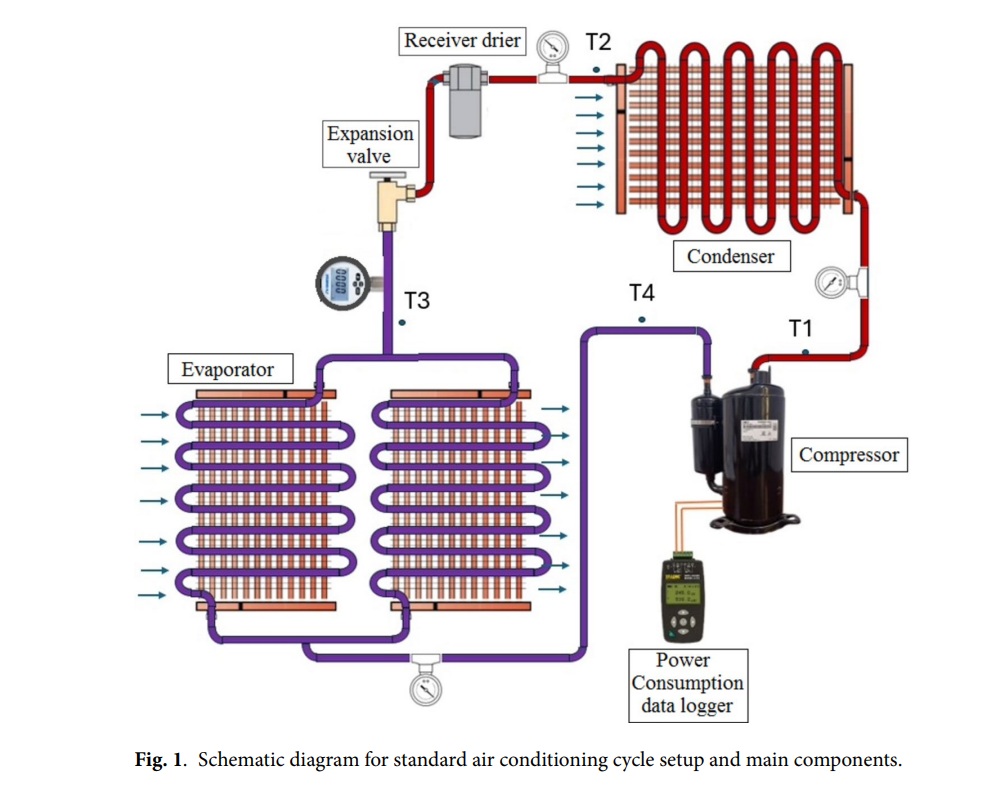
The experiments were conducted at the Institute of Aviation Engineering and Technology in Giza, Egypt, using a 1.5 HP direct-expansion split air conditioner with a cooling capacity of 12,000 BTU/h (approximately 3.52 kW). The system operated with ECO-22 refrigerant and was tested at air temperatures of 24 °C (75.2 °F), 26 °C (78.8 °F), and 28 °C (82.4 °F).
To generate pulsating refrigerant flow, the researchers divided the evaporator into two parallel sub-coils, each equipped with an electrically operated solenoid valve. A custom control circuit alternated valve operation at frequencies of 6, 9, and 12 Hz. The modification enabled periodic refrigerant flow modulation without changing the evaporator’s heat transfer surface.
The highest performance was recorded at 9 Hz, where COP increased from 1.12 under continuous flow to 1.27. At an inlet air temperature of 26 °C (78.8 °F), the heat transfer rate increased from 2,692.5 W to 3,051.5 W, while outlet air temperature decreased from 13.5 °C (56.3 °F) to 11.7 °C (53.1 °F). At an ambient temperature of 24 °C (75.2 °F), the time required to reach the target outlet air temperature fell from 15 to 11.5 minutes.
The researchers also evaluated acoustic performance and operational reliability. Noise levels increased from 41–46 dB(A) during continuous operation to 44–49 dB(A) at 9 Hz. Approximately 1,000 hours of testing, covering 32.4 million valve-switching cycles, revealed no refrigerant leakage, valve malfunction, or appreciable performance degradation.
Future research will examine performance under varying humidity levels and cooling loads, investigate refrigerant flow patterns, and assess programmable logic controller (PLC) operation and alternative refrigerants.