Esta página solo está disponible en inglés. Ir a la portada en español

×

Questa pagina è disponibile solo in inglese. Home page in italiano

×

Diese Seite ist nur auf Englisch verfügbar. Zur deutschen Startseite

×

Cette page est disponible uniquement en anglais. Aller à la page d'accueil en français

×

Sunswap Achieves ATP Certification

Sunswap Achieves ATP Certification

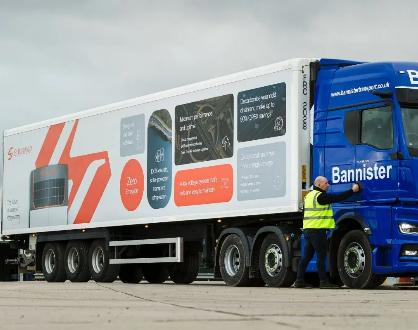
In a step forward for sustainable refrigerated transport, Sunswap Endurance has achieved ATP certification. This milestone validates the performance and reliability of technology and opens new opportunities for customers in the international cold chain logistics industry.

ATP is an international standard for the transport of perishable goods. It ensures that vehicles and equipment used for carrying food and other temperature-sensitive products across borders meet strict requirements for maintaining proper conditions.

For companies involved in international refrigerated transport, having ATP-certified equipment is a necessity, helping to avoid delays and spoiled cargo.

To achieve ATP certification, Sunswap Endurance underwent extensive testing at Cambridge Refrigeration Technology (CRT), an approved facility in the UK. This rigorous process included measuring the refrigeration capacity at different setpoints (-20°C, -10°C, 0°C) in 30°C ambient conditions to validate performance in demanding summer environments. Pull-down tests also confirmed the units can bring the trailer temperature down to -25°C within specified time limits, even in high outside temperatures.

The successful outcome shows that Sunswap Endurance meets and exceeds the performance requirements for international refrigerated transport. 

While ATP certification is not currently a requirement in the UK, it provides operators extra assurance that Sunswap’s technology will reliably maintain product quality and safety, even in extreme temperatures that can sideline traditional refrigeration units.

“Further evidence that the Sunswap Endurance is operationally a like-for-like alternative to diesel-powered units. For operators, this means you don’t need to choose between going green and getting the job done. With Sunswap’s ATP-certified transport refrigeration units, you can reduce your carbon footprint and meet your sustainability goals without compromising on the reliability and effectiveness of your cold chain operations”, commented Alastair Gough, Head of Business Development at Sunswap.

Get the daily refrigeration briefing

One email a day. Trusted by 3,000+ RACHP professionals.

More on Cold Chain

All on Cold Chain →

Insights

Secop's Solar Direct Drive (SDD) System Earns WHO PQS Approval – The Team Behind It
Article

Secop’s Solar Direct Drive (SDD) System Earns WHO PQS Approval – The Team Behind It

Partner's material In March 2026, Secop’s Solar Direct Drive Power Management Module was granted WHO PQS prequalification and officially listed in the WHO Catalogue of Prequalified Immunization Devices. The WHO IMD-PQS (Immunization Devices Performance, Quality and Safety programme) is the global benchmark for cold chain equipment used in immunisation. Being listed in its catalogue is

22 Jun 2026
Case Study - Effect of Louvers or diffusers on air flow distribution and cooling time on a meat log during Chill cycle
Tech Guide

Case Study – Effect of Louvers or diffusers on air flow distribution and cooling time on a meat log during Chill cycle

By Kushal Aurangabadkar An experimental analysis was conducted on a cooler space measuring 3.66 m × 6.096 m (12.0 ft × 20.0 ft), equipped with an ammonia refrigeration coil, five 30 cm (12 in.) fans, and five diffusers. The study measured airflow patterns, cooling rates, and heat transfer efficiency in meat storage by testing two configurations:

Kushal Aurangabadkar · 21 Jan 2026
Total Cost of Ownership (TCO) for Modular Refrigeration Systems in Life Sciences Distribution Centers
Tech Guide

Total Cost of Ownership (TCO) for Modular Refrigeration Systems in Life Sciences Distribution Centers

by Ramez Naguib, P.E. Introduction Life sciences distribution centers are under immense pressure to deliver consistent temperature control, comply with increasingly stringent regulations, and optimize operational efficiency. Traditional built-up refrigeration systems often prove cumbersome, costly, and slow to implement. In contrast, modular, factory-assembled refrigeration systems have emerged as a compelling alternative. Drawing on lessons from

Ramez Naguib · 14 Jan 2026
Everything on Cold Chain: 2,058 articles, 2 case studies, 23 insights

Most read this month

All news →