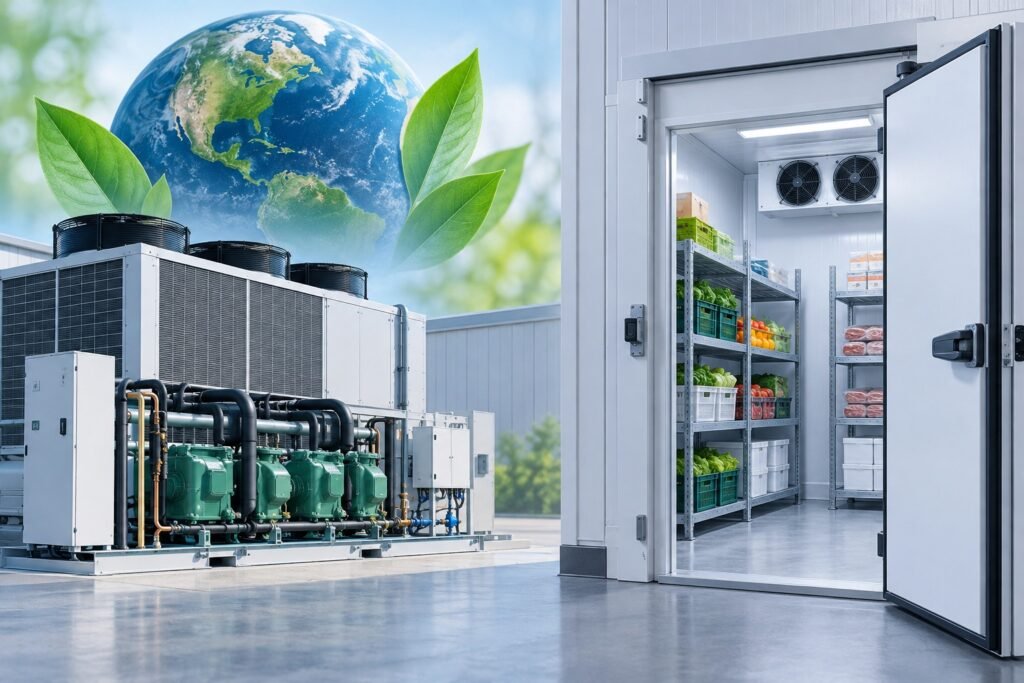
A review of walk-in coolers and freezers (WICF) in the U.S. identifies CO2 systems and several lower-GWP synthetic refrigerants as efficient options for different system configurations. The study by Abraham J. Lee, Vishaldeep Sharma, Junjie Luo, Praveen Cheekatamarla and Bo Shen examines next-generation refrigerants, regulatory developments and technologies aimed at improving energy efficiency.
The review finds that CO2 systems, particularly transcritical booster configurations, are effective for large parallel-rack WICF applications due to their efficiency. For smaller remote systems, the authors identify R454A, R454C and R455A as efficient options, while R454C and R455A are highlighted for smaller self-contained WICF.
The study also addresses technical challenges associated with zeotropic refrigerant blends, including temperature glide and fractionation and their implications for system performance and design. Its highlights note that control adjustments can help manage performance challenges associated with zeotropic refrigerants.
The regulatory review covers the U.S. American Innovation and Manufacturing (AIM) Act, which enabled the Environmental Protection Agency to regulate the phasedown of HFCs, as well as California Air Resources Board requirements. The paper also considers natural and synthetic alternative refrigerants and includes a thermodynamic analysis evaluating COP for alternative refrigerants in a small-to-medium-capacity WICF using an identical direct-expansion system and operating conditions.
The research was supported by the U.S. Department of Energy’s Building Technologies Office through Cooperative Research and Development Agreement NFE-23-09605. The authors declared no conflicts of interest.