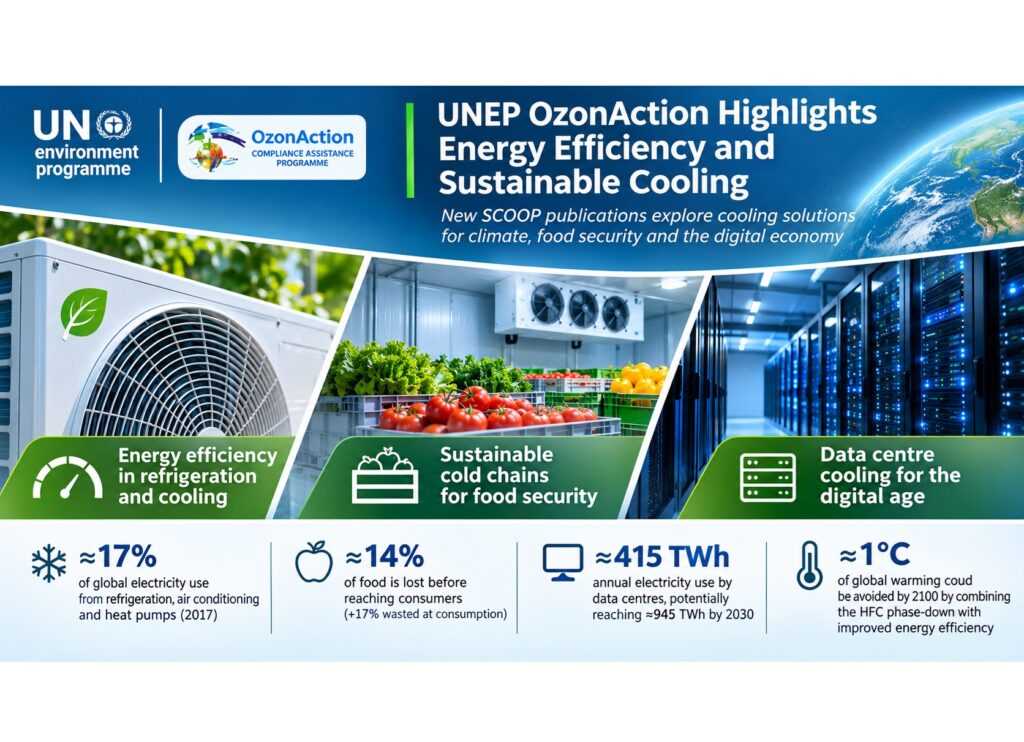
UNEP OzonAction has published three October 2026 editions of its SCOOP newsletter, addressing energy efficiency in refrigeration and cooling, sustainable food cold chains, and data centre cooling. The publications examine how the Montreal Protocol and its Kigali Amendment support the transition to lower-global-warming-potential (GWP) refrigerants alongside improvements in cooling system efficiency.
According to OzonAction, refrigeration, air conditioning and heat pump equipment accounted for approximately 17% of global electricity consumption in 2017. More than 80% of the sector’s climate impact came from electricity generation rather than refrigerants. The newsletter also reports that outdated appliances and equipment use approximately 40% more electricity than newer models employing energy-efficient technologies and low-GWP refrigerants.
Food cold chains are another focus. Approximately 14% of food produced globally is lost before reaching consumers, while a further 17% is wasted during consumption stages. Cold chains account for approximately 4% of global greenhouse gas emissions, including emissions associated with refrigerants, energy consumption and spoiled food. OzonAction identifies energy-efficient equipment, zero-ozone-depletion-potential refrigerants, low-GWP alternatives and improved logistics as measures for developing sustainable cold chains.
For data centres, the publications cite annual electricity consumption of approximately 415 TWh, with demand potentially reaching 945 TWh by 2030. Cooling technologies discussed include computer room air conditioners, chillers, cooling towers, direct-to-chip cooling and two-phase liquid cooling. According to the data centre edition, liquid cooling can reduce whole-site energy consumption by approximately 15% compared with air cooling. Other approaches include hot aisle/cold aisle configurations, variable-speed drives, waste heat recovery and refrigerants with lower GWP.
The publications also emphasize the Kigali Amendment, adopted in 2016 to progressively phase down hydrofluorocarbons (HFCs). UNEP OzonAction reports that combining HFC phase-down with improved energy efficiency could nearly double the climate benefits of the amendment, potentially avoiding approximately 1°C of global warming by the end of the century.