Researchers have developed and tested a compact R152a/DMF absorption refrigeration prototype designed to recover waste heat from warm-water liquid-cooled data centers. The system converts heat from secondary-side liquid-cooling loops into on-site cooling capacity, reducing reliance on mechanical cooling. The study was published in Applied Thermal Engineering.
The researchers compared three organic working pairs: R32/DMF, R152a/DMF and R161/DMF. R152a/DMF demonstrated better cycle performance under low driving temperatures, high evaporating temperatures and elevated cooling-water temperatures. The prototype incorporates a plate-type absorber, generator and solution heat exchanger to improve heat transfer, internal heat recovery, compactness and modularity.
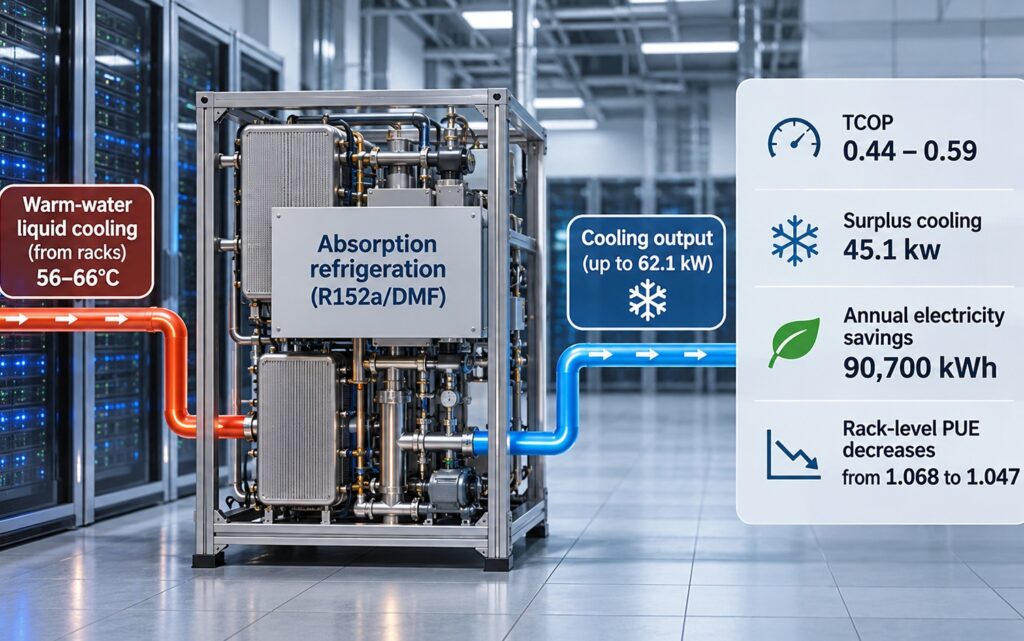
Experimental results demonstrated stable operation at heat-source temperatures of 56–66°C (133–151°F), with a cooling-water temperature of 27°C (81°F). The thermal coefficient of performance (TCOP) increased from 0.44 to 0.59. At a heat-source temperature of 56°C (133°F), the prototype maintained a TCOP of 0.38 with a cooling-water temperature of 31°C (88°F).
A techno-economic assessment considered a 132 kW-class warm-water direct-liquid-cooled rack. Assuming a measured TCOP of 0.54 at 62°C (144°F) could be maintained at rack scale, 115 kW (392,400 BTU/h) of recoverable waste heat would generate an estimated 62.1 kW (211,900 BTU/h) of cooling. This would cover the 17 kW (58,000 BTU/h) rack-side air-cooling load and provide 45.1 kW (153,900 BTU/h) of surplus cooling.
Under the modeled scenario, annual electricity savings are estimated at 90,700 kWh, while rack-level equivalent power usage effectiveness (PUE) decreases from 1.068 to 1.047. These figures represent scenario-based estimates rather than measured rack-scale results.
The research was supported by the National Natural Science Foundation of China.