By Sergei Mukminov, Editor-in-Chief, Refindustry.com
Industrial ammonia refrigeration facilities accumulate safety documentation over years: P&IDs, standard operating procedures, alarm lists, emergency plans and maintenance records. The problem is not that the information doesn't exist — it's that it lives in separate systems and rarely reaches the people making decisions on the plant floor. Kushal Aurangabadkar, an engineering manager at Cargill with nearly 14 years of experience in food manufacturing and process safety — and the author of Refindustry's First 90 Days in Ammonia Refrigeration Systems — recognised this gap and built a framework to close it.
LOOP-BAR stands for Layered Operations Overlay with PSM Barrier Assurance Register which overlays protection layers directly onto refrigeration system diagrams, linking each safeguard to a defined owner, performance standard, and verifiable evidence that it works. In this written interview with Refindustry, Aurangabadkar explains how the framework was developed, how it differs from existing safety tools, and what it takes to implement it in practice.

Background
You have nearly 14 years in food manufacturing and industrial ammonia refrigeration. How did that experience lead you to develop LOOP-BAR?
My background spans system design, plant operations, and process safety management, so I've seen these systems from both engineering and an operational perspective. I came to specialize in ammonia refrigeration because it sits at the intersection of reliability, efficiency, and safety. Over time, I became increasingly focused on closing the gap between how these systems are designed and how they are actually operated and safeguarded in the field.
What was the moment that made you think the existing approach wasn't enough?
The turning point was realizing that teams understand refrigeration systems as flow paths, but safety is often taught as a set of disconnected checklists. Facilities may have strong engineering foundations such as P&IDs, SOPs, alarm logs, maintenance programs but those tools rarely come together in a way that gives operators one practical view of hazards, safeguards, ownership, and verification. As a result, barriers can be assumed rather than confirmed, control systems can be mistaken for protection layers, and accountability for critical safeguards can become unclear. Working in food processing environments, where both reliability and safety are essential, I felt that approach was not enough for front-line decision-making. I wanted to create a tool that would help teams; especially new hires see the direct connection between the ammonia refrigeration system and the process safety management program. That need is what ultimately led to LOOP-BAR.
How long did the development take, and who was involved?
LOOP-BAR was developed over several months through iterative work on real ammonia refrigeration scenarios. I led that development from concept to a usable operating framework. Although the framework benefited from input from operations and refrigeration personnel, I was responsible for the core methodology, the visualization approach, and the barrier structure.
The Framework
What problem does LOOP-BAR solve that existing tools such as P&IDs, SOPs and PHAs don't?
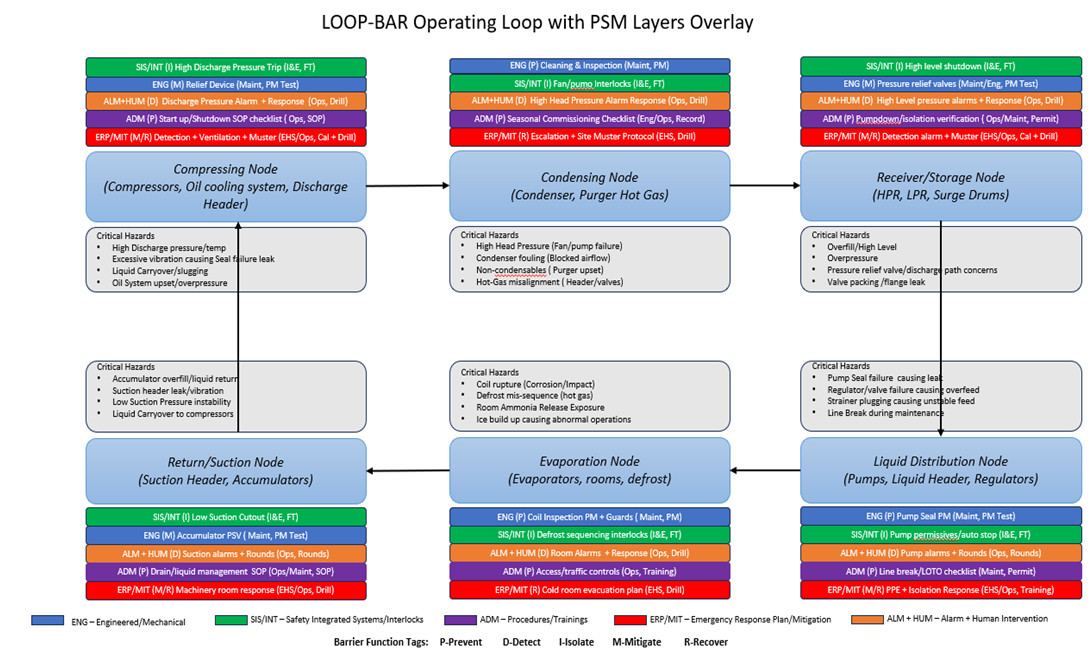
In ammonia refrigeration, those engineering tools are essential, but they exist in silos. What's missing is a direct, visual connection between the refrigeration system and the safeguards that keep it safe. LOOP-BAR solves this by overlaying protection layers along with the critical hazards identified at each node directly onto the refrigeration system diagram, and linking each barrier to its function, owner, and the objective proof that it works.
LOOP-BAR does not replace P&IDs, SOPs, or PHAs. It makes their safety logic visible and auditable in one place. It transforms safety from documentation into an operational tool. Teams can immediately see what the typical hazards are at each node, what safeguards protect each node, whether those protections are truly independent, and how they are verified and tested.
What does a LOOP-BAR diagram actually look like?
It's a simplified refrigeration loop organized into practical nodes: compression, condensing, receiver/storage, liquid distribution, evaporation, and return/suction. On top of each node, protection layers are color-coded and placed exactly where they act engineered barriers, interlocks and shutdowns, alarms with operator response, administrative controls, and emergency or mitigation layers. Each layer is tagged by function: prevent, detect, isolate, mitigate, or recover.
Behind that visual layer sits the Barrier Assurance Register, the BAR which is a structured dataset that defines each barrier's trigger, action, performance standard, accountable owner, and verification evidence.
Why does the distinction between a control loop and a protection layer matter?
Control loops are designed to keep the process running. Protection layers are designed to keep the system safe when something goes wrong. Not every safeguard deserves independent protection layer credit, particularly where multiple layers share the same sensor, PLC, or power source. If you don't separate them, you end up overestimating your level of protection.
One of the most common issues we see is common dependency: multiple safeguards that depend on the same sensor, PLC, or power source. When LOOP-BAR is first applied, a significant portion of assumed safeguards fail the independence test. They are reclassified as supporting layers rather than independent protection layers. That insight is often one of the most valuable outcomes of the framework.
In Practice
Walk us through a concrete scenario - a high-pressure receiver event. How does LOOP-BAR change what operators see and how they respond?
Take a high-pressure receiver scenario in which liquid ammonia is inadvertently trapped during valve isolation. As that trapped liquid warms, hydrostatic expansion can drive a rapid pressure rise. Traditionally, that hazard may be buried in SOPs or PHA documentation. With LOOP-BAR, it becomes operationally visible at the node where it matters.
Operators and engineers can immediately see the barriers that act directly on that scenario: correct valve lineup and isolation procedures to prevent liquid from being blocked in, hydrostatic relief or engineered expansion protection where trapped liquid is possible, vessel pressure relief, and any alarm or shutdown function designed to respond to the pressure rise. LOOP-BAR also separates those direct overpressure barriers from consequence-mitigation layers such as gas detection, ventilation, emergency response which become important if a release occurs.
The key difference is that each barrier is not just listed but it is tied to a performance standard, an accountable owner, and objective proof that it is functional. So instead of asking 'Do we have safeguards?’ the question becomes: 'Which barriers for this scenario are healthy right now?' If a relief device inspection is overdue, an alarm is impaired, or a detector is out of calibration, that condition is visible and drives action during shift handover, work planning, and operational reviews.
Who owns the Barrier Assurance Register and how is it maintained?
Ownership is distributed but clearly defined. Each barrier has an accountable role: Maintenance or Engineering for mechanical systems, Instrumentation and Controls for interlocks, Operations for alarm response and procedures, EHS for detection and emergency systems. The BAR is maintained by linking it directly to existing CMMS for inspections and testing, calibration systems for instrumentation, training records for operator response, and drill documentation for emergency layers. If a barrier test is overdue, it becomes a leading indicator as it is visible, tracked, and prioritized rather than hidden in separate systems.
Where does LOOP-BAR deliver the most immediate value?
The most immediate value shows up in clarity and decision-making speed. Practically, facilities see improvements in identifying weak or dependent safeguards before incidents, reducing time spent during PHAs, improving audit readiness and traceability, and strengthening shift handover discussions. One of the strongest measurable indicators is barrier health completion rate - the percentage of verification tasks completed on time. Facilities see a noticeable improvement because responsibilities and requirements are clearly defined. The framework also plays an important role in new hire training, helping operators learn the refrigeration system in context.
Implementation and Scope
What does a facility need to implement LOOP-BAR from scratch — in terms of time, resources, and expertise?
LOOP-BAR is intentionally designed to use what facilities already have. Implementation typically involves building a simplified loop diagram, identifying critical hazard scenarios for each node, overlaying existing protection layers, and creating the Barrier Assurance Register. A pilot system can be implemented in a few weeks if P&IDs and process safety information are current, using a small cross-functional team across engineering, operations, and maintenance, without requiring new software or major capital investment. The key requirement is not tools but it's alignment across disciplines.
Can LOOP-BAR be applied to CO2 systems or other refrigerants?
Yes. The framework is built on general process safety principles, particularly Layer of Protection Analysis. The same structure applies to CO2 or other refrigerants. The hazard scenarios, barrier types, and performance standards would differ as CO2 systems may emphasize different pressure ranges, detection strategies, and equipment-specific risks but the concept of mapping protection layers and verifying their independence remains the same.
Thank you, Kushal, for sharing your insights!
Refrigeration engineers and safety managers interested in learning more about LOOP-BAR are welcome to connect with Kushal Aurangabadkar directly on LinkedIn.