Trevor Matthews: Closing the Refrigeration Skills Gap, One Contractor at a Time
Trevor Matthews did not plan a career in refrigeration, but after two decades working his way from installation crews to national trainer at Copeland, he founded Refrigeration Mentor to tackle the industry's most persistent problem: the skills gap that nobody has managed to close.
Ilana Koegelenberg spoke with Matthews for Refindustry about his journey into the industry, why he walked away from a corporate promotion to build something of his own, and what it will actually take to bring more people, and better training, into refrigeration.
Matthews went to university in Canada to study business, but it was a chance conversation at an open house that set his career in motion. While exploring a bartending program, he got talking to someone whose father was a refrigeration technician earning $50 an hour. It was a career path he had never considered, but the earning potential was appealing. He signed up for an HVAC program shortly after, in 2004.
After completing a full-year HVAC and gas fitting program and earning his gas and oil burner licenses, Matthews cold-called a leading refrigeration contractor in Western Canada, packed up, and moved across the country to break into supermarket refrigeration. It was the first of many moves driven by a willingness to go wherever the work was and to keep learning once he got there. Over the years, he worked internationally, took jobs when he needed income, and traveled when he had freedom, gradually building real depth in commercial refrigeration.
The defining chapter came in 2014 when he joined Emerson, the parent company of Copeland, starting in technical support before eventually becoming their national trainer for Canada. It was there that he built his foundational knowledge in compressors, CO2, and supermarket refrigeration – and found his love for training.
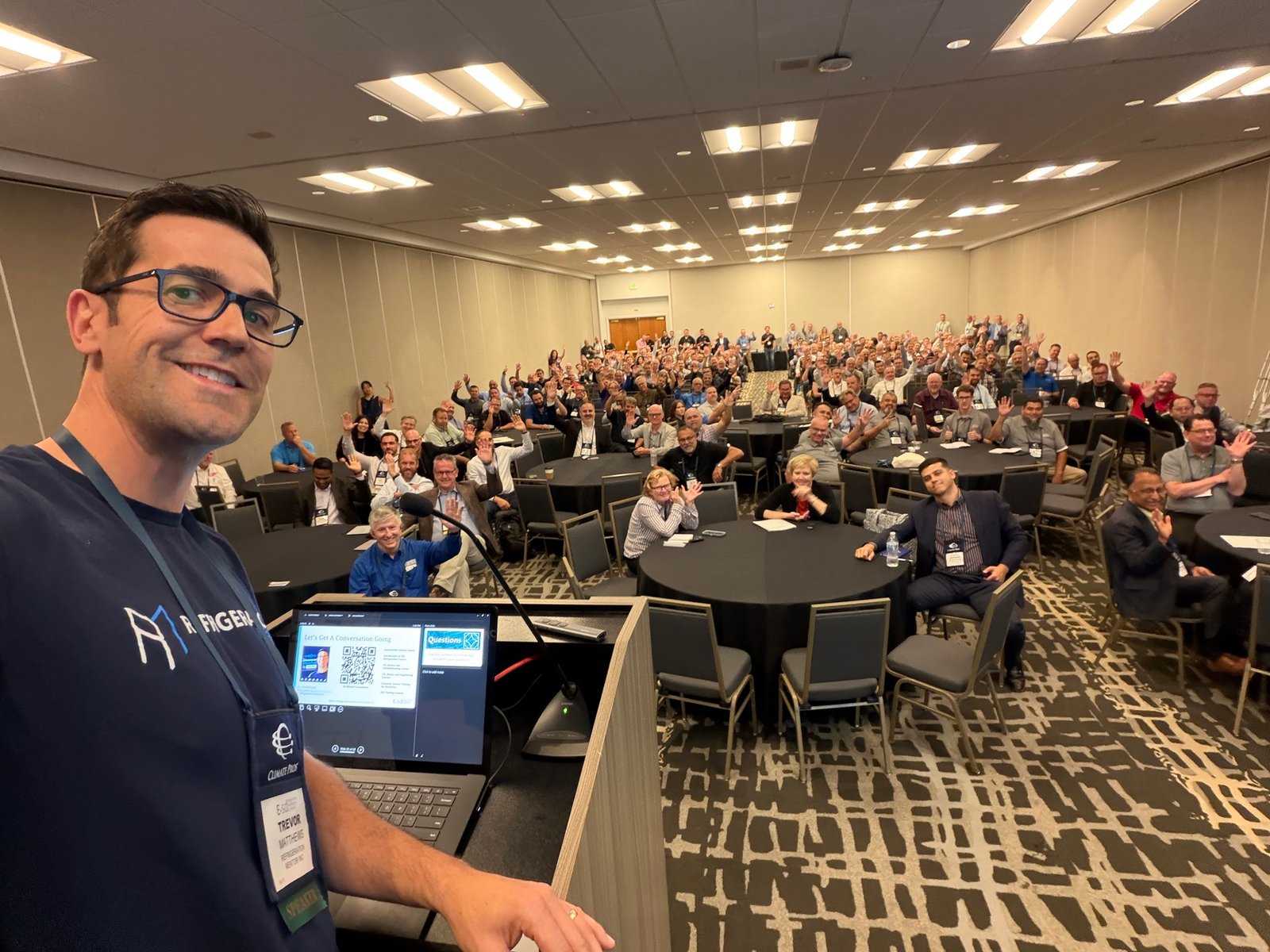
Working under Andre Patenaude, a globally recognized CO2 expert, Matthews began training contractors and technicians across Canada and into the US. The business development role gradually gave way to a training role.
From Employee to Entrepreneur
After seven years at Copeland, Matthews was offered a promotion to technical manager. By then, however, he had already started imagining a different path. After several months of deliberation with his wife, he turned down the role and resigned. Refrigeration Mentor launched in 2021.
The motivation behind the move traced back to his time doing technical support at Copeland, where he would take calls from technicians dealing with major system failures in the field, often with no one else to turn to. "You can hear the relief in their voice," he says of the moment the equipment starts back up. "That's when I started to grow a passion for this."
The early days of Refrigeration Mentor required patience. Many in the industry still associated Matthews with Copeland, and establishing an identity as an independent training business took time. What ultimately built credibility was a straightforward value proposition: contractors who put their technicians through Refrigeration Mentor programs significantly reduced their callbacks.
Since then, the business has grown a loyal client base, with companies returning repeatedly to put new cohorts through the programs. For the technicians themselves, the results are equally concrete: pay raises, new positions, and problems solved that no one else at their company could crack.
Five years in, Refrigeration Mentor has five staff members, plus part-time employees and subcontractors. When asked what he is most proud of, Matthews does not point to a business metric. He points to his wife, who joined the company full-time after two years and now serves as COO. "She believed in me, stuck behind me, and that's probably what I'm proudest of," he says.
How the Training Works
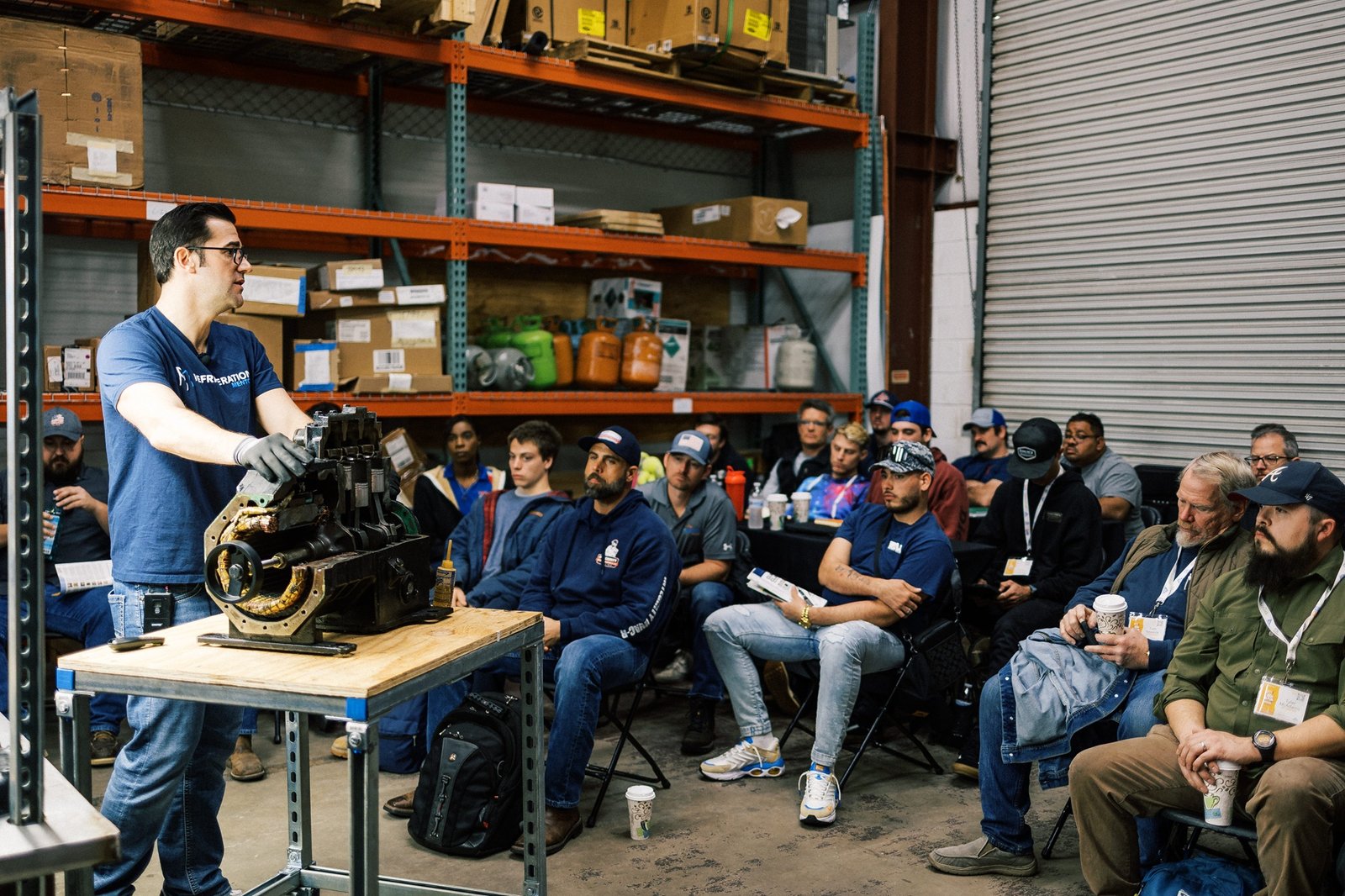
Refrigeration Mentor's primary focus is contractor training, building customized programs around the specific equipment technicians work on daily. Core offerings cover supermarket refrigeration and CO2 rack applications, with a chiller program available through a manufacturer partnership and on-demand content for individual learners.
Matthews has been training in CO2 refrigeration since 2015, and it remains one of the most popular courses he offers today. Global CO2 installations have grown exponentially over the past decade, driving a corresponding demand for technicians who can safely install, service, and maintain these systems.
Yet Matthews is careful not to position Refrigeration Mentor as a CO2-specific business. “At the end of the day, it's just a refrigerant," he says. "I need technicians to work safely, efficiently, and effectively across all refrigerants to solve hard problems."
At Refrigeration Mentor, all training is delivered online, a model that initially draws skepticism. Matthews addresses it directly: "A lot of people say, I can't learn online, it's not hands-on. But the hands-on happens after the session." Technicians attend live sessions, then go into the field to apply what they have learned, returning with questions and observations.
The online training model's reach is a significant operational advantage. Matthews can run programs across multiple states and countries simultaneously, making it a viable option for large contractors who would otherwise absorb the cost of flying teams in for centralized training. Programs are also built around the specific equipment a contractor operates, rather than generic manufacturer content.
The results in terms of technician development are measurable. It took Matthews nearly eight years to reach a level of genuine confidence in supermarket refrigeration. He is now teaching technicians the same body of knowledge in under two years, and in some cases, under a year.
What makes that possible, Matthews argues, goes beyond technical content. A consistent thread throughout Refrigeration Mentor’s training work is an emphasis on how technicians think, not just what they know. Matthews sees mindset as foundational. "When I talk to a technician or a business owner, it's really about the way they think about a problem, the way they think about their role, their job, their customer, the business itself. When you can start to crack that, technicians become more coachable."
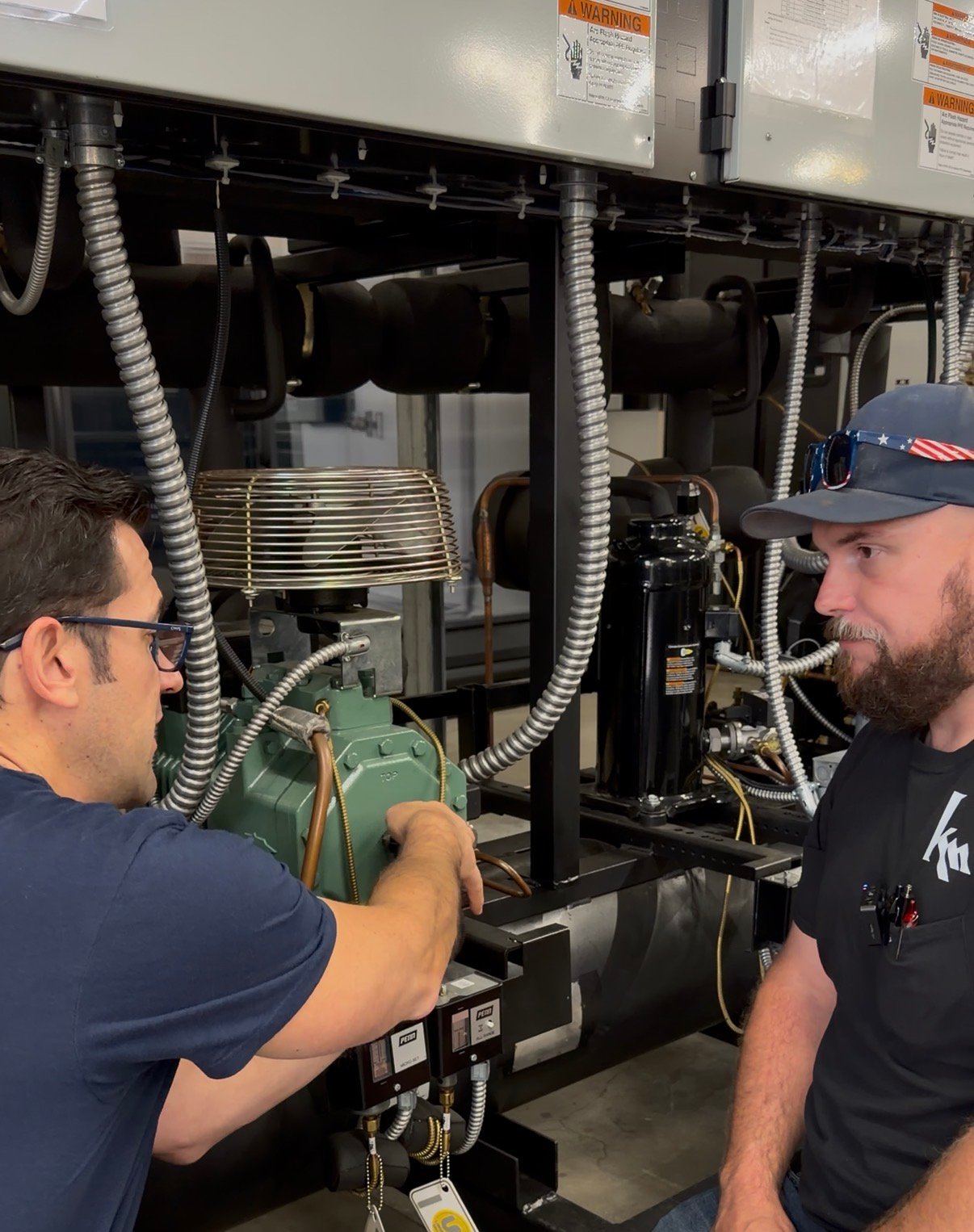
A pattern he encounters regularly is technicians who have spent years avoiding the areas they find difficult, whether wiring diagrams, variable frequency drives, or advanced controls, simply because no one has ever properly guided them through it. Once they work through the process, the reaction is almost always relief rather than difficulty.
Industry's Persistent Challenge
Matthews is direct about what he sees as the biggest issue facing refrigeration today, and it is not new. Training, and more broadly, getting people into the industry in the first place. He references a conversation with World Refrigeration Day founder Stephen Gill, who has been in the industry for more than 40 years. "He told me, Trevor, in the 80s it was the same conversation as in the 90s, as in the 2000s. We need more technicians; we need more people inside."
The urgency of that challenge is only growing. Demand for refrigeration and cooling is expanding rapidly, driven in part by the proliferation of data centers required to support AI infrastructure. At the same time, rising energy prices and aging power grids globally are pushing the industry toward more efficient equipment, which means more advanced controls and electronics, and technicians who know how to work with them. The skills gap is not just a legacy problem. It is one that the industry will need to close to keep pace with where cooling demand is heading.
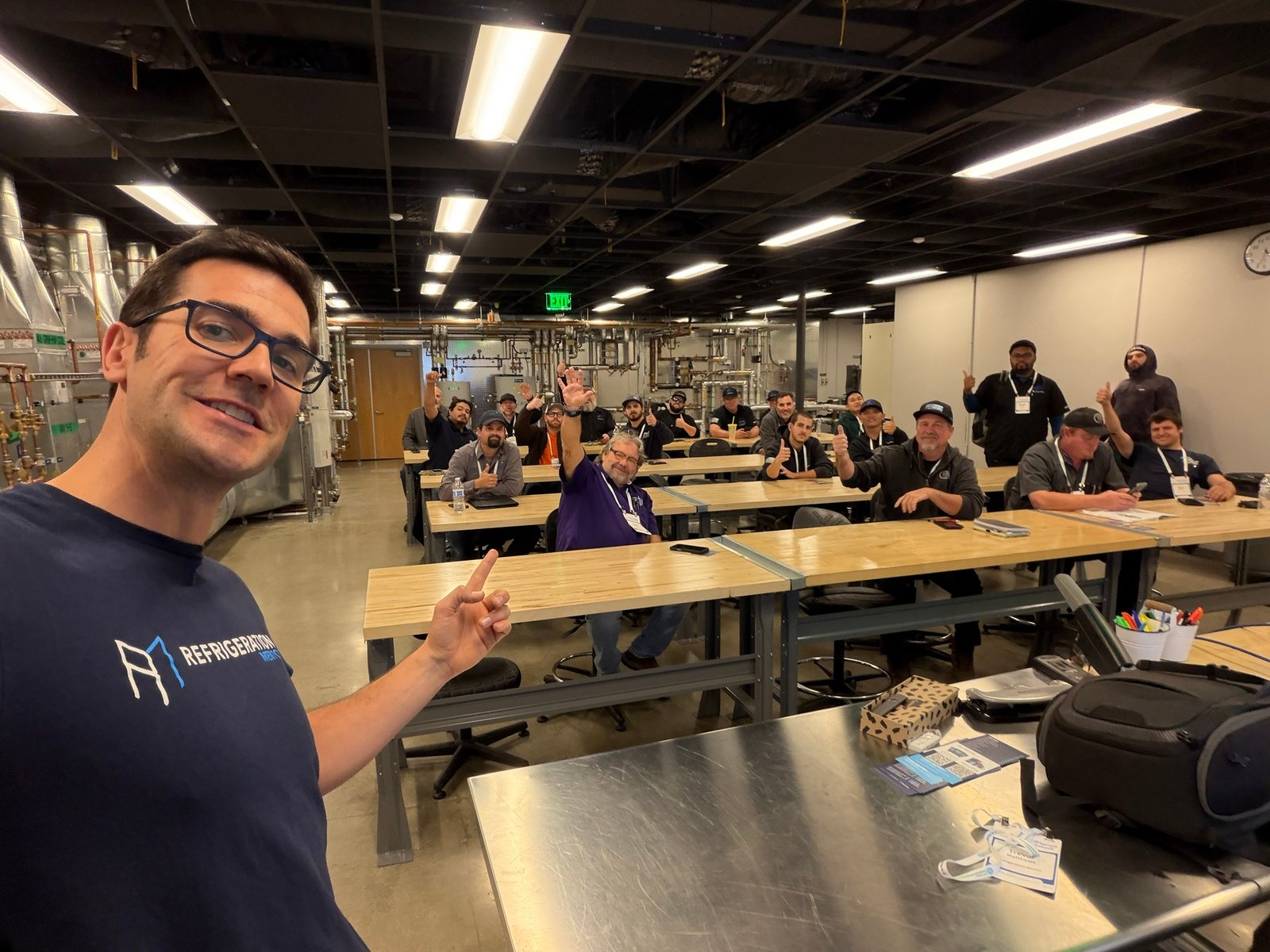
Matthews is particularly interested in broadening the pool of people who consider refrigeration a career path. He points to women as an underrepresented group that the industry is slowly beginning to reach, noting that the course he ran on the morning of this interview had two female participants, the most he has had in a single session. "They can do this job. They're detail-oriented, they're smart. So, how do we get the word out?"
He also points to the broader visibility problem: most people have no idea commercial refrigeration exists as a career until a chance conversation, much like the one that changed his own trajectory.
Advice for Anyone Starting Out
Matthews' advice for technicians entering the industry is consistent and specific: set goals and write them down. Every participant entering a Refrigeration Mentor program is required to document what they want to achieve before training begins, creating a baseline against which progress can be measured.
"Where do you want to be in five years? How much money do you want to make? Do you want to be good at controls, at install, at service?" he explains. "Writing those goals down and reverse engineering them is the biggest advice I give."
The technicians he has seen advance most quickly are those who treat their development as a deliberate process rather than something that happens by default.
Underpinning everything Matthews does is a belief that complexity is not the obstacle; lack of guidance is. When the right person walks a technician through a problem in the right way, difficult things become manageable. "We all used to have maps. Now we've got GPS. You look at it and it takes you from this point to that point. That's the same thing with training. Start at this point, get to this destination. Let's go there together."
**Stay up to date with Refrigeration Mentor's training content and programs, visit refrigerationmentor.com
We use cookies to enhance your experience by remembering your preferences and repeat visits. By clicking “Accept,” you agree to the use of all cookies. Learn more Privacy Policy.