Refindustry has released its 2025 year-in-review, compiled from the most-read and most impactful updates published on
https://refindustry.com/. The review captures how the industry moved from “refrigerant choice” discussions to real-world transition execution—where compliance pathways, safety engineering, component readiness, service capacity, and digital monitoring determine outcomes on projects and in day-to-day operations.
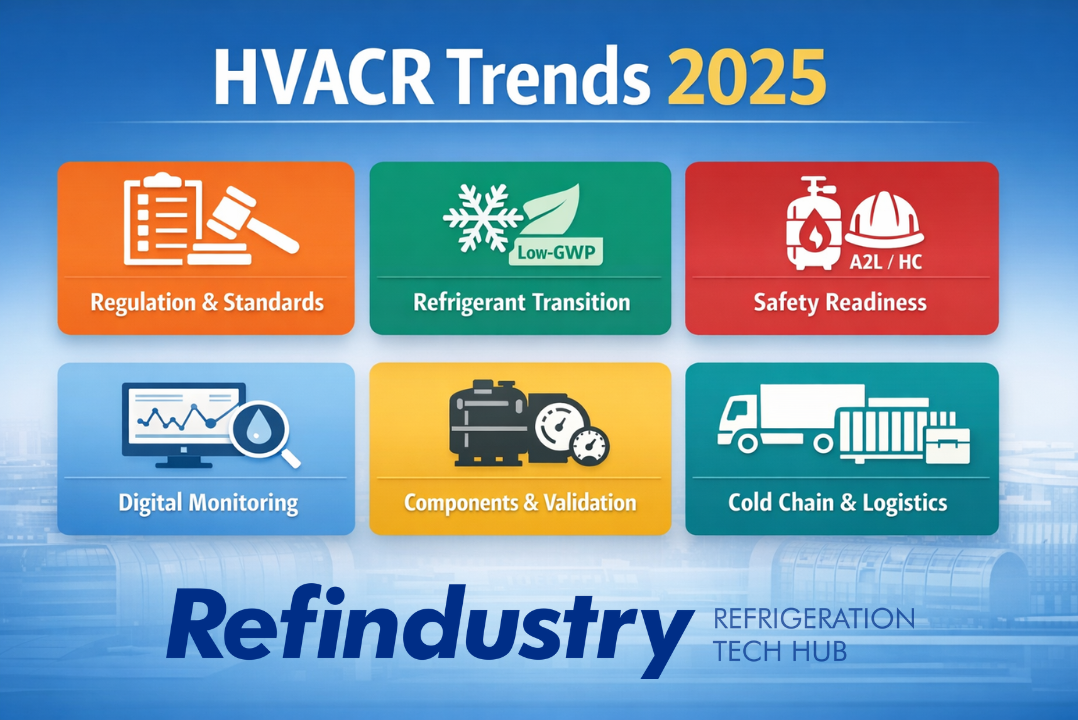
What shaped 2025 in practice:
-
Regulation and standards became less linear, with reviews, petitions, and evolving timelines pushing companies to plan for multiple scenarios.
-
Safety readiness moved to the core of system design and service, driven by wider deployment of A2L refrigerants and hydrocarbons and rising attention to leak detection and verification.
-
Environmental scrutiny widened beyond GWP, with more focus on lifecycle impacts and chemical-policy pressure that can influence long-term refrigerant strategies.
-
Digital operations accelerated, with continuous monitoring and analytics increasingly seen as practical tools for leak reduction, reporting, and performance stability.
-
Component and platform innovation remained central, as compressors, validated testing, and equipment design translated transition goals into real installations.
-
Cold chain investment continued to grow, with decarbonisation framed more often as project-level engineering and measurable performance.
Regional highlights in the full review include:
-
United States: compliance uncertainty under the AIM Act review environment, alongside continued consolidation and operational digitalisation.
-
UK and Europe: strong transition pressure paired with policy volatility and active discussions around standards and safety readiness.
-
Asia: large-scale industrial and cold chain activity with policy signals and corporate repositioning shaping market direction.