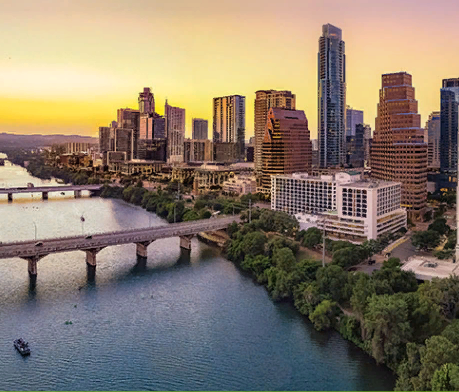
The 2020 ASHRAE Annual Conference will be held in Austin, Texas. The Technical Program along with Committee meetings, Registration, the Bookstore and Speakers Lounge will be at the JW Marriott and Austin Convention Center.
The 2020 ASHRAE Annual Conference technical program is comprised of eight tracks as well as a mini-track, selected to represent areas of focus common among ASHRAE membership. The track focus areas include fundamentals and applications, HVAC&R systems and equipment, research summit, professional development and other specific topics including grid-interactive efficient built environment, multifamily and residential buildings, resilient buildings and communities, zero energy buildings, communities: opportunities and challenges and a building myths mini-track.
“We are living in a constant changing world. ASHRAE members are facing a major evolutionary change in how buildings and energy systems interact,” said Bing Liu, chair of the 2020 Annual Conference. “Instead of individual equipment and system, buildings are becoming integrated, flexible and resilient systems to respond to the climate change challenges. The 2020 ASHRAE Annual Conference aims to address these challenges and feature a strong technical program with a wide range of topics applicable to engineers, architects, designers and professionals.”
Fundamentals and Applications:
Fundamentals are the foundation for understanding applications in engineering. Key components of ASHRAE fundamentals include thermodynamics, psychometrics, fluid and mass flow. This track provides opportunities for papers and presentations of varying levels across a large topic base. Concepts, design elements and shared experiences for theoretical and applied concepts of HVAC&R design are included.
HVAC&R Systems and Equipment:
HVAC&R Systems and Equipment are constantly evolving to address the changing requirements of the built environment. Papers and programs in this track will focus on the development of new systems and equipment, improvements to existing systems and equipment and the proper application and operation of systems and equipment.
Research Summit:
Active research, and the exchange of those research findings, are critical to the development of our HVAC&R industry and built environment. The 8th annual research summit invites researchers to share those results, including ASHRAE-sponsored research and research of interest to the ASHRAE community. Researchers are invited to present papers, extended abstracts, seminars, forums or participate in panel discussions. The Research Summit includes a partnership with ASHRAE's archival journal, Science and Technology for the Built Environment.
Professional Development:
As members of a professional organization, we not only participate for the great value of technical exchange, but also the interpersonal exchange. We recognize that the single greatest strength of our organization is its membership. This track is designed to allow those professionals an opportunity to develop in the areas of presentation skills, leadership, team-building, understanding various business operations, interpersonal skills, etc. In short, the Professional Development Track will cover all aspects of business outside of engineering/technical applications and lends itself to interactive session types such as workshops and forums.
Grid-Interactive Efficient Built Environment:
This new track focuses on the effects of industry trends (grid-enabled buildings, demand response, decarbonization, etc.) on system, building and community design practices. Topics include smart building, grid-enabled equipment and appliance, and HVAC design and operation for load flexibility. Topic can also include energy storage (thermal, battery, building mass, etc.), energy recovery (from condenser water or air), time-of-day practices, utility programs, etc.
Multifamily and Residential Buildings:
Multifamily is one of the fast growth building sectors but has been underserved. Multifamily buildings present challenges and opportunities on energy codes requirements, energy efficiency opportunities, ventilation and air tightness balance, and equality to address low-income multifamily buildings. This track covers programs and papers on best practices, utility and above-code incentive programs, field studies, and codes and standards requirements. This track also welcomes programs and papers for single family housing and other residential buildings.
Resilient Buildings and Communities:
The cycle of building development, design and construction is moving more rapidly than ever. Key stakeholders in the design and construction process face new challenges of responding to a range of environmental, market and consumer-driven pressures. Increasingly, it is being recognized that “smart” buildings and integrated systems are central to successfully addressing challenges posed by climate change, natural disasters, accidents, disease, and terrorism. Papers and program in this track focus on innovation and exploration related to these challenges and best practices that enable adaptability, resilience and recovery of buildings and communities.
Zero Energy Buildings and Communities:
Opportunities and Challenges. To address the climate change challenges and carbon reduction needs, zero energy buildings and communities have proven concept in many cases. However these case studies remain a very minor portion of the building stock. This track provides an opportunity to address the challenges and demonstrate opportunities in a wide range of perspectives. Topics in this track includes integrated design approach, tools and resources to make it easier on zero energy design and operation, innovative and state-of-art technologies and strategies; balance between energy efficiency measures and on-site renewable generation, aggregated scale to achieve zero energy communities and campuses. This track will also cover the topics on policies and regulations, codes and standards and utility programs for adoption and scale up of zero energy buildings and communities.
Building Myths:
It is often difficult to present or publish “negative” results where there was no successful outcome of an experiment or study. This often leads to people conducting similar experiments to discover what others knew but never published. This min-track is designated to share the lessons learned from these precious experiences. This mini-track will also identify and test unquestioned assumptions related to the built environment and its efficient operation.
Know more