Let’s discuss heat recovery without conjecture or misconceptions, relying solely on meter readings. This article will explain how we build NHL ice arenas and how effective heat recovery is.
About the Author
Let’s start with a few words about the author. My name is Elvira M. Kadyrova, I graduated from St. Petersburg State University of Refrigeration and Food Engineering with an engineering degree in Service of Transport and Technological Machines and Equipment (refrigeration units, equipment, and air conditioning systems). I now live and work in North America, designing ice arenas for the NHL.
NHL Arena Standards
The National Hockey League sets high standards for its arenas. Firstly, the quality of the ice is crucial. The ice must maintain a specific temperature and hardness. If your ice melts, it means the arena is improperly designed, and blaming overly warm visitors or abnormal weather is not entirely correct. The arena must also be safe for both visitors and staff. Among other considerations, it is important to account for the building’s location to avoid evacuating the entire area in case of a toxic refrigerant leak. Lastly, the arena is a commercial project and must be profitable while remaining accessible to all social groups, including offering free public skating and services like walking tracks, workshops, etc.
Case Study: Nova Scotia Ice Arena
As an example, we will examine a recently renovated ice arena in Nova Scotia, Canada. The building features an ice rink, a pub (for those who prefer to watch hockey with a drink), a walking track (a favourite spot for local seniors and runners), and rooms for workshops and lease.
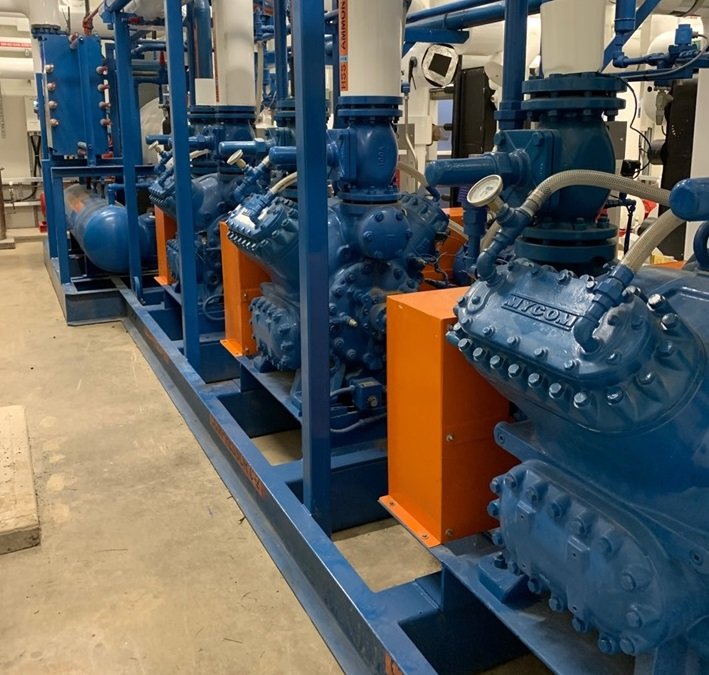
The heart of the arena is an ammonia refrigeration plant equipped with Mycom piston compressors, an Alfa-Laval plate heat exchanger condenser, and a Vahterus plate shell evaporator heat exchanger. The cooling capacity of the unit is 660 kW (188 TR). This plant serves a dual purpose: providing the necessary cooling for the ice arena while also generating heat that is effectively used in the building’s heating system. The heat from the refrigeration plant is directed to various components of the heating system, including fan coils, ventilation equipment, underfloor heating, and water preheating. The refrigeration plant consumption accounts for 26.7% of the building’s total energy consumption. Excess heat is disposed of through a fluid cooler, which consumes 2.7% of the energy. Additionally, pumps play a key role in circulating the heat transfer fluid throughout the heating system. They supply cold glycol to the ice floor and dehumidifier coil, and hot glycol to fan coils, heating coils of ventilation units, and underfloor heating. Pump energy consumption is 35.2% of the arena’s energy balance.
Another element in the system is the fans, which ensure air exchange and heat distribution throughout the building. Fan energy consumption is 12.9%, covering supply and return fans for the dehumidifier, supply and return fans for ventilation units, and fan coil fans. Lighting accounts for 17% of the arena’s total energy balance, and 5.7% of the energy is used for other electrical loads.
Geothermal pump consumption is not included in the balance because it was not used throughout the year. The geothermal heat pump is installed as a backup heat source and is used when the building requires thermal energy, and the existing refrigeration plant and propane boiler cannot meet the heating needs.
Load Inventory
The building is controlled by an automation system, allowing us to monitor and manage the plant operation as needed and collect data to understand the effectiveness of the proposed solution. This article is based on data from this system.
Energy Consumption Before and After Renovation
We will start by comparing data from before and after the renovation: how the building was operated in terms of energy consumption over a year. The basic unit of measurement is the equivalent kW (ekW).
Tables show the electrical and heating energy consumption of the arena before and after the equipment upgrade. After the renovation, the building’s electricity consumption decreased by 7%, and fuel consumption dropped by 80%.
EUI (Energy Use Intensity) is a key metric used to measure the amount of energy consumed per unit area of the building. Initially, the energy consumption was 21.1 kW per square foot. However, after the renovations and improvements, this figure significantly decreased to 17.6 kW per square foot. EUI serves as an important tool for assessing a building’s energy efficiency. By measuring the energy consumed per square foot, EUI allows for comparison and analysis of energy consumption across different buildings, regardless of their size. This helps evaluate how efficiently energy is used in a building and provides a basis for implementing improvements to reduce energy costs.
|
Before Renovation |
After Renovation |
|
|---|---|---|
|
Electrical Energy Consumption |
897.2 MW |
834.9 MW |
|
Thermal Energy Consumption |
||
|
Propane |
63,000 ekW |
168,204 ekW |
|
Fuel Oil |
778,000 ekW |
0 ekW |
|
EUI |
||
|
Electricity |
18.9 kWh/sq ft |
17.6 kWh/sq ft |
|
Combined (electricity and propane) |
36.6 kWh/sq ft |
21.1 kWh/sq ft |
The heat produced by the refrigeration unit to maintain the rink floor is directed into the building for heating. Excess heat, which cannot be immediately used by the building, is disposed of through the fluid cooler. When the refrigeration plant either cannot provide enough heat for the building or is not in operation (e.g., during the off-season when cooling is not required, or when the ice arena is not in use), backup heating is provided by a propane water heater. The graph below shows the heat consumption dynamics of the building over the year. Building heating throughout the year is provided by the heat generated by the refrigeration plant, and the boiler serves as a backup source, providing only 1.8% of the total heat load.
Building Heat Breakdown, ekWh
The chart illustrates all the data discussed. If we consider all the heat produced by the building as 100%, specifically from the refrigeration plant, propane water heater, and geothermal heat pump, the figures are as follows:
-
42% of all heating energy was produced by the refrigeration plant and used for building heating;
-
56.3% of the total generated heat was disposed of through the fluid cooler (the building’s heating needs were met);
-
In February, the coldest month in this province, 1.8% of all heating energy was produced by the propane heater;
-
0% of the heat load came from geothermal pumps. The pumps were turned on manually once during annual maintenance, so these figures are not reflected in the balance.
In June and July, the building is not in operation, and annual maintenance of all systems is conducted during this time.
Building Heat Breakdown, %
Conclusion
In this article, we examined the issue of effective heat recovery in the context of designing ice arenas for the National Hockey League. Approaching this topic strictly scientifically and using factual data, we avoided assumptions and unreliable information. The results showed that heat recovery plays a crucial role in ensuring the energy efficiency of the arena. The data indicated that over 40% of the heating energy was recovered thanks to the refrigeration plant, only 1.8% of the heat came from backup sources, and more than half of the excess heat was disposed of through the fluid cooler. This highlights the importance of proper use and recovery of heat in energy-saving systems.
Analysis of the arena’s energy consumption before and after the upgrade showed a significant reduction in electricity and heating energy consumption after implementing modern solutions. This confirms that the right approach to heat recovery can greatly improve the energy efficiency of sports facilities. Efficient use of heating energy can reduce operational costs. This article focused on the technical and energy aspects of heat recovery in the context of the construction and operation of ice arenas for the National Hockey League. However, it is essential not to overlook the significant environmental aspect of this. Effective heat recovery not only reduces energy costs but also contributes to reducing harmful emissions into the atmosphere. Implementing modern heat recovery technologies can help decrease environmental impact, create more eco-friendly arenas for hockey and other sports, and enhance the efficiency of building and business operations overall.