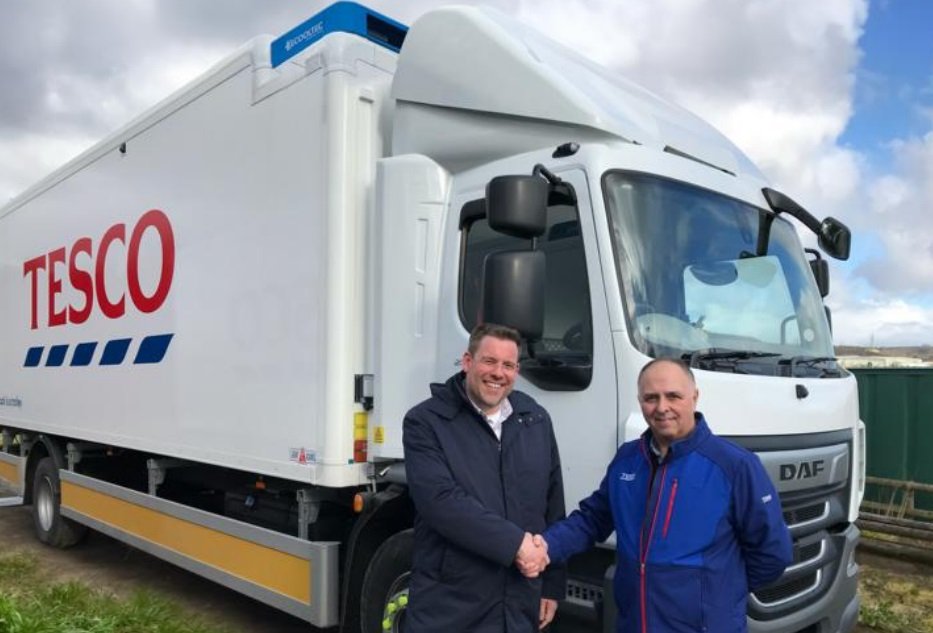
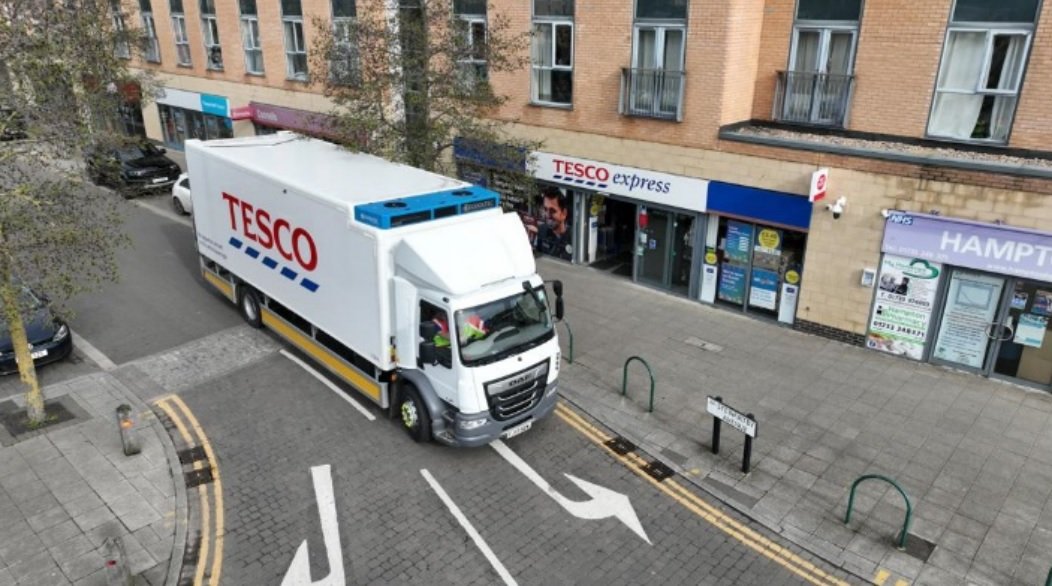
Specialist manufacturers Gray & Adams and ECOOLTEC have jointly developed a refrigerated rigid body vehicle with the ECOOLTEC TM182
transport refrigeration unit, with Tesco being the first company in the UK to put the technology into use. The refrigerated body has the innovative and particularly sustainable ECOOLTEC technology, which is unique in heavy duty road transport up to now. The German company's purely electrically driven system generates refrigeration using sustainable natural refrigerants exclusively. Therefore, the system neither emits any CO2 locally, nor any other gases with high greenhouse warming potential. The retailer is now using two rigid trucks with multi-temp bodyworks from specialist manufacturer, Gray & Adams.
Two 18-tonne rigid body vehicles built by British industry leaders, Gray & Adams and the purely electrically driven ECOOLTEC TM182 transport refrigeration machines now move products between a warehouse in Peterborough and the surrounding Tesco stores. Representatives from Gray & Adams and ECOOLTEC recently handed over the two vehicles to Tesco.
A multi-temp box body from vehicle manufacturer Gray & Adams with a movable transverse bulkhead system is used to split the box into two compartments, allowing the set-up of two compartments for simultaneous frozen and chilled operation. Inside the body, the ECOOLTEC single discharge evaporator 1221 in the front compartment and the double discharge evaporator 1312 in the second compartment distribute the cold air. The electric energy for powering the TM182 is generated by ECOOLTEC's G30 alternator, which is mounted to the truck engine. At the depot, the transport refrigeration system can also be supplied via a mains plug point.
Reducing environmental impact through natural refrigerants
The use of the natural refrigerants CO2 (R744) and propene (R1270) to generate refrigeration is unique in the heavy-duty commercial vehicle segment. Those have a negligible low global warming potential (GWP), instead of the fluorinated refrigerants R452A and R410A predominantly used in transport refrigeration with GWP values of approx. 2,000 (GWP calculated per 100 years on average). When conventional refrigerants leak, they have a significant environmental impact, and as many current transport refrigeration systems do not have a fully hermetic refrigerant circuit, refrigerant can leak steadily over time. According to studies, the leakage rate for such systems is up to 30 percent per year. The total refrigerant charge in typical systems for heavy-duty commercial vehicles is up to 14 kilogrammes, depending on the exact specification. In this case, an average of around 4.2 kilogrammes of F-gases per vehicle is released into the atmosphere every year. Depending on the refrigerant, this corresponds to a CO2 equivalent of around 9 tonnes per year and per unit. On the other hand, if one kilogramme of the natural refrigerant propene escapes, according to the latest F-gas revision (EU) 2024/573, less than one kilogramme of CO2 equivalent is released into the environment. Furthermore, HFC-based refrigerants belong to so-called perpetual
chemicals. When they are released into the atmosphere, they are also responsible for the formation of environmentally harmful substances such as perfluoroalkoxy polymers (PFAS).
Thanks to the purely electric, locally almost emission-free and CO2-free drive, the system produces neither local pollutant nor CO2 emissions when in battery operation, and up to 98 percent fewer emissions compared to diesel-powered refrigeration systems via the alternator drive.
Enormous cooling capacity, high efficiency and silent operation
Other advantages of the ECOOLTEC refrigeration unit include its enormous cooling capacity, which also fulfils the high requirements for temperature safety in the demanding food distribution with perishable goods. Despite its high performance, the energy consumption of the transport refrigeration machine is low. The system requires 60 to 80 per cent less energy than a conventional dieselpowered system for the same cooling capacity. The noise level is significantly lower than that of comparable units with diesel engines. This is of particular benefit to people in towns and cities during night deliveries, as well as to drivers. At the same time, the ECOOLTEC design pays very close attention to maximum operational safety.