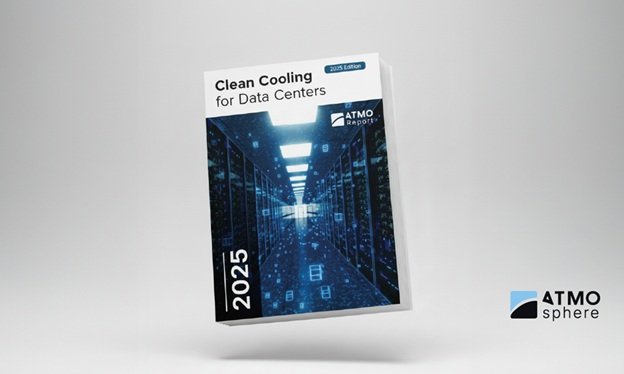
The latest ATMOsphere report highlights a growing opportunity for natural refrigerant-based cooling systems in the data center sector, driven by rapid global expansion of high-performance computing and artificial intelligence infrastructure.
According to
Clean Cooling for Data Centers 2025, global data center capacity is expected to nearly double from 103GW to 200GW by 2030, with the United States leading in new builds. This surge is creating thermal management challenges as server rack densities exceed 100kW, far beyond the effective range of conventional air cooling. As a result, liquid cooling technologies—particularly direct-to-chip and immersion systems—are gaining market share.
While synthetic refrigerants still dominate, manufacturers are beginning to supply CO2 (R744), propane (R290), and ammonia (R717) chillers for data center applications in Europe and North America. CO2-based CRAC units have also been deployed. Heat pump manufacturers are targeting opportunities to repurpose waste heat from data centers into district heating networks using high-temperature hydrocarbon systems.
In the U.S., regulatory measures such as the AIM Act will prohibit new IT cooling systems using refrigerants with a GWP over 700 from 2027. The European Union is enforcing even stricter measures through the 2024 F-gas Regulation, which bans fluorinated gases with GWP ≥750 in chillers over 12kW from 2027. A proposed PFAS restriction could further limit the use of synthetic refrigerants.
The report defines “clean cooling” as mechanical cooling using natural refrigerants, direct-to-chip and immersion liquid cooling with non-fluorinated fluids, and heat exchangers or pumps enabling waste heat reuse or free cooling.
In interviews with nine manufacturers, the report presents a snapshot of progress and challenges. Secon and Zudek discussed deploying propane and ammonia chillers, respectively. Heat exchanger producers Alfa Laval and SWEP noted growing demand for free cooling applications. Meanwhile, BAC and Carel highlighted innovations in single-phase immersion and CRAC technologies.
“We learned that natural refrigerants presently occupy a very small niche in this burgeoning industry,” noted Michael Hines, Managing Editor and Lead Author of the report. “But the opportunity for clean cooling in data centers is real and growing.”
Executive Summary – Key Insights
Data Center Growth Driven by AI
-
High-performance computing (HPC) and generative AI are accelerating global data center expansion.
-
Global capacity expected to nearly double from 103GW to 200GW by 2030.
-
This growth has created a thermal management challenge, with server rack densities exceeding 100kW, beyond what air cooling can handle efficiently.
Transition to Liquid Cooling
-
Traditional air cooling (CRAC/CRAH units) is being supplemented or replaced by liquid cooling, particularly direct-to-chip (DTC) and immersion cooling.
-
Liquid cooling is up to 3,000 times more effective than air cooling at dissipating heat.
Role of Natural Refrigerants
-
CO₂ (R744), propane (R290), and ammonia (R717) chillers are being deployed in both Europe and North America.
-
Natural refrigerants occupy a small but growing niche, supported by regulatory and sustainability pressures.
Regional Highlights
-
U.S.: Leading in capacity; construction projected to hit $86 billion by 2026. Facing power grid delays and PFAS regulation at state level.
-
Europe: Leading in sustainability. EU laws now mandate heat reuse, PUE targets, and phase-out of high-GWP refrigerants.
-
APAC: Fast growth in China, Malaysia, and Singapore. Singapore is adopting high-temp liquid cooling standards; China mandates PUE < 1.5.
-
Middle East: Large sovereign AI data centers with advanced adiabatic/hybrid cooling systems.
Cooling Technology Breakdown
-
Gray Space: Mechanical cooling systems (air- and water-cooled chillers, dry/hybrid/adiabatic coolers).
-
White Space: CRAC/CRAH units still used, but liquid cooling is dominant for AI workloads.
-
Heat Recovery: High-temperature heat pumps (using hydrocarbons) are enabling district heating from waste heat.
Regulation and Certification
-
EU F-gas Regulation (2024/573): Bans high-GWP refrigerants in new chillers over 12kW starting 2027.
-
PFAS Restrictions: EU considering total PFAS bans, which includes many synthetic refrigerants.
-
U.S. AIM Act: HFC phase-down by 85% by 2036; GWP limit of 700 for IT cooling systems from 2027.
-
Efficiency Metrics: Growing emphasis on PUE, WUE, CUE, ERF, REF.
-
Voluntary Initiatives: Climate Neutral Data Centre Pact (CNDCP) and others enforce stricter efficiency goals.
Industry Perspectives
-
Nine manufacturers (e.g., Secon, Zudek, BAC, Carel) shared insights on:
-
Deploying natural refrigerants in data centers.
-
Scaling up heat exchanger solutions.
-
Pioneering heat pump-chiller hybrids.
-
Optimizing liquid immersion cooling systems.
Related tags: chiller,
Carel,
R290,
R717,
R744,
Heat exchanger,
chillers,
heat pump,
ammonia,
propane,
CO2,
natural refrigerants,
CO₂