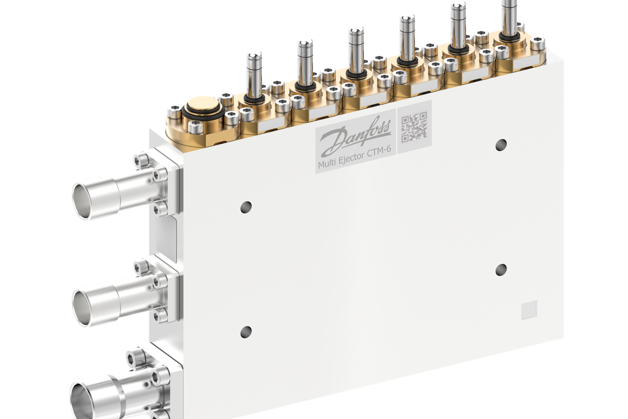
Danfoss has released a whitepaper detailing test results for its Multi Ejector High Pressure (HP) in transcritical CO2 booster systems with parallel compression. The company says the technology can deliver significant energy savings in warm climates, where CO2 refrigeration systems face efficiency challenges at high ambient temperatures.
The whitepaper, “Danfoss Multi Ejector High Pressure (HP): Unlocking 21% Savings over Traditional CO2 Booster Systems,” describes how parallel compression and ejector technology can use potential energy that is otherwise wasted in traditional transcritical CO2 booster systems. According to the source, this reduces overall energy consumption and compressor workload.
Danfoss engineers installed the Multi Ejector HP in a Hussmann transcritical CO2 booster system using parallel compression. A Danfoss pack controller was also installed to manage variable receiver pressures and control rack operation, valve logic and ejector staging. The system was tested in two new supermarkets, one in a mild climate and one in a warm climate, with the ejector both on and off.
Several months of testing showed that at ambient temperatures of 95 degrees Fahrenheit (35 degrees Celsius), using the ejector delivered actual incremental energy savings of up to 13.4% compared with parallel compression alone. Total energy savings over a traditional booster system reached 21%. With the ejector on, compressor cycling was also reduced, with a 43–47% reduction in on/off cycles.
“The test results showed the value of the Multi Ejector HP in helping supermarket customers achieve the full benefit of CO2 refrigeration,” said DJ Frye, director of sales for food retail in North America at Danfoss. “Ensuring energy efficiency and reduced operating costs in almost any climate is a necessary step to increasing the adoption of CO2 across the food retail industry.”