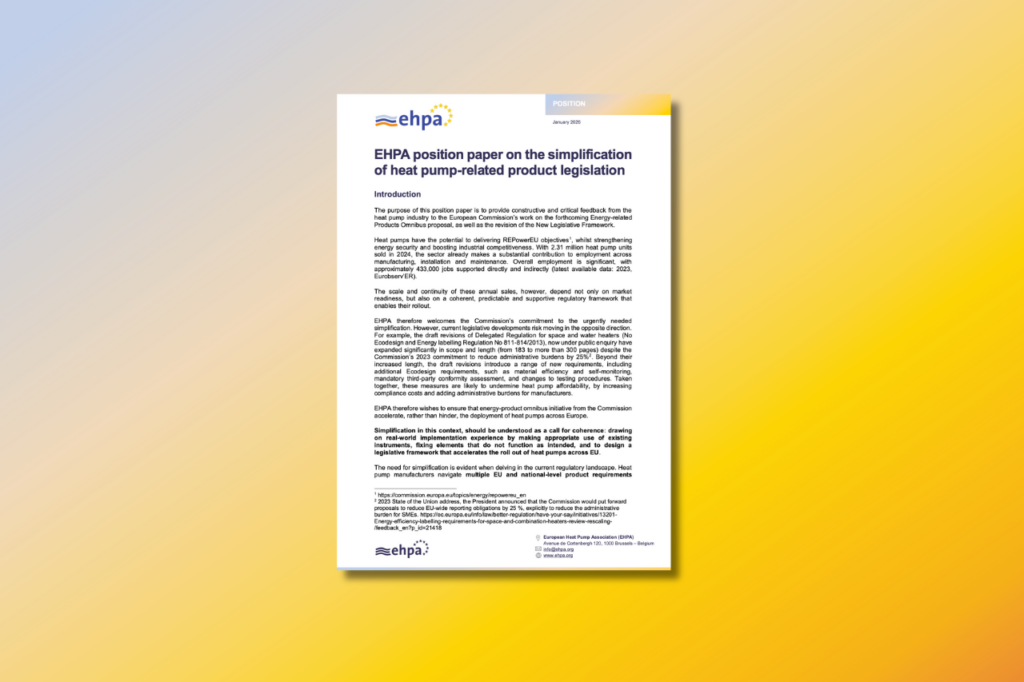
The European Heat Pump Association (EHPA) has published its
position paper on the European Commission’s upcoming Energy-related Products Omnibus proposal and the revision of the New Legislative Framework. The document highlights the need to streamline regulatory requirements to support the rollout of heat pumps across Europe.
In 2024, 2.31 million heat pump units were sold, supporting around 433,000 jobs in manufacturing, installation, and maintenance. EHPA warns that continued growth of the sector depends on a stable and coherent legislative framework. It expresses concern that recent regulatory developments — such as draft revisions to Ecodesign and Energy Labelling regulations — risk increasing administrative burden and compliance costs.
EHPA calls for product-level requirements to take precedence over component-level rules, greater coordination of legislative timelines, and the consolidation of reporting systems. The position paper also proposes maintaining fixed revision schedules to avoid delays or rushed updates that could disrupt investment and redesign cycles.
The association suggests that legislative changes should be proportionate, evidence-based, and avoid disadvantaging heat pumps compared to other heating technologies. EHPA further recommends using digital energy labels to reduce waste, simplifying the EPREL database structure, and ensuring consistent implementation across Member States.
Key concerns include the interaction between the revised F-gas Regulation and the proposed PFAS restriction, which could reduce the availability of refrigerants and increase planning uncertainty. EHPA calls for guidance from the European Commission to address potential regulatory overlaps.
On smart heat pump integration, EHPA advocates for harmonised EU-level flexibility requirements, avoiding new hardware mandates under the Network Code on Demand Connection, and leveraging existing systems like EPREL and the Code of Conduct on Energy Smart Appliances.
“Simplification is not about lowering ambition, it is about doing better: making full use of existing instruments, fixing what does not work, and learning from implementation to improve future legislations,” the paper concludes.