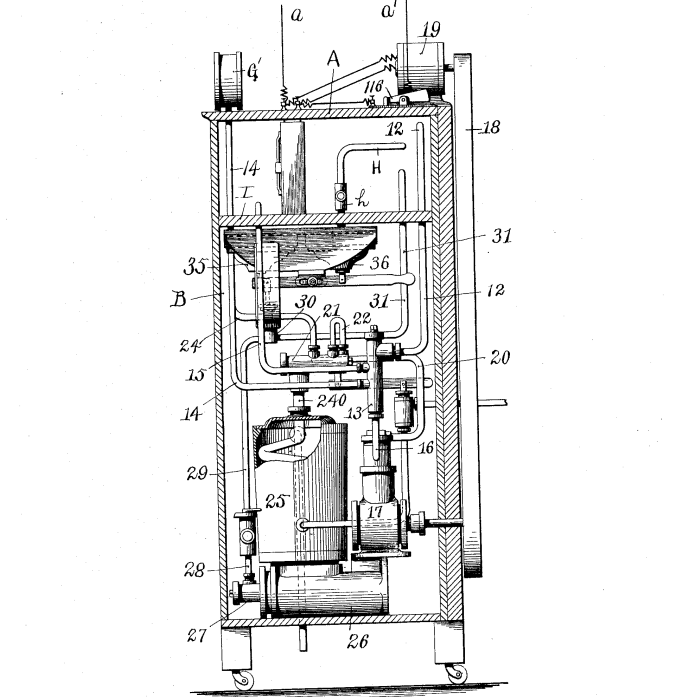
On August 8, 1899, the United States Patent Office granted Albert T. Marshall of Brockton, Massachusetts, two patents covering automatic control of anhydrous ammonia refrigerating machines: No. 630,616 for a complete automatic refrigerating apparatus and No. 630,617 for an automatic expansion valve.
Patent 630,616, filed on June 4, 1897, sets four objectives: automatic regulation of refrigerant admission to the expansion pipes, a combined thermostat and rheostat controlling the motor that drives the pump, automatic cut-out of that motor under defined conditions, and automatic regulation of the cooling water circulation. The specification applies the design to a comparatively small cabinet refrigerator or chest while stating that it suits larger ice and refrigerating machines equally.
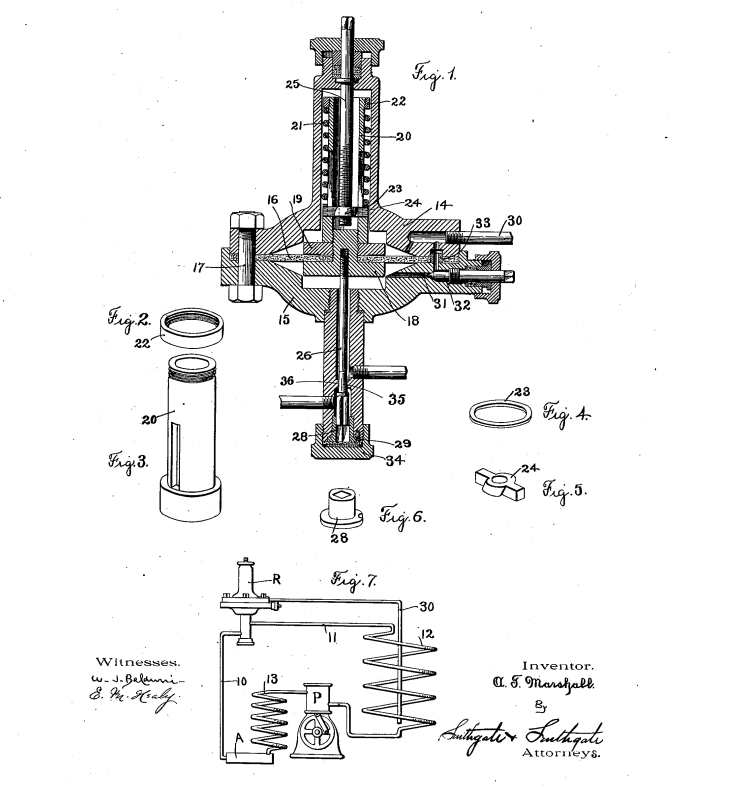
The machine uses a needle expansion valve worked by two diaphragms through a lever with an adjustable fulcrum. One diaphragm senses pressure on the suction side of the pump; the other senses a charge of ammonia confined in a closed vessel immersed in the brine tank alongside the expansion coils. Moving the fulcrum sets the pressure difference at which the valve opens, and the valve closes automatically whenever the pump stops and the two pressures equalise.
Motor control runs through a hard rubber thermostatic rod in the refrigerated space, linked to a spring-driven rheostat. Resistance coils are cut out of the armature circuit in sequence so the motor starts gradually. The specification notes that simple make-and-break switching burns out the armature in service. A further cut-out drops the motor when street current fails, and a diaphragm on the pump discharge both throttles the condenser water valve and breaks the motor circuit if water supply is lost and pressure rises abnormally.
Patent 630,617, filed on February 11, 1898, covers the expansion valve as a standalone regulator: a diaphragm clamped between two castings, refrigerant pressure on one side, a thermostatic pipe carried through the brine tank on the other, and a coiled spring set by an adjusting screw. A valve-controlled by-pass inside the casing charges the thermostatic pipe. Commissioning is judged by frosting of the circulating pipes, with frost only at the coil outlet indicating overfeed.