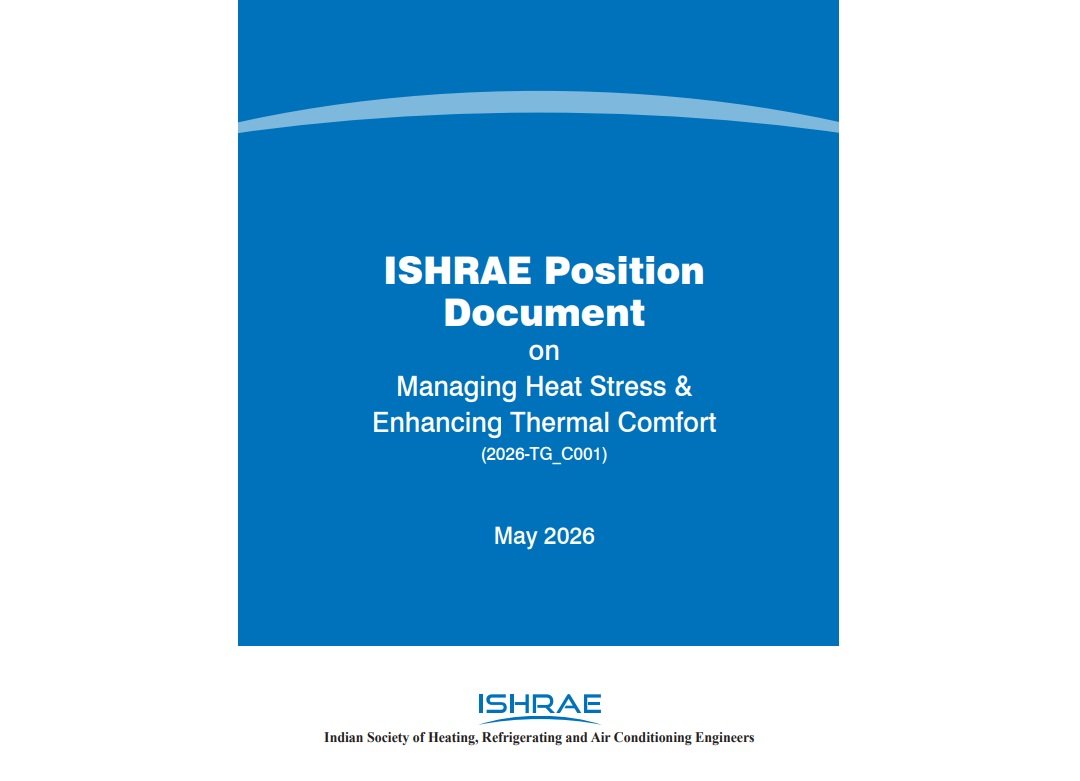
ISHRAE has
released a position document on Managing Heat Stress & Enhancing Thermal Comfort for India’s built environment. The document provides evidence-based measures for individuals, building owners and managers, institutions, and policymakers during extreme hot seasons.
Prepared by ISHRAE Technical Groups on Healthcare, Thermal Comfort, Passive Cooling, Evaporative Cooling and Safety, the document covers three scales of intervention: individual behaviour, building design and management, and indoor environment control. It states that the guidance applies to India across all climate zones and is broadly relevant to other heatwave-affected regions with local adaptation.
For individuals, ISHRAE recommends avoiding direct sun exposure during peak heat hours, especially 12 noon to 3 p.m.; wearing loose, thin, light-coloured cotton clothing; drinking water before feeling thirsty; and using ceiling fans with air conditioners. The document says AC setpoints in the 24–26°C range (75–79°F) are recommended for Indian conditions depending on climate, clothing, air movement, and occupant adaptation.
For buildings, the document lists passive and active measures such as planting trees, using shaded green walls, applying cool-roof coatings, providing external shading, reducing east and west glass, and maintaining wind movement. It says cool roofs can reduce roof surface temperatures by 6–15°C (11–27°F) and indoor temperatures by 2–5°C (4–9°F), depending on construction type and insulation levels.
Indoor measures include increasing air movement, using night ventilation where outdoor air is cooler and safe, reducing internal heat gains, switching to LED lighting, controlling afternoon sun in west-facing rooms, and preparing for power cuts. The document says ceiling fans, pedestal fans, wall fans or HVLS fans at air speeds of 0.8–1.2 m/s (2.6–3.9 ft/s) can improve comfort at higher temperatures.
“I urge all stakeholders — professionals, administrators, and citizens alike — to study, adopt, and share these recommendations widely, for the health, comfort, and resilience of our communities depend on it,” said Prof R Saravanan, Society President ISHRAE (2026-27).