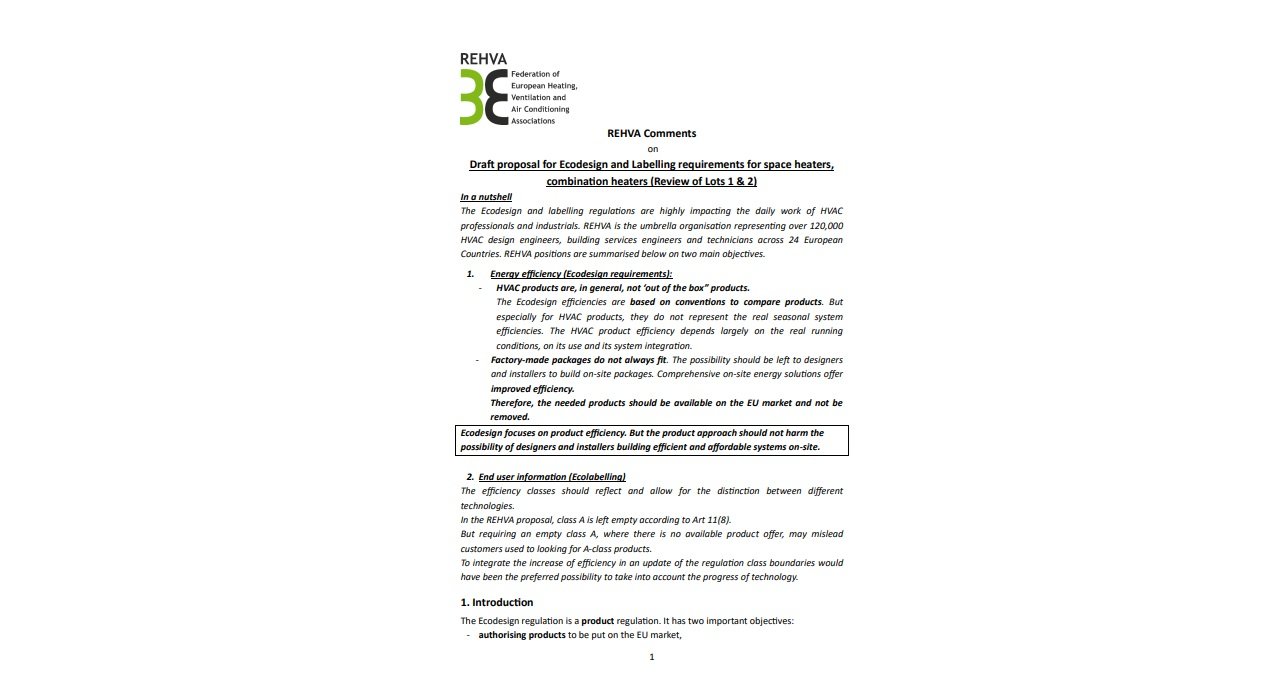
REHVA has submitted expert feedback to the European Commission on the review of ecodesign and energy labelling requirements for space and combination heaters. The contribution, prepared by REHVA’s EU Policy Advisory Group (EU PAG), reflects insights from HVAC engineers, designers, technical experts, and manufacturers across Europe.
The two EU initiatives—covering energy efficiency labelling and ecodesign requirements—aim to shape the regulatory framework for heating technologies, market access, and consumer information through 2030 and beyond.
REHVA emphasizes that heating appliances function as components of broader HVAC systems, where real-world performance depends on design, sizing, installation, and operating conditions. The association calls for product regulations to account for this system-level perspective, especially in renovations, hybrid setups, and renewable-integrated solutions.
On ecodesign, REHVA supports setting minimum performance levels but warns that requirements based solely on standard test conditions may not reflect real seasonal efficiency. It advocates for a technology-neutral approach to maintain flexibility for system designers and prevent exclusion of products that contribute to optimized and cost-effective configurations. REHVA also highlights the need to align product test methods with system-level calculation standards used in building regulations.
Regarding energy labelling, REHVA supports the Commission’s aim to rescale energy classes but warns that proposed thresholds could group dissimilar technologies into the same class, reducing clarity for users. It raises concerns about the introduction of an empty A class, which could confuse consumers and complicate subsidy schemes linked to top-tier energy labels. REHVA proposes adjusted class thresholds to better reflect the market landscape.
The consultation closed on 23 January 2026, with the Commission expected to adopt the final rules in the first quarter of 2026.
REHVA stated it will continue to monitor developments and work with EU institutions to ensure the regulations remain practical and support high-performance, low-emission heating systems.
The full REHVA contribution, developed by the EU PAG, is available here.