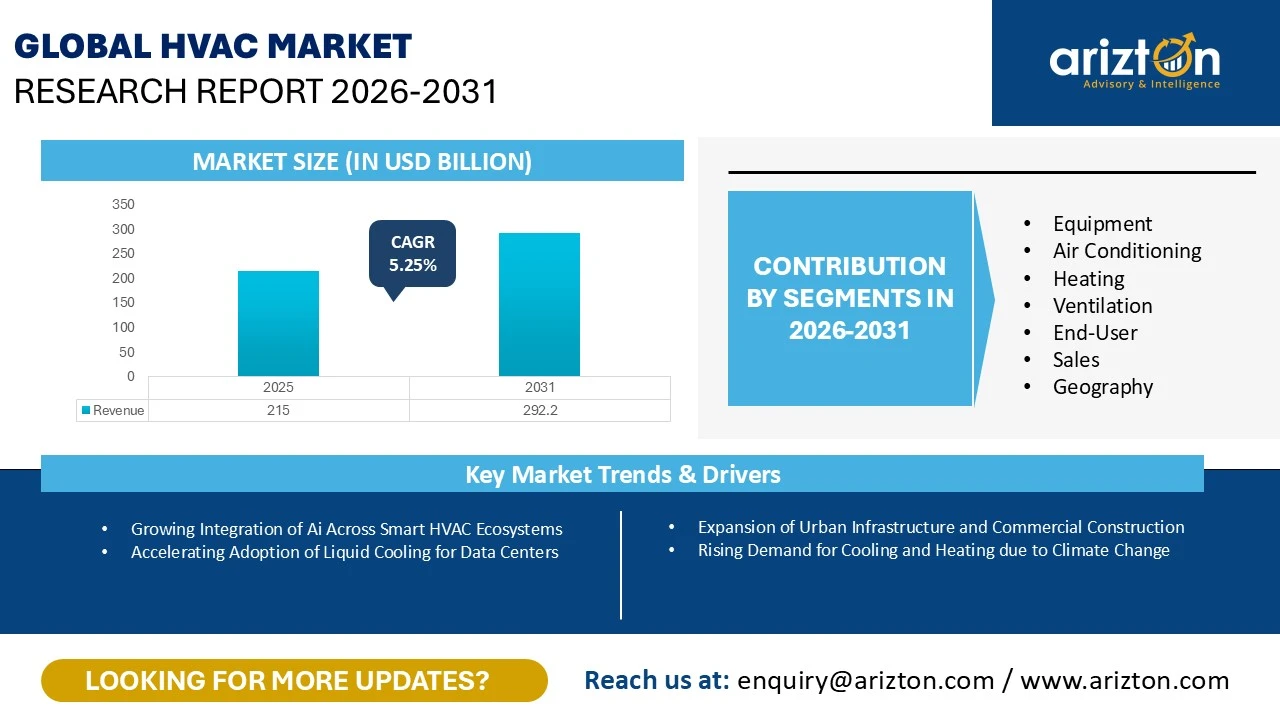
Arizton forecasts global HVAC market at USD 292.20 billion by 2031
The global HVAC market is expected to reach USD 292.20 billion by 2031, according to Arizton Advisory & Intelligence. Growth is supported by new construction, equipment replacement and renovation activity across residential and non-residential buildings.
Infrastructure and real estate projects in China, India, South Korea, Brazil, Germany, France, the UK and Spain are contributing to demand. Arizton cited projects including India’s Noida International Airport and Europe’s 230,000-square-meter (2.48 million-square-foot) Nantes University Hospital as examples of demand for integrated HVAC systems.
AI is also becoming an investment priority for HVAC manufacturers. Johnson Controls acquired Nantum AI in 2026 and integrated its algorithms into the OpenBlue platform for real-time HVAC optimization, occupancy-based airflow management and predictive energy management.
Industry consolidation continued in 2025. Midea Group and Frigicoll formed joint ventures in Spain and France, Samsung Electronics acquired Germany-based FlaktGroup for approximately USD 1.7 billion, and Bosch Group acquired Johnson Controls’ residential and light commercial HVAC business for approximately USD 8 billion.
Europe’s HVAC market is forecast to reach USD 58.67 billion by 2031. Heating equipment represented around 50% of the regional market in 2025, while Western and Southern Europe generated more than 53% of revenue. The commercial segment is projected to grow at a compound annual growth rate of 5.33% through 2031.
Regional demand is supported by renovation programs, energy-efficiency requirements and construction investment. Germany’s Heating Act requires newly installed heating systems to use at least 65% renewable energy, while the European Commission’s Renovation Wave Strategy aims to double building renovation rates by 2030.