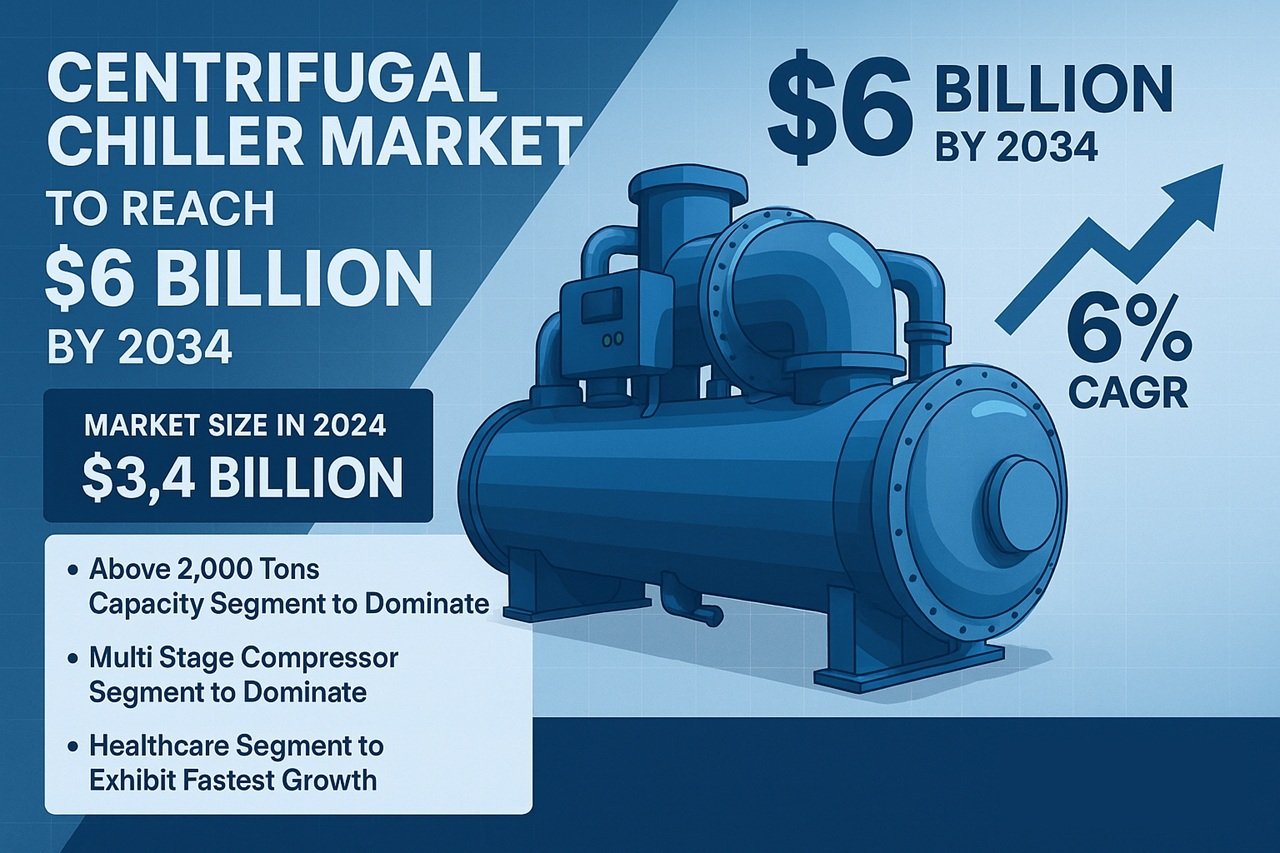
The global centrifugal chiller market is projected to grow from $3.4 billion in 2024 to $6 billion by 2034, registering a compound annual growth rate (CAGR) of 6%, according to a new report by Allied Market Research.
Centrifugal chillers, which use centrifugal force for heat exchange, are widely deployed in HVAC systems for commercial buildings, industrial facilities, and data centers. Market growth is being driven by rising demand for energy-efficient systems, increased adoption in sustainable buildings, and technological advancements in smart cooling technologies. However, high installation and maintenance costs, along with the need for skilled personnel, are noted as key restraints.
The report identifies the "above 2,000 tons" capacity segment as the fastest-growing category, supported by demand from large-scale applications such as district cooling, petrochemical complexes, and hyperscale data centers. In terms of compressor type, multi-stage centrifugal chillers are expected to dominate due to their high operational efficiency in mission-critical environments like pharmaceutical and research facilities.
Among end users, the healthcare segment is projected to see significant growth, driven by expanding infrastructure and the need for precise climate control in medical and pharmaceutical environments.
Regionally, LAMEA (Latin America, Middle East, and Africa) is anticipated to register the fastest growth rate due to increased urbanization, industrial investment, and large government cooling projects. Asia-Pacific remains the largest market, supported by rapid industrialization and high demand from smart city and commercial developments.
Key market participants include Johnson Controls, Trane Technologies plc, Daikin, Haier, Midea, Smardt Chiller Group, Carrier, Mitsubishi Heavy Industries, LG Electronics, and TopChiller.
Read More