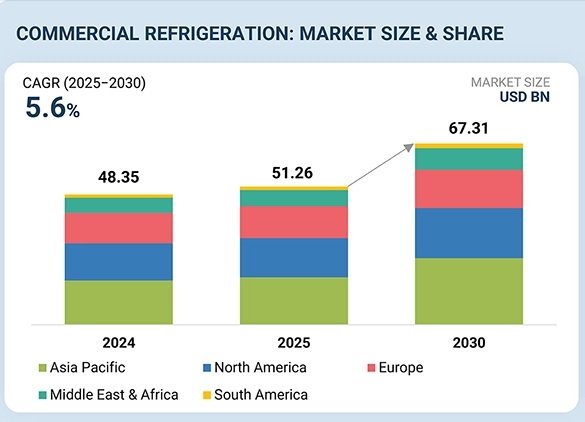
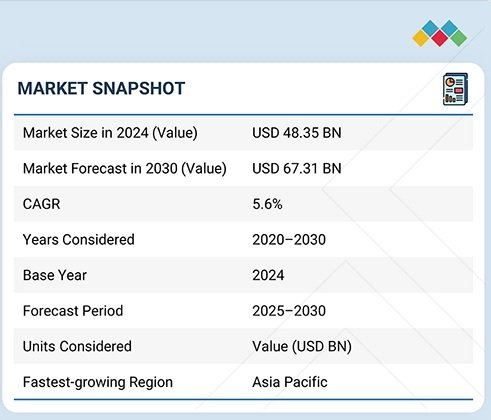
The global commercial refrigeration market is projected to grow from USD 51.26 billion in 2025 to USD 67.31 billion by 2030, at a compound annual growth rate (CAGR) of 5.6%, according to a new report by MarketsandMarkets.
Growth is driven by rising demand for efficient refrigeration solutions across sectors such as food retail, hospitality, pharmaceuticals, and logistics. Expanding cold-chain infrastructure, urbanization, and consumer trends toward fresh and ready-to-eat products are also contributing to market expansion.
By product type, transportation refrigeration is expected to lead the market, accounting for a 32.1% share in 2024. This growth is linked to increased global trade in perishable goods and the need for temperature-controlled logistics in food and pharmaceutical supply chains.
Fluorocarbons are projected to hold the largest market share among refrigerant types due to their availability and performance, despite regulatory pressures. However, hydrocarbons are expected to see the fastest growth, with a forecasted CAGR of 10.4% over the period.
Among applications, the food services segment is expected to dominate, driven by the expansion of restaurants, cloud kitchens, and food delivery platforms. In terms of end use, supermarkets and hypermarkets are projected to lead the market, with demand for high-performance refrigeration systems to support fresh and frozen product offerings.
The Asia Pacific region is expected to register both the highest CAGR of 7.0% and the largest overall market share during the forecast period, supported by economic growth, urbanization, and investment in retail and cold-chain infrastructure.
Key companies operating in the market include Daikin (Japan), Johnson Controls (US), Hussmann Corporation (US), Danfoss (Denmark), Dover Corporation (US), Haier Inc. (China), and EPTA Corporate (Italy).
Source