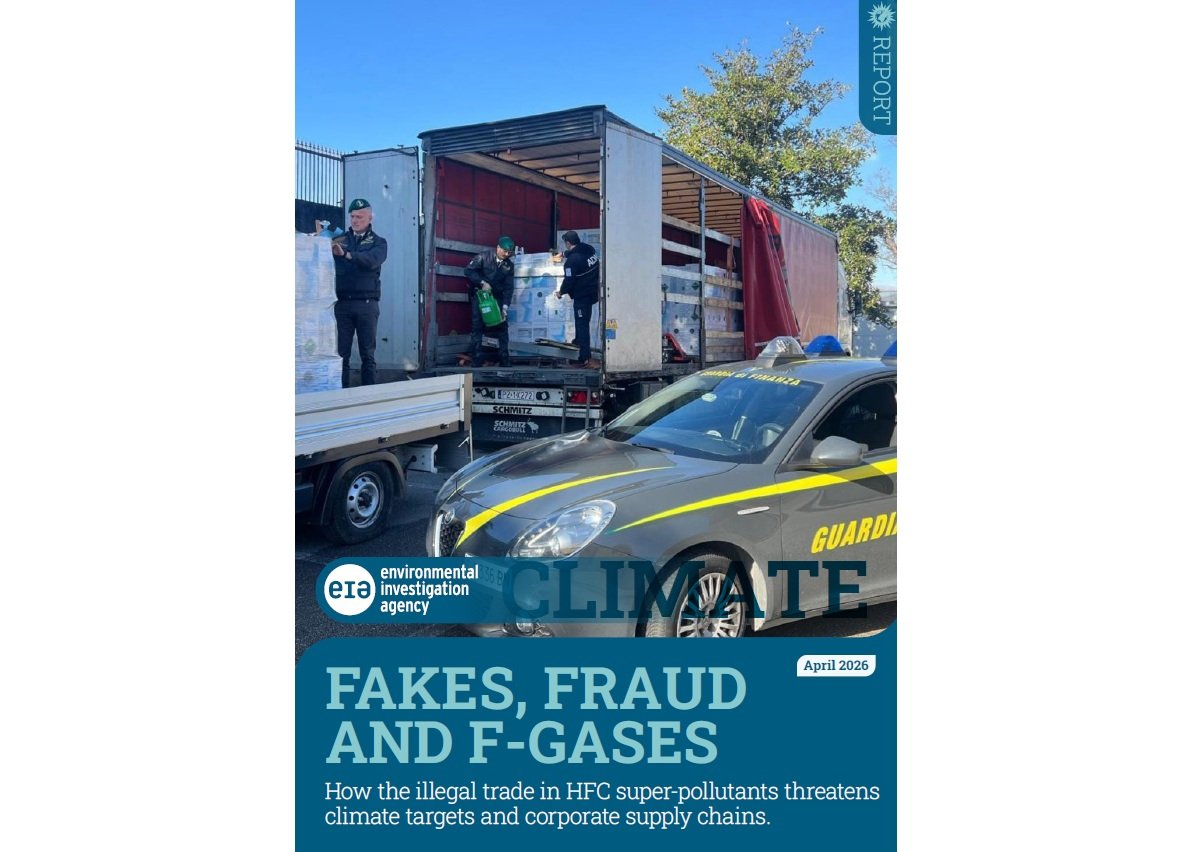
The Environmental Investigation Agency said in its April 2026
report Fakes, Fraud and F-Gases that illegal trade in hydrofluorocarbons continues to threaten climate targets and commercial supply chains in Europe despite tighter EU rules. The report identifies Italy as a major hotspot because it is one of Europe’s largest cooling markets and the member state with the highest reported volume of HFC seizures.
Building on earlier work in 2021 and 2023, EIA investigated Italy’s refrigerant market in 2025 and said representatives from companies at different points in the supply chain admitted practices including exceeding quota limits, falsifying invoices, mislabelling virgin refrigerants as reclaimed and evading VAT. EIA said some of these companies also claimed to supply major manufacturers, transport operators and supermarket chains, including the Italian state railway, Carrefour and Lidl Italy.
The report also records responses from companies named in the investigation. Carrefour said Carma Metal is not an authorised supplier and has no commercial relationship with the company; Tecno Polgas and Carma Metal rejected EIA’s statements and said they comply with standards and regulations; and Arvisa rejected the suggestion that it knowingly imported virgin HFCs and marketed them as reclaimed or placed gases on the EU market outside the regulatory framework. Lidl Italy did not respond to EIA’s request for comment, while Iveco pointed to its supplier compliance and audit processes and did not confirm sourcing from Puglia Oxygen.
EIA said reported HFC seizures in Europe rose from about 250 tonnes (approx. 276 short tons) in 2023 to about 670 tonnes (approx. 739 short tons) in 2024. It added that the Italian Ministry of Finance reported nearly 500 tonnes (approx. 551 short tons) of illegal refrigerants seized in 2024, and that Italy’s environment ministry, customs agency and the Carabinieri set up a permanent F-gas roundtable in January 2026 to coordinate action against illegal trade.
The report says the EU’s revised 2024 F-Gas Regulation has already reduced the open sale of very high-GWP gases, but new loopholes are emerging, including mislabelling of virgin high-GWP HFCs as reclaimed and sales of counterfeit lower-GWP blends. EIA also said HFC prices have risen tenfold since the EU phase-down began and warned that the next quota cut in 2027 is likely to intensify pressure on the market.