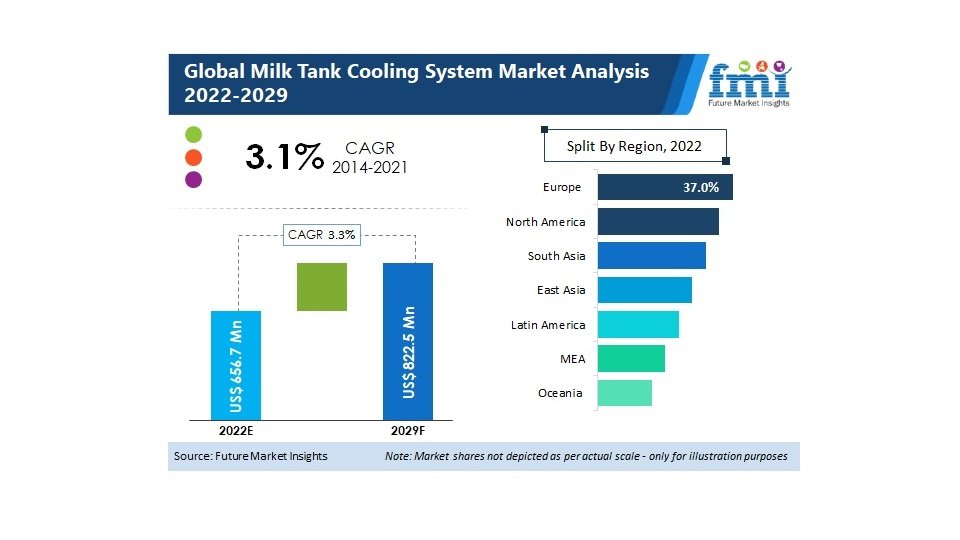
According to Future Market Insights (FMI) the Global Milk Tank Cooling System Market is expected to grow with a year-on-year growth of 3.2% in 2022 reaching a value of about US$ 656.7 Mn by 2022 end.
The increase in the use of machinery and the demand for high quality products in various industries coupled with the installation of smart devices in the machinery are some of the factors driving the growth of the Milk Tank Cooling System market in industrial automation.
Industries are executing automation to increase efficiency and reduce labour costs. The global Milk Tank Cooling System Market is anticipated to witness a considerable value CAGR of 3.3% during the period of 2022 and 2029.
FMI has identified Europe as one of the most prominent markets. Europe dominants global market in the milk tank cooling systems, followed by North America, owing to a considerable share of the dairy sector. North America and Europe are estimated to hold a collective revenue share of 54.6 % in the global market, by the end of 2029.
Food safety regulations regarding the use of refrigerators for storing and transporting milk cause manufacturers to look for solutions that will not only comply with these rules but also provide effective milk tank cooling systems. With the phasing out of HFC refrigerants, key players in the milk tank cooling system market are steadily moving toward low global warming potential refrigerants.
These manufacturers continue to use modern technology to provide sustainable, energy-efficient, and intelligent machineries of milk tank cooling systems that not only solve the challenges of labour shortages but also reduce the cost of milk cooling. Smart devices such as sensors are also used to deliver actual information about the condition of the tank and to monitor the milk cooling systems.
Worldwide, daily, a huge amount of milk is transported and stored in milk tank cooling systems. With increasing population around the world, the volume of milk consumed is also estimated to rise. Manufacturers of milk tank cooling systems are trying to construct cooling systems depending on the temperature surroundings at the locations of their end use. The Milk Tank Cooling System market is estimated to grow at a rate of 3.1 % by Volume over the assessment period of 2022-2029.
Which factors will drive demand for Milk Tank Cooling System in various application?
In the current situation, the need for cooling systems for milk tanks is growing from an intense increase in milk production. As the world's population grows, so does the production capacity to meet growing demands. This requires that the milk be cooled before and after processing to avoid contamination. The implementation of these systems on dairy farms or raw milk collection centres is increasing worldwide.
Scope of usage of these systems in milk transportation increase, as collection points are usually located in remote areas. Increasing the volume of exported milk is contributing to the growth of cooling systems for milk tanks. Other factors include temperature difference on different continents and an increase in milk production in African and Central American countries.
Increasing the export of milk and distribution channels within countries will address the demand of milk tank cooling systems. Additionally, high investment in dairy farming, the promotion of the use of bulk tanks by regulatory agencies, the provision of sustainable milk supply worldwide and rapid growth of the co-operative dairy business in rural areas around the world is expected to boost the market during the estimate period.
How is technology advancement in milk tanks supporting market growth?
A strong global focus on stability and energy efficiency is leading to tectonic change in all industries. With so many rules in place, require a reduction in the HFC refrigeration category, and key players in the milk tank cooling system market are gradually switching to lower GWP (global warming potential) refrigerators.
These manufacturers are further leveraging modern technologies to deliver energy efficient, sustainable, and smart components of milk tank cooling systems that not only meet labour shortage challenges but also bring milk cooling costs down. Development of smart sensors to monitor the milk cooling system and provide real-time information about the status of the tank to farmers will remain instrumental to milk tank cooling system market growth.
What was the Impact of the COVID-19 Crisis on the Milk Tank Cooling System Market?
Lockdowns implemented in a number of countries had a negative influence on the market. Obstacles have arisen as a result of limited production and transportation-related delays caused by travel restrictions. Furthermore, economic activities had come to a halt due to widespread lockdowns and mobility restrictions.
Companies have to deal on an important margin basis to revive the market. Financial losses were incurred in generating revenue for Milk Tank Cooling System companies due to the lockdown. The Global Milk Tank Cooling System Market has been significantly hit by a drop in sales as a result of a number of constraints, but it will undoubtedly rebound over time.
Country-wise Insights
Which is the most prominent market for Milk Tank Cooling System?
In 2022, Germany is expected to register 3.0% year-on-year growth by volume for Milk Tank Cooling System market. Germany dominates the Europe milk tank cooling system in terms of market share. This growth can be attributed the diversity and quality of available dairy products which stimulate consumption, boosting business for top global companies and propelling the global dairy sector forward. Advanced methodologies brought out Europe in terms of milking and cattle maintenance contributing to success of the European counties including Germany. Study projects that the Germany market will surpass the revenues worth US$ 53.9 Mn by the end of 2022.
Which trends in U.S. will impact Milk Tank Cooling System market?
Between 2022 and 2029, U.S. is estimated to grow at a CAGR of 2.2%. Consumption of dairy products in the US has increased faster than population growth. The major trends in milk production in the US include a gradual increase in milk production and a steady decline in the number of dairy products associated with a steady increase in the number of cows in each operation. Farm milk production varies by day, week, and season due to weather and other factors. Similarly, sales of liquid milk vary greatly by day and period due to consumer purchase patterns. Because these patterns cannot be accurately predicted, the system must be maintained to obtain milk where it is needed due to which demand for Milk Tank Colling systems is increase in U.S.
Why is Demand for Milk Tank Cooling System Market increasing in India?
The Milk Tank Cooling System market in India is expected to rise at nearly 4.7% CAGR over the estimated period. India has been a leading producer and consumer of dairy products across the globe for decades. India has managed to secure an export value of Rs 1,358.29 crores of dairy products for the year 2020-21, with the biggest market for Indian dairy products being the UAE. According to National Dairy Development Board (NDDB), which expects the demand for milk and milk products at a pan India level to be 266.5 million metric tonnes in 2030 due to which demand for Milk tank cooling systems will increase. The country is expected to reach a value of about US$ 91.2 Mn by 2029.
Category-wise Insights
Which Capacity is most preferred in the Market?
1000 - 5000 Lt Milk cooling tanks see a greater need compared to other categories, and will continue to comprise 1/3rd of the revenue share. As the global dairy industry is divided into commercial and private enterprises, players in the milk tank cooling system are focused on increasing the production of less than 1000 Lt Milk cooling tanks for the benefit of smaller farms. Considering the growing reliance on large dairy farms sold for milk cooling in tanks combined with modern technology, manufacturers are investing in product development. 1000 - 5000 Lt Capacity tank is projected to create an absolute dollar opportunity of more than US$ 58.6 Mn during the period of 2022 to 2029.
Which Application makes the most value from Milk Tank Cooling System Market?
The Milk Farm segment is estimated to remain prominent over the forecast period, which is mainly attributed to the growing demand for milk and its value added products along with dairy commodities from the consumer end. Rapid surge in population leads to rise in milk consumption. Implementation of Milk Tank Cooling System in milk farms or raw milk collection points will continue to produce on a significant pace, contributing around 86.4% of the total market share in 2029.
Competitive Landscape
Over the past few years, increasing acquisition and expansion activities has been witnessed to improve the supply chain of Milk Tank Cooling System. Several key manufacturers of Milk Tank Cooling System supplies are also focusing on developing new technology driven Milk Tank Cooling System. Emergence of various manufacturers has also been witnessed in this space.
For Instance,
- In 2021, GEA Grroup AG and Hochwald Food gmbh launch the first milk intake of a new, highly efficient dairy near Cologne together with all employees of the large construction site. The new plant in the German town of Mechernich will be the most modern dairy in Europe and will start commercial production as early as January 2022.
- In 2019, Paul Mueller Company to achieve global coverage of cooling solutions, Lely and Mueller B.V. in Groenlo signed an agreement to include Mueller milk tanks, silos and ancillary products in the Lely portfolio.
The latest study conducted by Future Market Insights covers all the strategies and success factors of key manufacturers of the market.
Read More