A study
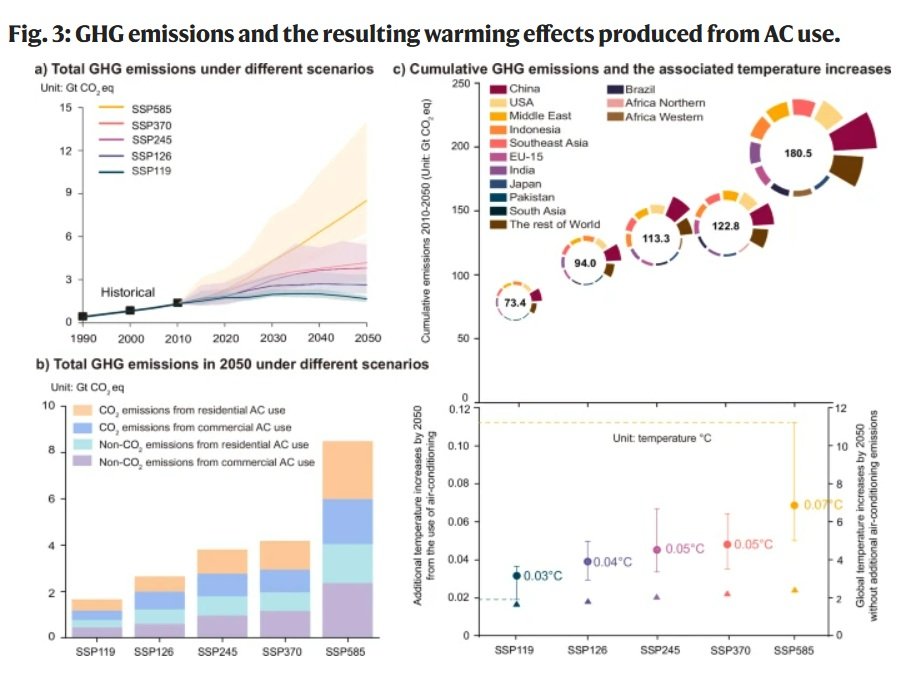
published in Nature Communications by Hongzhi Zhang and co-authors quantifies greenhouse gas emissions from global air-conditioning use under five SSP-RCP climate scenarios. In the middle-of-the-road SSP245 pathway, the authors estimate cumulative AC-related emissions of 113.3 GtCO2eq between 2010 and 2050, adding 0.05°C (0.03°C-0.07°C) to global-mean temperature.
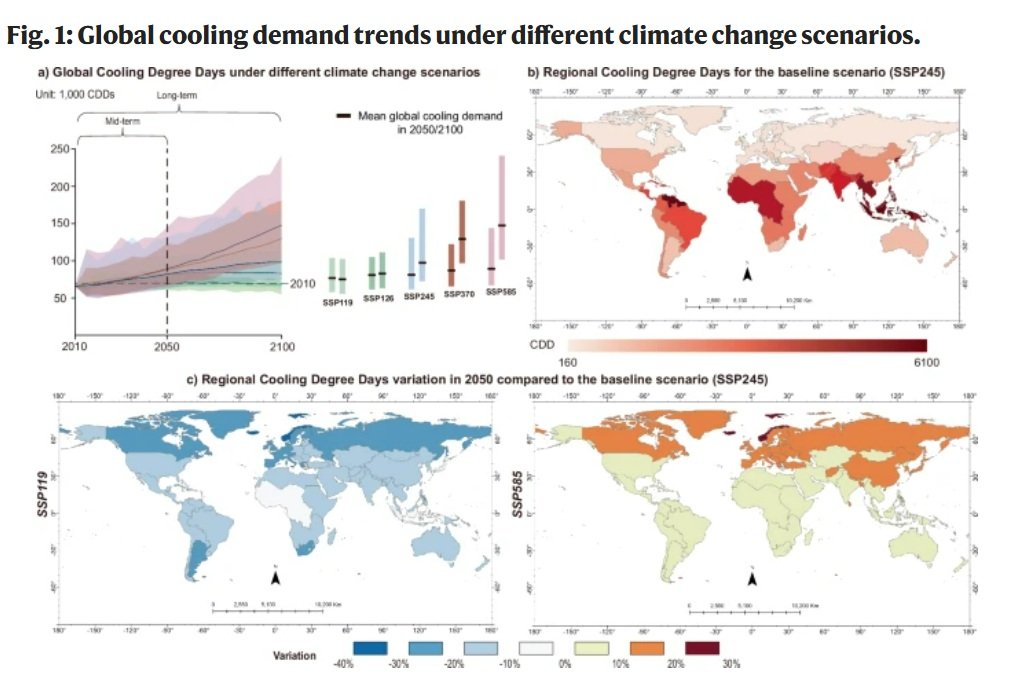
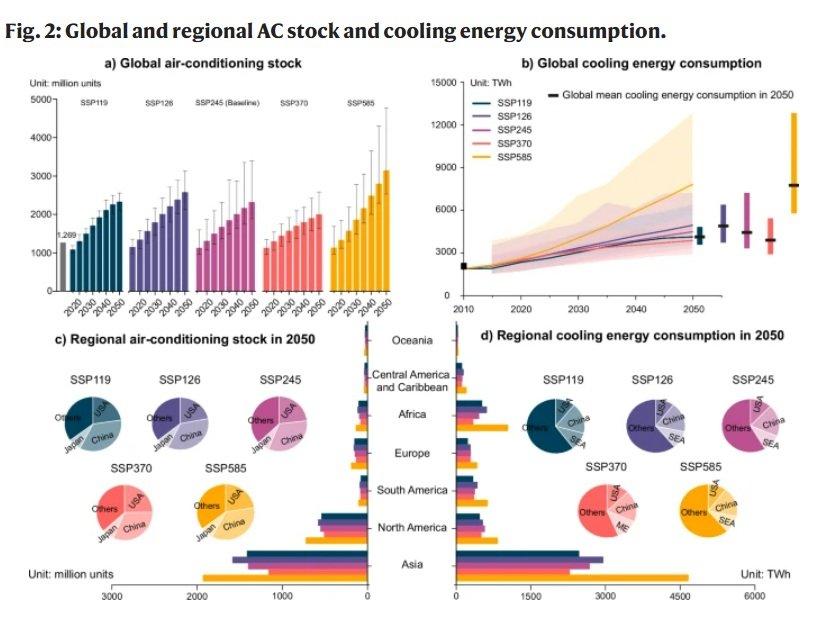
The analysis combines population-weighted cooling degree days, the Global Change Analysis Model (GCAM) and MAGICC v7.5.3, using climate outputs from 25 general circulation models. Under SSP245, global cooling demand rises by an average 25% by 2050 versus 2010, while global AC electricity consumption reaches 4493 (3326-7225) TWh in 2050, equal to 8.0% of total energy consumption in the building sector.
Under the same baseline scenario, annual AC-related greenhouse gas emissions rise from 1.3 GtCO2eq in 2010 to 3.8 (2.9-5.5) GtCO2eq in 2050. The paper says refrigerant leakage becomes the main source by 2050, accounting for up to 60% of total AC-related emissions, while China and the United States together represent almost 40% of annual emissions from AC use by 2050 across all scenarios.
The study also identifies large inequality in cooling access. Regions with high cooling demand, such as Pakistan, Western Africa and South Asia, are often those with the lowest economic development, while many high-income regions have much lower cooling demand. The authors find that income growth is the main driver of future AC uptake, and that raising incomes in lower-income regions would narrow cooling gaps but increase emissions. If all regions reached the highest income level within each SSP framework, income-driven AC growth would add 14-146 GtCO2eq and a further 0.003°C-0.05°C of warming by 2050.
The authors say the findings point to the need for a low-carbon cooling transition that balances emissions reductions with equitable access to cooling. The paper highlights faster power-sector decarbonization, wider use of low-GWP refrigerants and targeted cooling policies as key measures to reduce the warming impact of rising AC use.