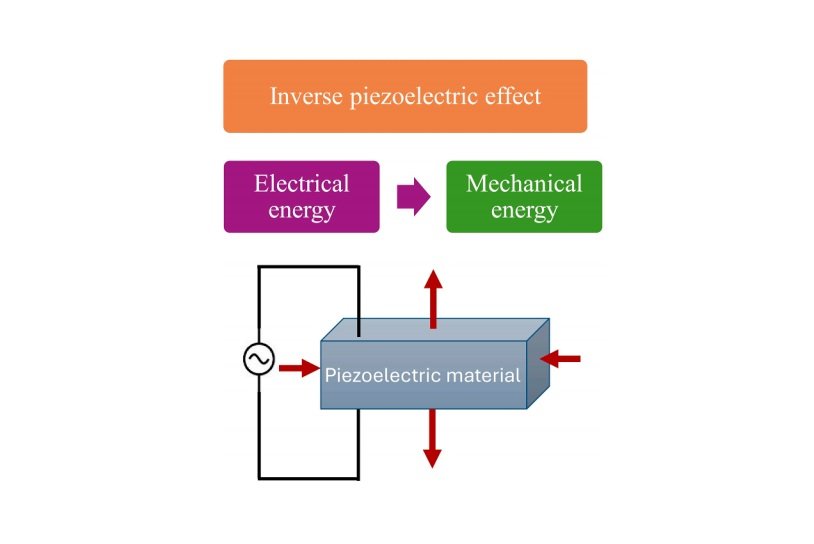
A review published in the International Journal of Refrigeration examines cooling technologies based on the inverse piezoelectric effect as a possible alternative to conventional thermal management in compact electronic devices. The paper was authored by researchers from Tunis El Manar University and the University of Gabes in Tunisia, and Imam Mohammad Ibn Saud Islamic University in Saudi Arabia. It addresses rising heat generation in increasingly miniaturised electronics, where efficient thermal management is needed to maintain performance, reliability and lifespan.
According to the review, the inverse piezoelectric effect causes certain materials to deform when an electric field is applied. In cooling applications, this deformation can generate airflow, pump fluids or enhance heat transfer near electronic components. The article says these systems use oscillating elements rather than rotating mechanical parts, which can support quiet operation, relatively low power consumption and integration into space-constrained and noise-sensitive devices such as laptops, tablets and wearable electronics.
The review analyses several device types that use this principle to improve heat dissipation. These include piezoelectric fans, which use a vibrating beam or blade to improve convective heat transfer near components such as CPUs, memory modules or power devices; piezoelectric micropumps, which move small volumes of liquid or gas through microchannels; and piezoelectric microblowers, designed for directed airflow in compact electronic enclosures. It also covers piezoelectric synthetic jets, which produce pulsating jets from a sealed cavity, and piezoelectric translational agitators, which induce local air movement and mixing near heated surfaces.
The authors note that these technologies remain largely at the research and development stage. The review highlights a lack of standardised performance metrics, integration challenges in dense electronic packaging and larger systems, and the need for improved control strategies, including real-time temperature feedback or AI algorithms. It also points to environmental and regulatory concerns linked to lead-based ceramics such as lead zirconate titanate (PZT), and says wider adoption will depend on effective lead-free alternatives and scalable fabrication methods.
For more information, the review article is available in the
International Journal of Refrigeration and on
FRIDOC.