bronze partner
03 November 2020
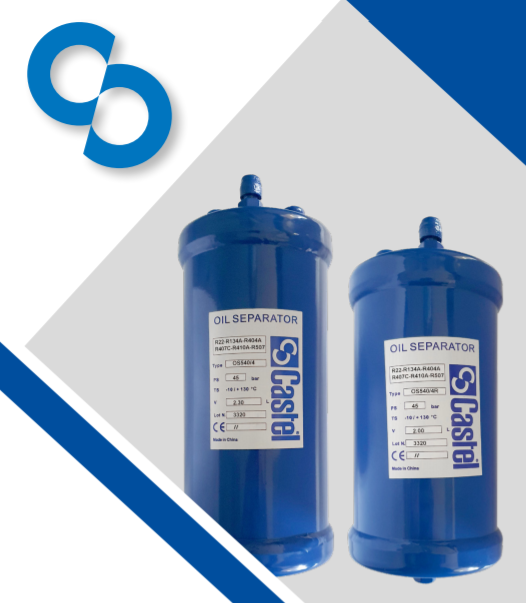
Castel's new compact oil separator
Castel presented new compact oil separator. With a height of only 250mm, this compact oil separator guarantees excellent operating performance at a very competitive price.
Applications
Castel oil separators are designed for installation on commercial refrigeration systems and on civil and industrial air conditioning plants that use HCFC, HFC, HFO refrigerant fluids.
The oil separator extracts the oil mixed with compressed gas and returns it to the oil reservoir or to the compressor crankcase, ensuring efficient lubrication of its moving parts. Furthermore, by eliminating or reducing the oil film on the condenser and evaporator heat exchange surfaces, it maintains a high heat exchange coefficient in this equipment.
Construction
Castel manufactures oil separators in series OS540, that are hermetically sealed and cannot be disassembled from the system, except by cutting the pipework.
The separator body is composed of a steel tube of adequate thickness, also the end caps are made of steel. The solder connections are machined from steel bar.
The internal mechanism is simple to ensure a trouble-free longterm operation.
Appropriate metal screens, placed on the inlet and outlet, along with the rapid reduction in gas velocity create ideal conditions for separating the oil from the refrigerant. A float mechanism, located on the bottom of the vessel, returns the oil to the compressor.
The bottom of the separator also includes a chamber for collecting any iron debris. A permanent magnet holds these impurities to avoid them clogging or damaging the operation of the float-controlled needle valve.
Installation
The oil separators OS540 should be installed on the discharge line between the compressor and the condenser, mounted exclusively in a vertical position and as close to the compressor as possible.
To prevent the return of the refrigerant liquid from condenser to the oil separator during the off-cycle, it’s advisable to install a check valve (see Castel catalog for details) between the condenser and oil separator.
The oil separator performs best when operating at or near the compressor discharge temperature.
If possible, avoid installation in locations that could cause the body of the separator to be cooled, causing condensation of the refrigerant. If this is not possible, it is advisable to equip the separator with appropriate solutions (insulation, strap heater, or other) to prevent the refrigerant in the system from condensing.
Before the oil separator is installed add the amount of lubricant specified in the table as an initial oil charge.
It is very important to carry out this oil pre-charge correctly for a good operation of the separator and to avoid damaging the float mechanism. Always use the same type of lubricant that is in the compressor crankcase.
Based on the layout of refrigerating system, connect the oil return line to one of the following positions:
– Directly to the compressor crankcase.
– To the suction line upstream of the compressor or upstream of the receiver, if present.
– To the oil reservoir if the system has a centralized oil control system and an oil distribution system to compressors.
It is recommended that a liquid indicator (see Castel catalog for details) be installed in the oil return line, in order to check the correct working of the oil separator.
Applications
Castel oil separators are designed for installation on commercial refrigeration systems and on civil and industrial air conditioning plants that use HCFC, HFC, HFO refrigerant fluids.
The oil separator extracts the oil mixed with compressed gas and returns it to the oil reservoir or to the compressor crankcase, ensuring efficient lubrication of its moving parts. Furthermore, by eliminating or reducing the oil film on the condenser and evaporator heat exchange surfaces, it maintains a high heat exchange coefficient in this equipment.
Construction
Castel manufactures oil separators in series OS540, that are hermetically sealed and cannot be disassembled from the system, except by cutting the pipework.
The separator body is composed of a steel tube of adequate thickness, also the end caps are made of steel. The solder connections are machined from steel bar.
The internal mechanism is simple to ensure a trouble-free longterm operation.
Appropriate metal screens, placed on the inlet and outlet, along with the rapid reduction in gas velocity create ideal conditions for separating the oil from the refrigerant. A float mechanism, located on the bottom of the vessel, returns the oil to the compressor.
The bottom of the separator also includes a chamber for collecting any iron debris. A permanent magnet holds these impurities to avoid them clogging or damaging the operation of the float-controlled needle valve.
Installation
The oil separators OS540 should be installed on the discharge line between the compressor and the condenser, mounted exclusively in a vertical position and as close to the compressor as possible.
To prevent the return of the refrigerant liquid from condenser to the oil separator during the off-cycle, it’s advisable to install a check valve (see Castel catalog for details) between the condenser and oil separator.
The oil separator performs best when operating at or near the compressor discharge temperature.
If possible, avoid installation in locations that could cause the body of the separator to be cooled, causing condensation of the refrigerant. If this is not possible, it is advisable to equip the separator with appropriate solutions (insulation, strap heater, or other) to prevent the refrigerant in the system from condensing.
Before the oil separator is installed add the amount of lubricant specified in the table as an initial oil charge.
It is very important to carry out this oil pre-charge correctly for a good operation of the separator and to avoid damaging the float mechanism. Always use the same type of lubricant that is in the compressor crankcase.
Based on the layout of refrigerating system, connect the oil return line to one of the following positions:
– Directly to the compressor crankcase.
– To the suction line upstream of the compressor or upstream of the receiver, if present.
– To the oil reservoir if the system has a centralized oil control system and an oil distribution system to compressors.
It is recommended that a liquid indicator (see Castel catalog for details) be installed in the oil return line, in order to check the correct working of the oil separator.