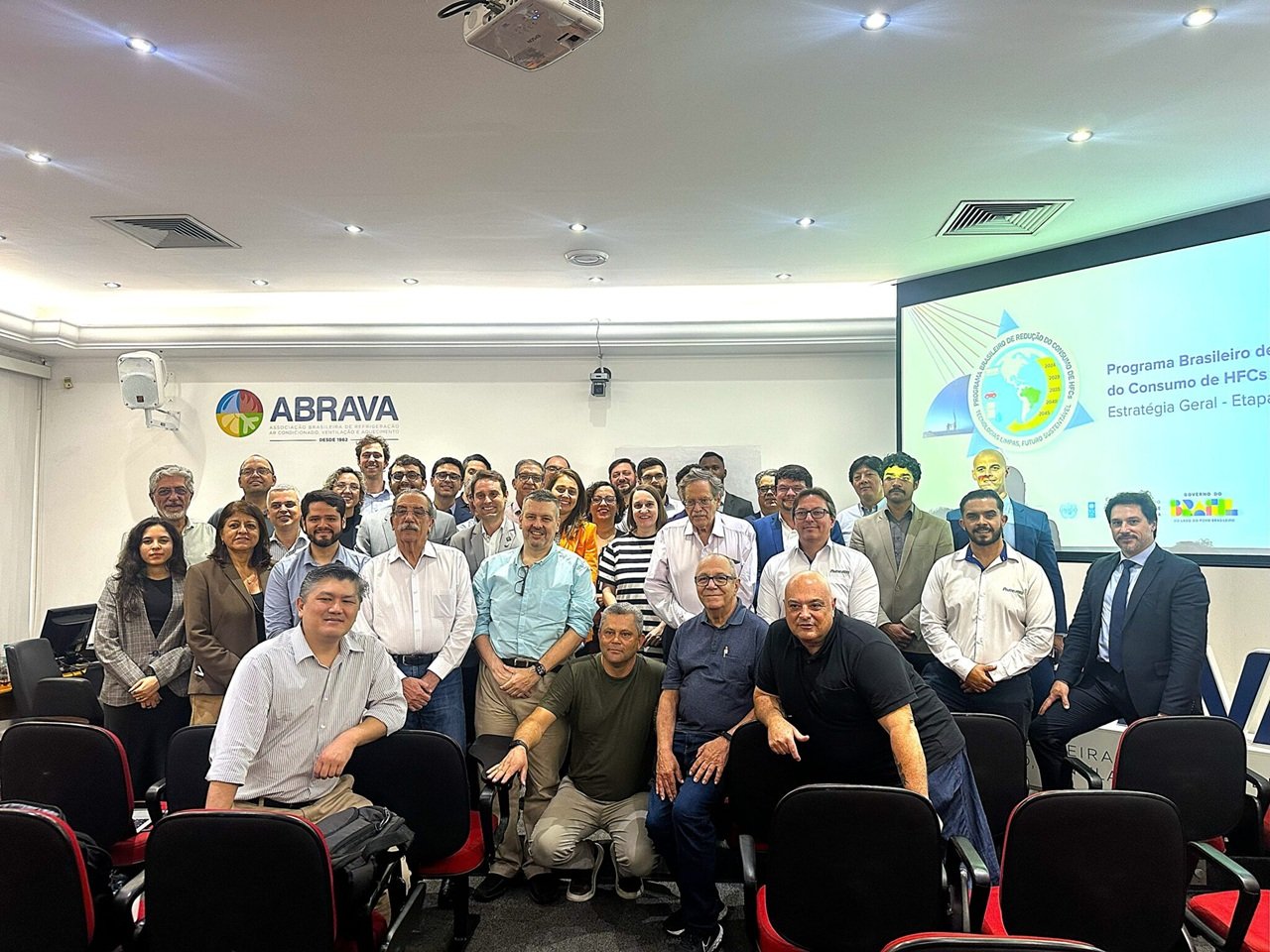
On December 1, Brazil presented the proposed strategy for Stage I of its National HFC Phase-Down Program, reinforcing the country’s commitment to the Kigali Amendment to the Montreal Protocol. The event, held in São Paulo by ABRAVA (Brazilian Association of Refrigeration, Air Conditioning, Ventilation and Heating), was organized by the Ministry of Environment and Climate Change (MMA) in partnership with UNDP, UNIDO and GIZ, and offered both in-person and online participation.
Stage I of the Program will run from 2027 to 2032 and targets a reduction of 7,289,768 metric tons of CO₂ equivalent—equal to 10% of Brazil’s HFC baseline consumption. The strategy includes a gradual phase-down of HFCs, sectoral diagnostics, and support for adoption of low-GWP and energy-efficient technologies across multiple industries.
Key components presented include regulatory actions such as national limits on GWP by equipment type or sector, and the proposed ban of HFC-134a and R-410A in domestic refrigeration and residential air conditioning equipment starting in 2029. The strategy also includes international standard adoption, updated energy labeling regulations, and a dedicated policy for the supermarket sector to promote safe and economically viable use of low-GWP refrigerants.
Technical presentations covered projected HFC consumption trends up to 2035. According to the UNDP, without additional action, consumption could reach 55 million metric tons of CO₂ equivalent, surpassing the 2035 target limit of 51 million. IBAMA also presented current HCFC-22 consumption data and outlined the ongoing public consultation on updated HFC import guidelines.
Plans were also announced for sectoral projects supporting the commercial refrigeration and automotive air conditioning industries, including technician training and demonstration projects using low-GWP refrigerants. UNIDO highlighted work on industrial refrigeration and heat pump systems using natural refrigerants like ammonia. GIZ detailed initiatives under the ongoing HCFC Phase-Out Program and the HFC Program, including training, awareness campaigns, and the launch of a Qualification, Certification and Registration (QCR) system for refrigeration technicians.
“The active participation of different sectors is essential to ensure that public policies reflect real market and societal needs,” said Frank Amorim, technical representative of the MMA.