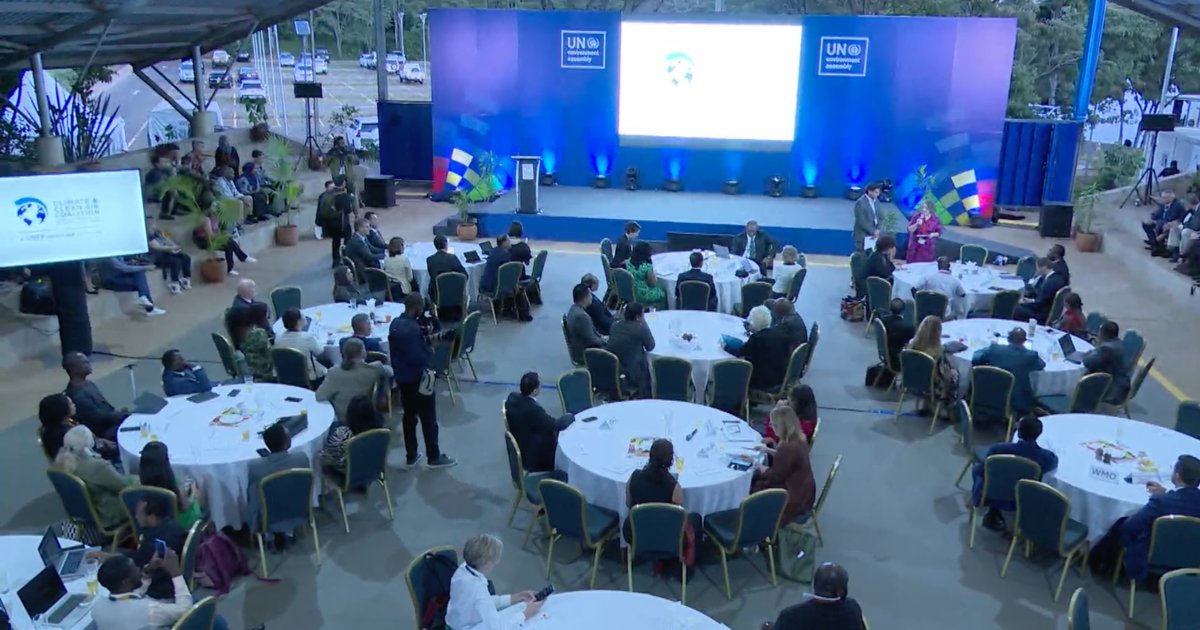
Ministers and non-state leaders of the Climate and Clean Air Coalition (CCAC) gathered in Nairobi during the 7th United Nations Environment Assembly (UNEA-7) for the 2025 Annual Ministerial Meeting. The session reaffirmed the CCAC’s role in accelerating global action on super pollutants to achieve climate, clean air, and sustainable development goals.
The meeting was co-facilitated by Adalberto Maluf, National Secretary of Urban Environment, Water Resources and Environmental Quality, Ministry of Environment and Climate Change of Brazil, and Ruth Davis OBE, Special Representative for Nature, United Kingdom. UNEP Executive Director Inger Andersen opened the session, followed by a presentation from Elliott Harris, former UN Under-Secretary-General and Chief Economist, on early findings from the upcoming Global Economic Assessment of Climate and Clean Air, scheduled for release in 2026.
Ministers reviewed progress on UNEA Resolution 6/10 promoting regional air pollution cooperation and welcomed the launch of the CCAC Super Pollutant Country Action Accelerator. They discussed leveraging the forthcoming Economic Assessment to attract finance and catalyze national action. Early findings suggest that super pollutant mitigation is economically beneficial in both the short and long term and complements CO₂ reduction efforts.
Participants reiterated support for CCAC initiatives such as the Fossil Fuel Regulatory Programme and the Farmers’ Initiative for Resilient and Sustainable Transformations (Farmers’ FIRST). A UK-led statement released at COP30 and signed by 11 countries emphasized drastic methane reductions in the fossil fuel sector through partnerships.
Ministers committed to addressing inefficient cooling equipment with high-global-warming-potential refrigerants and supporting circular economy and waste management strategies. These are backed by the new CCAC cross-sectoral Challenge funding window launched in 2025.
The Super Pollutant Country Action Accelerator, introduced at COP30 with seven initial countries, was highlighted as a key implementation tool. Ministers called for expanding support to reach 30 countries by 2030 and to secure at least USD 150 million for the CCAC Trust Fund. The Accelerator aims to strengthen national capacity, provide technical assistance, and promote leadership on super pollutants.
In 2025, clean air was recognized as a global priority in the G20 Leaders Declaration and the Cape Town Ministerial Declaration on Air Quality, under South Africa’s presidency. Ministers noted that morbidity impacts from air pollution carry significant social and economic costs, adding urgency to coordinated action.
Countries are increasingly integrating super pollutant action into their Nationally Determined Contributions under the Paris Agreement. Ministers emphasized that including specific measures enhances transparency and acknowledges the distinct near-term impacts of these pollutants.
Looking ahead to 2026, the CCAC plans to continue advancing action through the launch of the Global Economic Assessment, an Integrated Assessment on Agriculture and Food Systems, and insights from the CCAC Technology and Economic Assessment Panel. The Coalition aims to accelerate impact through technical assistance, capacity-building platforms, and cross-sectoral challenge programmes.
Source