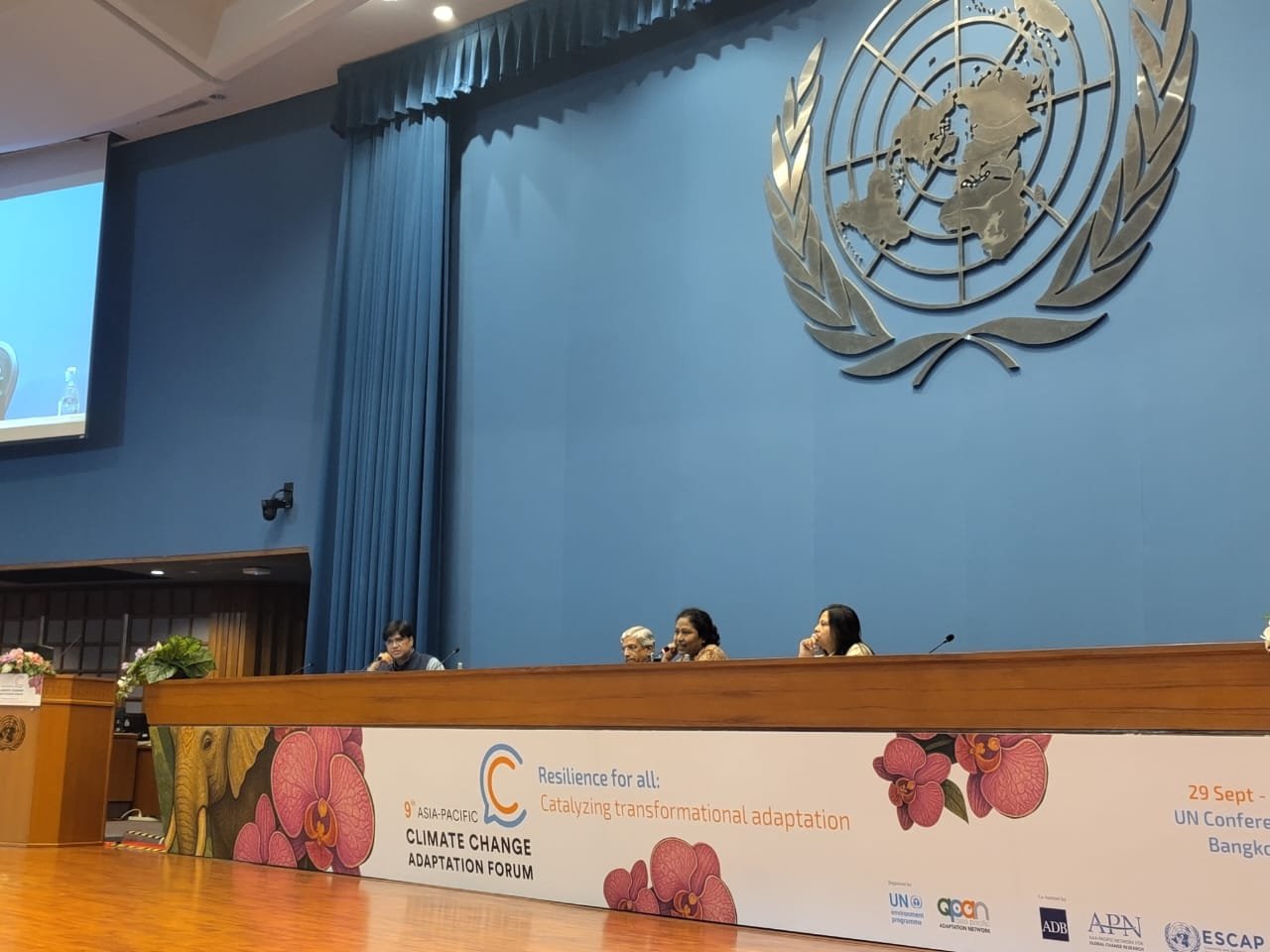
At the 9th Asia-Pacific Climate Change Adaptation Forum, the UNEP Cool Coalition and India’s National Institute of Urban Affairs (NIUA) hosted a session titled “Cities on the Frontline: Insights from India and the region on long-term mitigation of extreme heat in cities.” The event highlighted how national and local governments are addressing extreme urban heat through integrated planning, financing, and inclusive governance.
S. Rakesh Kumar, Joint Secretary at India’s National Disaster Management Authority (NDMA), described the country’s shift from emergency responses to structured heat governance. He cited national advisories, operational guidelines, and access to disaster mitigation funds as enablers for state-level heat action plans and innovative cooling initiatives.
Raman Kumar Singh, Senior Urban Development Specialist at NIUA, emphasized the role of urban planning in climate adaptation. Through the NIUA-GIZ partnership under the Sustainable Urban Development in Smart Cities II (SUDSC II) initiative, several states and cities are adopting integrated spatial planning for disaster risk reduction. Singh noted that resilience is being embedded into routine decision-making, supported by training programs for officials.
Benjamin Hickman, Programme Manager at UNEP India, presented global and regional insights, referencing the Swiss Agency for Development and Cooperation’s BeCool India Project. In Tamil Nadu, heat has been officially recognized as a disaster, enabling new financing avenues. Chennai’s urban master plan now incorporates detailed heat risk mapping and passive cooling strategies.
A panel discussion explored how to operationalize these strategies. Moumita Shaw, Urban and Regional Development Advisor at GIZ India, spoke on the need for socially inclusive planning. She shared work from Telangana and Karnataka under the SUDSC II project, where gender-responsive strategies, green-blue infrastructure, and participatory methods are being used to prioritize vulnerable communities.
Rajesh Sharma, Programme Specialist at UNDP, discussed integrating risk data and early warning systems into city planning to proactively identify heat hotspots and protect high-risk populations. Parimita Mohanty, Senior Programme Manager at UNEP Asia and the Pacific, called for leveraging blended finance approaches. She highlighted options such as affordable housing retrofits and microfinance to expand equitable access to climate resilience funding.
Speakers agreed that mitigating extreme heat requires coordinated action across government levels and sectors. The session underscored the importance of aligning planning, data, community engagement, and finance to build long-term urban resilience.