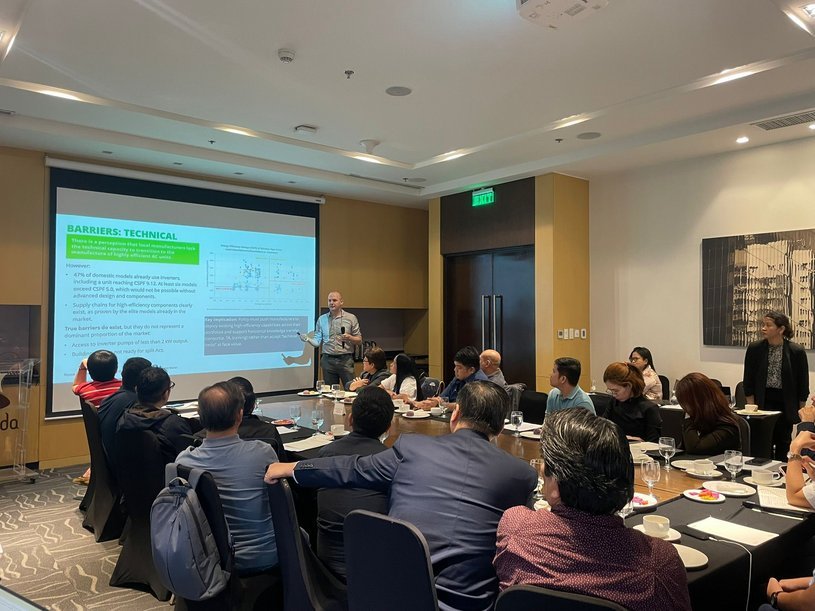
A recent stakeholder consultation under the ACT MEPS project has reinforced efforts to tighten energy standards for air conditioners in the Philippines. The meeting, held on 21 November 2025, highlighted the need for more ambitious minimum energy performance standards (MEPS), stronger enforcement, and improved consumer awareness to support national energy efficiency and climate goals.
The ACT MEPS (Accelerating Air Conditioning Transformation through Enhanced Energy Performance Standards) project is implemented by GIZ and funded by the Clean Cooling Collaborative. It aims to support the Philippines in strengthening MEPS and energy labelling systems for air conditioners in response to increasing demand and emissions from the cooling sector.
At the consultation, organized by the Department of Energy (DOE) and GIZ, the International Institute for Energy Conservation (IIEC) presented findings from a market assessment and industry analysis of the Philippine room AC sector. The study showed that window-type units dominate the market with around 63% of sales, while split-type ACs—more likely to feature energy-efficient inverter technology—are growing in popularity. However, the higher upfront cost of efficient units and limited consumer awareness about long-term energy savings remain key barriers to wider adoption.
An expert from HEAT also presented a roadmap for increasing MEPS, addressing market barriers and recommending steps for implementation. Participants agreed on the need for a phased approach to raise MEPS, supported by clear compliance and enforcement mechanisms.
The meeting emphasized the importance of cross-sector collaboration and improved product information to ensure that stronger MEPS are achievable and contribute effectively to national climate targets.
Source