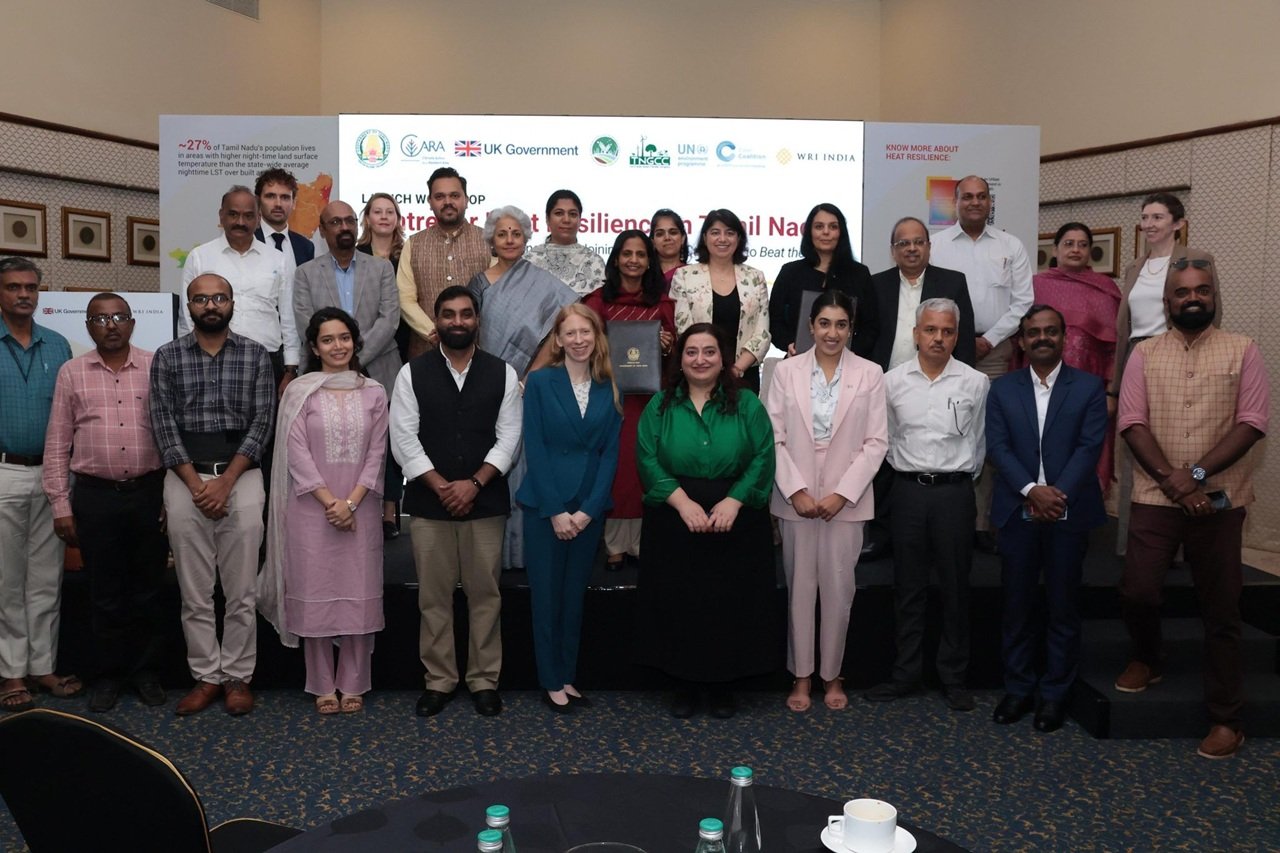
The Government of Tamil Nadu and the UK Government have launched a Heat Resilience Centre to strengthen the state’s capacity to manage rising extreme heat. The initiative is part of the UK’s Climate Action for a Resilient Asia (CARA) programme, in collaboration with the United Nations Environment Programme (UNEP) Cool Coalition and supported by the Swiss Agency for Development and Cooperation (SDC)-funded BeCool project, along with the World Resources Institute (WRI). The programme will continue until September 2026.
A Letter of Intent was signed on 21 November 2025 between the Tamil Nadu Green Climate Company and the UK Government, formally exchanged by Supriya Sahu IAS, Additional Chief Secretary, Environment, Climate Change and Forests Department, and Seema Malhotra MP, Parliamentary Under-Secretary of State, Government of the United Kingdom.
The Heat Resilience Centre will serve as the state’s coordinating body for cross-sectoral heat-risk management. It will establish a governance framework, enhance technical capacity across departments, generate climate data and policy tools, support city and district-level heat action plans, and help develop projects eligible for funding from development banks and climate finance institutions.
Tamil Nadu is now one of the first Indian states to establish a dedicated institutional mechanism to address extreme heat. The state has also joined the global "Beat the Heat Implementation Drive," launched on 11 November 2025 at COP30 in Belém, Brazil, by the Brazil COP30 Presidency and UNEP-led Cool Coalition. Eleven Tamil Nadu cities are part of this initiative, including Chennai, Coimbatore, Madurai, and Tiruchirapalli.
Under the UNEP BeCool project, Tamil Nadu is implementing the Green Schools Initiative in 197 government schools to enhance heat resilience using passive cooling and nature-based solutions. The state is also preparing to mandate minimum passive cooling standards in new buildings and integrate district cooling into local and state development plans.
Dr. Balakrishna Pisupati, Country Head, UNEP India, said, “Tamil Nadu’s leadership role in dealing with climate change, including on extreme heat is laudable. Under the leadership of Department of Environment, Climate Change and Forests, UNEP is pleased to collaborate with the Department on climate adaptation and mitigation as well as a number of issues related to environmental management.”
Supriya Sahu IAS stated, “Accurate heat maps and clearly defined heat-risk zones should be an essential foundation for climate readiness in the State… Every urban plan in Tamil Nadu must speak the language of heat resilience.”
UK Minister for the Indo-Pacific, Seema Malhotra MP, added, “The UK is proud to partner with Tamil Nadu in this pioneering effort. The state has already demonstrated visionary leadership being the first Indian state to establish a Green Climate Fund and recognise heatwaves as a state-specific disaster.”
Source