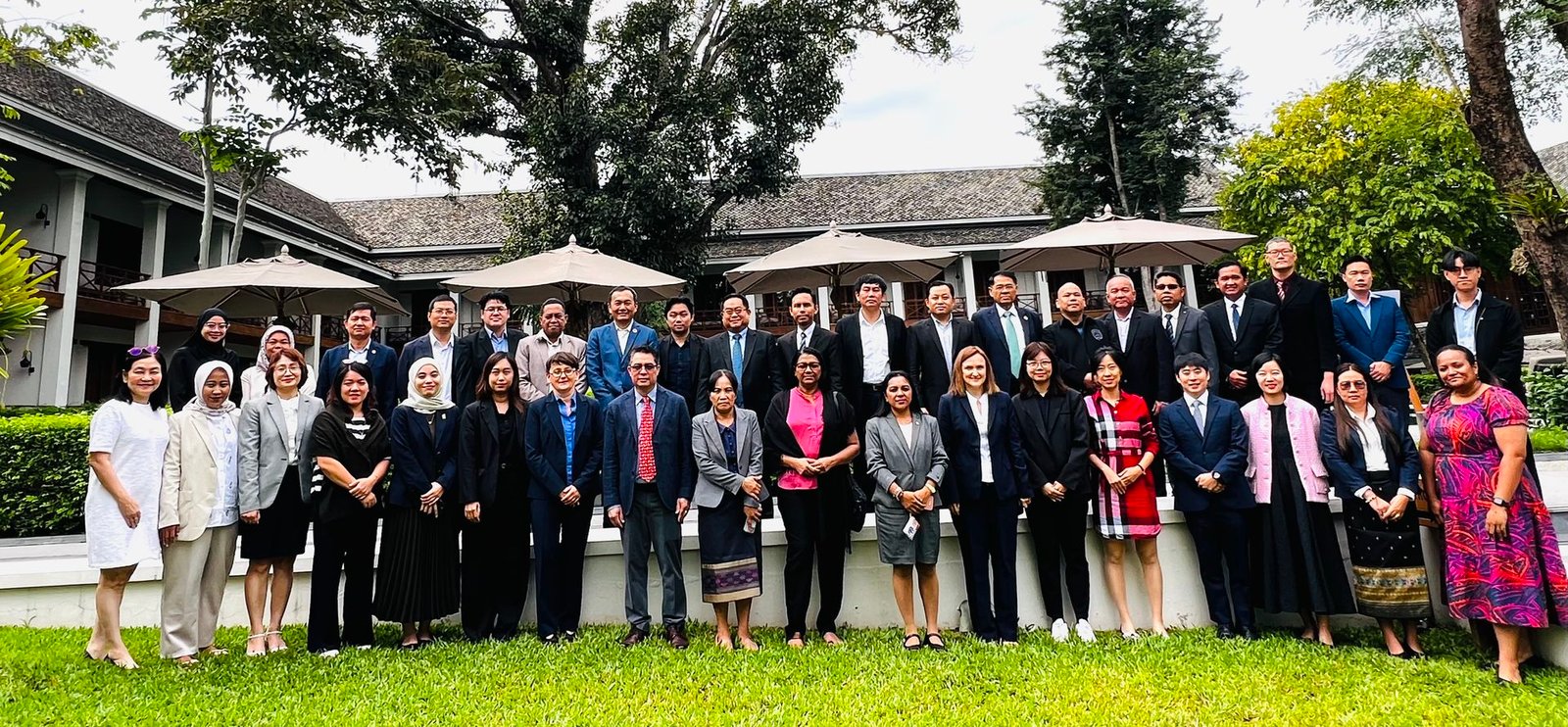
National Ozone Officers (NOOs) from Southeast Asia, together with Customs authorities, partner agencies and international organizations, met in Lao PDR on 16–19 December 2025 for the Network Meeting of Southeast Asia National Ozone Officers, held back-to-back with a Twinning National Ozone Officer–Customs Workshop on trade control enforcement under the Montreal Protocol. The events were jointly organized by the Ministry of Agriculture and Environment of Lao People’s Democratic Republic and the UNEP OzonAction Compliance Assistance Programme (CAP) in Asia and the Pacific, with support from the Multilateral Fund for the Implementation of the Montreal Protocol. Organizers reported 58 participants (30 women and 28 men), including 18 who joined online.
According to the organizers, the meetings aimed to help countries share experiences, review recent developments under the Montreal Protocol and the Kigali Amendment, and strengthen institutional and technical capacity of National Ozone Units, including on mobile air-conditioning and national inventories of used and unwanted controlled substances. The Network Meeting opened with remarks from UNEP OzonAction, the Ozone Secretariat, the Multilateral Fund Secretariat, and the Department of Environment of Lao PDR, with discussions covering compliance with hydrochlorofluorocarbon (HCFC) phase-out obligations and preparation for the accelerated hydrofluorocarbon (HFC) phase-down under the Kigali Amendment.
Participants also received updates on outcomes and decisions from recent Montreal Protocol-related meetings, including the 37th Meeting of the Parties and the 96th and 97th Meetings of the Executive Committee, as well as issues expected at upcoming Implementation Committee and Open-ended Working Group meetings. Emerging topics discussed included atmospheric monitoring initiatives, verification requirements for HFC consumption under Kigali Implementation Plans, and new funding windows related to life-cycle refrigerant management and energy efficiency.
Technical sessions focused on national implementation of HCFC Phase-out Management Plans and Kigali HFC Implementation Plans, including competency-based training and certification of refrigeration and air-conditioning technicians and the revision of a curriculum for servicing mobile air-conditioning systems in electric vehicles. H.E. Pak Sokharavuth, Under Secretary of State, Ministry of Environment of Cambodia stated that, “Training modules in Cambodia have focused mainly on traditional MAC systems, as knowledge and experience related to electric vehicles remain limited. He highlighted that a key challenge is the lack of national expertise in electric vehicle air conditioner service maintenance and emphasized the need for targeted training to address this skill gap among electric vehicle air-conditioning technicians.”
The Network Meeting also addressed preparation of national inventories of banks of used and unwanted controlled substances and how inventory data could be translated into national action plans for life-cycle refrigerant management, including prevention and leak reduction, recovery and recycling, reclamation and reuse, and environmentally sound disposal. Organizers said discussions highlighted engaging stakeholders such as waste management authorities and Basel Convention Focal Points and Competent Authorities, and UNEP presented CAP services for 2025 and brainstormed potential services for 2026.
In the Twinning NOO–Customs Workshop, participants reviewed risk-profiling methodologies and criteria for identifying high-risk shipments of ozone-depleting substances (ODS) and HFCs, using practices and tools referenced from the World Customs Organization, and discussed reconciliation between importing and exporting country data. The workshop also reviewed developments under the ASEAN Harmonized Tariff Nomenclature, including updates under AHTN2028, and options such as national sub-codes or mandatory data fields to improve tracking. Mr. Mohammad Ali Wafee Bin Zainee, National Ozone Officer of Brunei Darussalam, stated that, “The twinning workshop allowed us to understand the upcoming AHTN2028. There is a need for countries to explore national mechanisms to track trade statistics of HFCs and blends to ensure accurate data analysis, such as additional internal reclassification.”