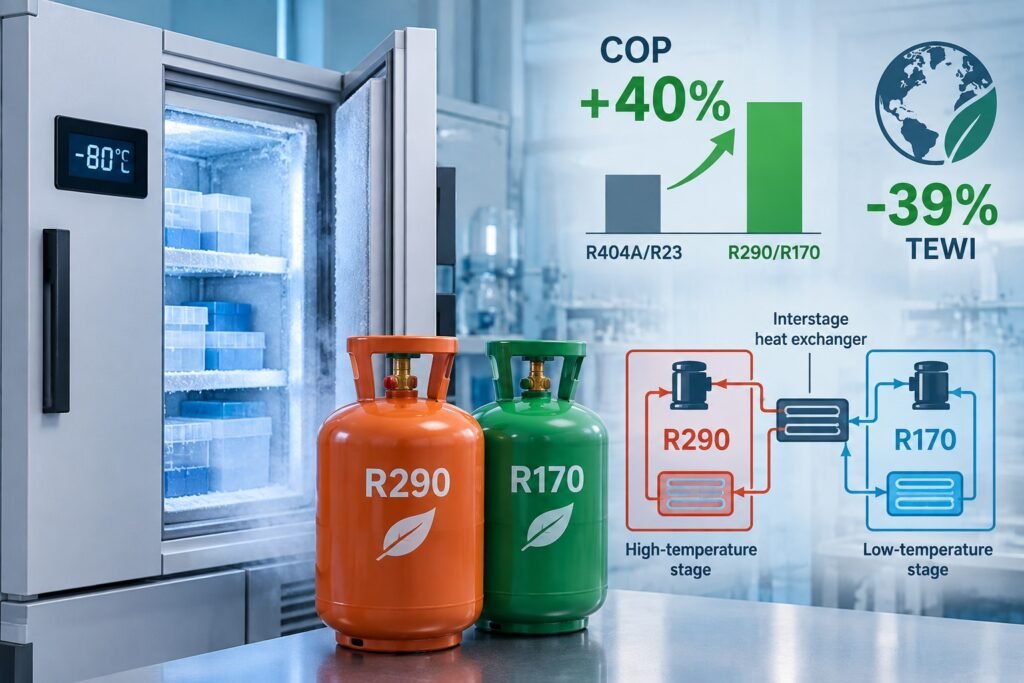
Researchers experimentally evaluated a two-stage cascade refrigeration cycle using R290 in the high-temperature stage and R170 in the low-temperature stage for ultra-low-temperature operation at −80 °C and −70 °C. The natural refrigerant pair was compared with conventional R404A/R23 under identical operating conditions and at condensation temperatures of 25 °C, 28 °C and 31 °C.
The R290/R170 configuration achieved COP improvements of up to 40% compared with R404A/R23. It also provided higher cooling capacity while operating with a lower refrigerant mass flow rate. The tested cascade cycle incorporated internal heat exchangers in both stages.
The environmental assessment, based on the Total Equivalent Warming Impact (TEWI) methodology, showed a 39% reduction in equivalent CO2 emissions for the natural-refrigerant system. R290 and R170 were evaluated as very low-GWP alternatives to the conventional refrigerant pair.
The experiments also identified the low-temperature-stage expansion valve inlet as a critical safety point because of extremely low material temperatures. To address this issue, the researchers proposed an interstage heat exchanger connecting the high-temperature-stage liquid line with the low-temperature-stage vapor line. The configuration also ensures an adequate compressor suction temperature for proper lubrication.
The interstage configuration kept the identified high-risk points within safe operating temperatures while maintaining comparable system performance. Its maximum COP reduction was 6.5% compared with the tested configuration without this safety modification.