Esta página solo está disponible en inglés. Ir a la portada en español

×

Questa pagina è disponibile solo in inglese. Home page in italiano

×

Diese Seite ist nur auf Englisch verfügbar. Zur deutschen Startseite

×

Cette page est disponible uniquement en anglais. Aller à la page d'accueil en français

×

UNEP OzonAction Highlights Energy Efficiency and Sustainable Cooling

The SCOOP editions detail efficiency gains, low-GWP refrigerants and cooling strategies across cold chains and data centres.

UNEP OzonAction Highlights Energy Efficiency and Sustainable Cooling

UNEP OzonAction has published three October 2026 editions of its SCOOP newsletter, addressing energy efficiency in refrigeration and cooling, sustainable food cold chains, and data centre cooling. The publications examine how the Montreal Protocol and its Kigali Amendment support the transition to lower-global-warming-potential (GWP) refrigerants alongside improvements in cooling system efficiency.

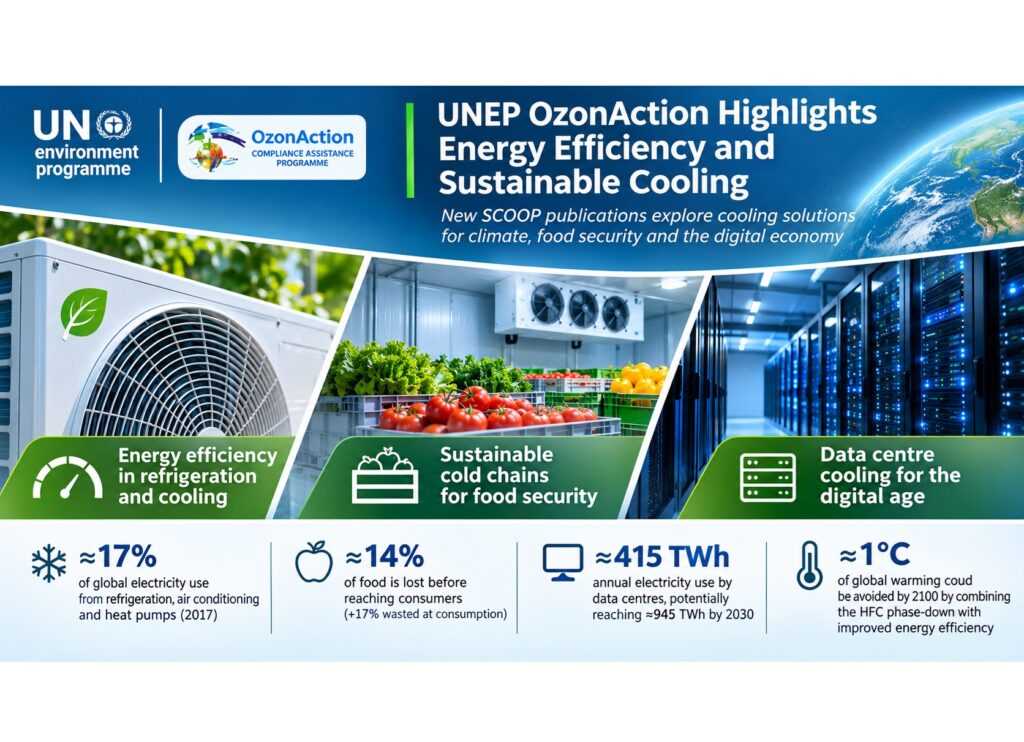
According to OzonAction, refrigeration, air conditioning and heat pump equipment accounted for approximately 17% of global electricity consumption in 2017. More than 80% of the sector’s climate impact came from electricity generation rather than refrigerants. The newsletter also reports that outdated appliances and equipment use approximately 40% more electricity than newer models employing energy-efficient technologies and low-GWP refrigerants.

Food cold chains are another focus. Approximately 14% of food produced globally is lost before reaching consumers, while a further 17% is wasted during consumption stages. Cold chains account for approximately 4% of global greenhouse gas emissions, including emissions associated with refrigerants, energy consumption and spoiled food. OzonAction identifies energy-efficient equipment, zero-ozone-depletion-potential refrigerants, low-GWP alternatives and improved logistics as measures for developing sustainable cold chains.

For data centres, the publications cite annual electricity consumption of approximately 415 TWh, with demand potentially reaching 945 TWh by 2030. Cooling technologies discussed include computer room air conditioners, chillers, cooling towers, direct-to-chip cooling and two-phase liquid cooling. According to the data centre edition, liquid cooling can reduce whole-site energy consumption by approximately 15% compared with air cooling. Other approaches include hot aisle/cold aisle configurations, variable-speed drives, waste heat recovery and refrigerants with lower GWP.

The publications also emphasize the Kigali Amendment, adopted in 2016 to progressively phase down hydrofluorocarbons (HFCs). UNEP OzonAction reports that combining HFC phase-down with improved energy efficiency could nearly double the climate benefits of the amendment, potentially avoiding approximately 1°C of global warming by the end of the century.

Get the daily refrigeration briefing

One email a day. Trusted by 3,000+ RACHP professionals.

More on Cold Chain

All on Cold Chain →

Insights

Secop's Solar Direct Drive (SDD) System Earns WHO PQS Approval – The Team Behind It
Article

Secop’s Solar Direct Drive (SDD) System Earns WHO PQS Approval – The Team Behind It

Partner's material In March 2026, Secop’s Solar Direct Drive Power Management Module was granted WHO PQS prequalification and officially listed in the WHO Catalogue of Prequalified Immunization Devices. The WHO IMD-PQS (Immunization Devices Performance, Quality and Safety programme) is the global benchmark for cold chain equipment used in immunisation. Being listed in its catalogue is

22 Jun 2026
Case Study - Effect of Louvers or diffusers on air flow distribution and cooling time on a meat log during Chill cycle
Tech Guide

Case Study – Effect of Louvers or diffusers on air flow distribution and cooling time on a meat log during Chill cycle

By Kushal Aurangabadkar An experimental analysis was conducted on a cooler space measuring 3.66 m × 6.096 m (12.0 ft × 20.0 ft), equipped with an ammonia refrigeration coil, five 30 cm (12 in.) fans, and five diffusers. The study measured airflow patterns, cooling rates, and heat transfer efficiency in meat storage by testing two configurations:

Kushal Aurangabadkar · 21 Jan 2026
Total Cost of Ownership (TCO) for Modular Refrigeration Systems in Life Sciences Distribution Centers
Tech Guide

Total Cost of Ownership (TCO) for Modular Refrigeration Systems in Life Sciences Distribution Centers

by Ramez Naguib, P.E. Introduction Life sciences distribution centers are under immense pressure to deliver consistent temperature control, comply with increasingly stringent regulations, and optimize operational efficiency. Traditional built-up refrigeration systems often prove cumbersome, costly, and slow to implement. In contrast, modular, factory-assembled refrigeration systems have emerged as a compelling alternative. Drawing on lessons from

Ramez Naguib · 14 Jan 2026
Everything on Cold Chain: 2,059 articles, 2 case studies, 23 insights

Most read this month

All news →