Esta página solo está disponible en inglés. Ir a la portada en español

×

Questa pagina è disponibile solo in inglese. Home page in italiano

×

Diese Seite ist nur auf Englisch verfügbar. Zur deutschen Startseite

×

Cette page est disponible uniquement en anglais. Aller à la page d'accueil en français

×

Carrier Highlights Societal and Environmental Benefits of the Sustainable Cold Chain at United Nations Meeting of the Montréal Protocol

Carrier Highlights Societal and Environmental Benefits of the Sustainable Cold Chain at United Nations Meeting of the Montréal Protocol

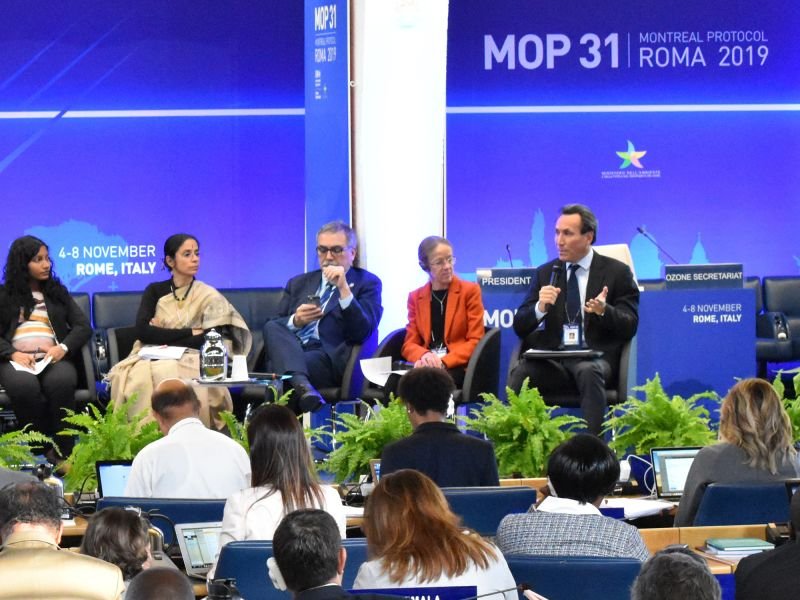
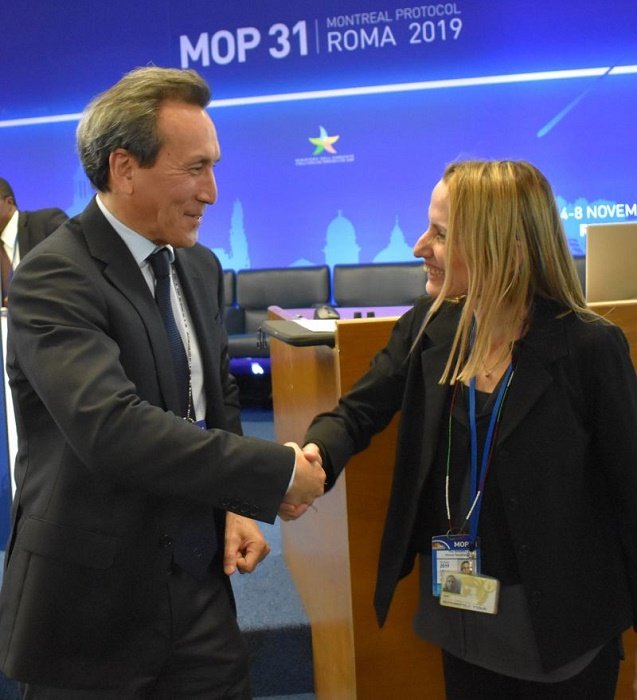
Carrier Transicold & Refrigeration Systems President David Appel discussed the sustainable cold chain and how it can cut food loss and waste, during a roundtable session in front of nearly 200 member nations at the 31st Meeting of the Parties of the Montréal Protocol on Nov. 7.

The roundtable, which focused on food loss and waste, took place at the United Nations Food and Agriculture Organization headquarters in Rome, Italy, and included Ministers of Environment for several nations, senior representatives from the United Nations Environment Programme, the World Resource Institute and a leading produce grower / distributor. Appel, on behalf of Carrier, provided the industry perspective on how refrigeration is a critical partner in reducing food loss.

“There is a clear connection between food waste and climate change,” said Appel. “In fact, if food waste were a country, it would be the third largest emitter of greenhouse gas emissions after China and the U.S. Additionally, more than 50% of all perishable food waste today could be avoided by simply using cold chain technology. Yet, only 15% of perishable food produced worldwide is actually refrigerated.”

During the session, Appel discussed how a sustainable cold chain can:

  • Reduce food losses and help feed more people
  • Reduce greenhouse gas emissions associated with production and supply of food
  • Improve food safety and quality by connecting consumers and producers much more effectively

In addition, he explained how technology exists today, which can be accessible in an affordable way to strengthen cold chains and in turn help people and the planet, even in the most challenging environments.

Carrier was among roundtable participants that signed the “Rome Declaration on the Contribution of the Montréal Protocol to Food Loss Reduction through Sustainable Cold Chain Development.” The declaration stresses the importance of pursuing international cooperation and promoting the exchange of information on the contribution of the cold chain to sustainable development. 
“Carrier is proud to play an important role in helping to preserve, protect and extend the world’s food and pharmaceuticals supply,” Appel said.
Get the daily refrigeration briefing

One email a day. Trusted by 3,000+ RACHP professionals.

Related news

Most read this month

All news →

Related insights

Article

Secop’s Solar Direct Drive (SDD) System Earns WHO PQS Approval – The Team Behind It

Partner's material In March 2026, Secop’s Solar Direct Drive Power Management Module was granted WHO PQS prequalification and officially listed in the WHO Catalogue of Prequalified Immunization Devices. The WHO IMD-PQS (Immunization Devices Performance, Quality and Safety programme) is the global benchmark for cold chain equipment used in immunisation. Being listed in its catalogue is

22 Jun 2026
Tech Guide

Case Study – Effect of Louvers or diffusers on air flow distribution and cooling time on a meat log during Chill cycle

By Kushal Aurangabadkar An experimental analysis was conducted on a cooler space measuring 3.66 m × 6.096 m (12.0 ft × 20.0 ft), equipped with an ammonia refrigeration coil, five 30 cm (12 in.) fans, and five diffusers. The study measured airflow patterns, cooling rates, and heat transfer efficiency in meat storage by testing two configurations:

Kushal Aurangabadkar · 21 Jan 2026
Tech Guide

Total Cost of Ownership (TCO) for Modular Refrigeration Systems in Life Sciences Distribution Centers

by Ramez Naguib, P.E. Introduction Life sciences distribution centers are under immense pressure to deliver consistent temperature control, comply with increasingly stringent regulations, and optimize operational efficiency. Traditional built-up refrigeration systems often prove cumbersome, costly, and slow to implement. In contrast, modular, factory-assembled refrigeration systems have emerged as a compelling alternative. Drawing on lessons from

14 Jan 2026