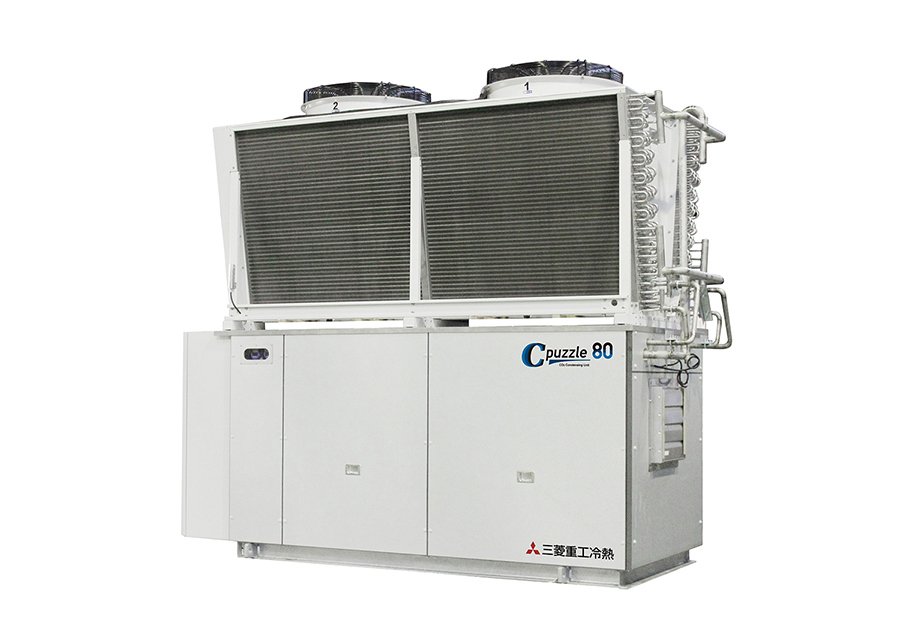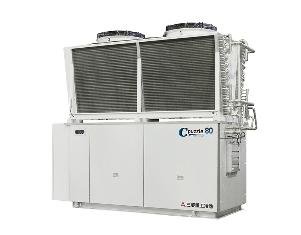
Mitsubishi Heavy Industries Air-Conditioning and Refrigeration Corporation (MHI-AC&R), a Group company of Mitsubishi Heavy Industries, Ltd. (MHI), has developed a large-capacity 80 horsepower (HP) model to add to its series of “C-puzzle” fluorocarbon-free commercial refrigeration condensing units that use R744, a natural refrigerant of carbon dioxide (CO2). The new model responds to increasing demand for larger-capacity refrigeration system that use natural refrigerants, especially for food refrigeration applications such as cold storage facilities. The new 80HP model C-puzzle realizes environmental load reduction initiatives through energy saving and using the natural refrigerant. It is scheduled to go on sale in the domestic market in summer 2021. (Domestic sales only)
The 80HP model C-puzzle will complement the 10HP model (HCCV1001) and 20HP model (HCCV2001M) launched since 2017 and the 40HP model added to the C-puzzle series in 2020. Introduction of the 80HP model will not only respond to rising demand for larger-capacity refrigeration systems, but also expand the range of applications beyond refrigerated storage to further include food freezing and ice making.
As with earlier models in the C-puzzle series, the new 80HP model is equipped with a proprietary two-stage compressor integrating a scroll compressor and a rotary compressor developed and manufactured by MHI Thermal Systems*1. The scroll compressor delivers superlative efficiency under heavy loads, while the rotary compressor offers outstanding efficiency with lighter loads. Together, they result in higher efficiency and noise reduction through the entire operating range. In addition, integrated compact design of the gas cooler and the compressor unit helps to reduce plumbing, thus making the new unit suitable to diverse locations.
The refrigerant used in the C-puzzle is R744, a natural refrigerant of carbon dioxide (CO2) and an ozone depletion potential (ODP) of its refrigerant is zero and global warming potential (GWP) is only 1. As a result, the environmental impact is very low, making a significant contribution to the prevention of global warning. In Japan, low-GWP refrigeration systems are mandated under the Act on Rational Use and Proper Management of Fluorocarbons enacted in April 2015. Globally, with effectuation in January 2019 of the Kigali Amendment to the Montreal Protocol on Substances that Deplete the Ozone Layer*2, coupled with enactment of the Revised Ozone Layer Protection Law, phasing down of production and usage of hydrofluorocarbons (HFCs) is now mandatory, part of intensifying moves to prevent climate change.
Today the adoption of natural refrigerants in the refrigeration and food freezing markets lags at around 30%, and in response moves are accelerating toward adopting natural refrigerants in the domestic market for low-temperature systems. Business expansion is anticipated from growing demand for use not only in new systems but also for upgrades of existing units currently using fluorocarbon refrigerants.
Going forward, MHI-AC&R will continue to focus on expanding and improving its offerings of energy saving products that use low-GWP refrigerants, as its way of promoting adoption of natural refrigerants in the refrigeration market and thereby contributing to protection of the global environment.
*1 MHI Thermal Systems’ two-stage compressor adopts the world’s first technologies (patented) enabling outstanding efficiency even with high-pressure refrigerants.
*2 Formally known as the “Act on Rational Use and Proper Management of Fluorocarbons,” this is a totally revised update, carried out in April 2015, to the original Fluorocarbons Recovery and Destruction Law enacted in 2001. Under this new legislation, commercial refrigeration condensing units and stationary refrigeration units with a refrigeration capacity exceeding 1.5 kilowatt (kW) (approx. 2HP) are required by 2025 to adopt refrigerants with a GWP below 1500 (CO2=1).