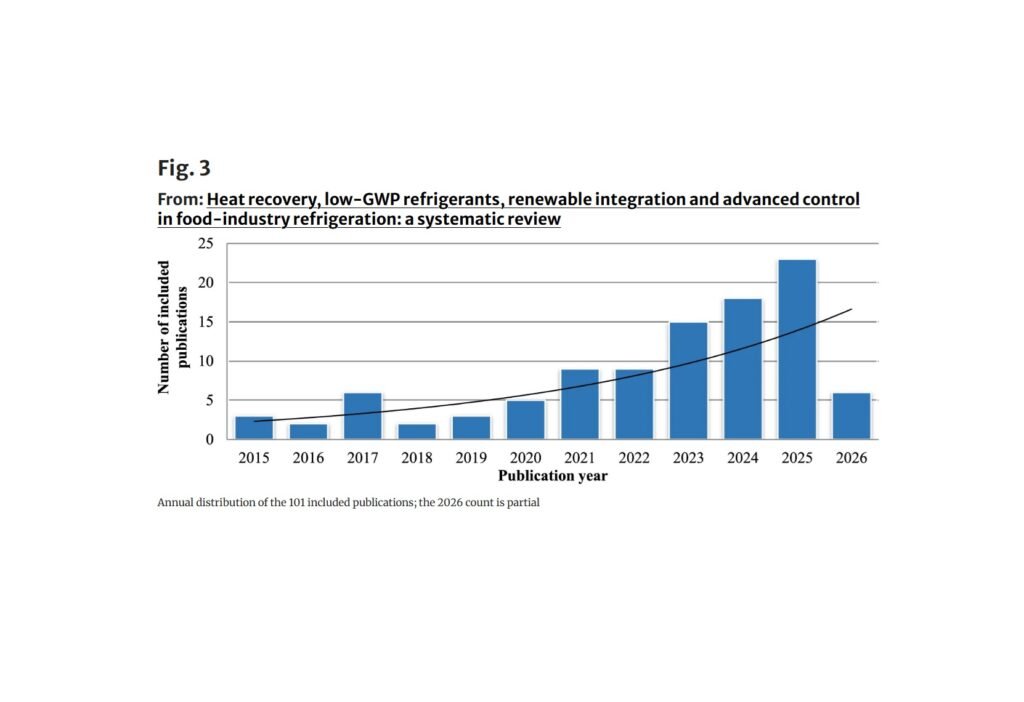
A systematic review of 101 peer-reviewed publications has identified a lack of integrated, field-validated studies combining low-GWP refrigerants, heat recovery, renewable energy and advanced control in food-industry refrigeration. Published on 26 October 2026 in the International Journal of Air-Conditioning and Refrigeration, the review was conducted by Alexandru Panait, Răzvan Calotă and Alina Girip. It examined research published between 2015 and April 2026.
The researchers analysed four overlapping areas: heat recovery, energy efficiency and low-GWP refrigerants, renewable energy integration, and modelling and control. Of the 101 publications, 88 addressed energy efficiency and refrigerants, 70 examined modelling and control, 39 covered heat recovery, and 21 investigated renewable energy. Only two studies covered all four areas, and neither provided a full-year, stage-resolved field demonstration at an operating food-industry installation.
The review found that refrigerant replacement can produce different efficiency outcomes depending on system configuration and operating conditions. For example, R455A increased average coefficient of performance (COP) by 4.3% compared with R404A in one variable-speed laboratory system, while compressor discharge temperatures reached 130 °C (266 °F). Studies of R449A reported outcomes ranging from a 3.6% COP reduction in a field retrofit to improvements of 5–10% in other configurations.
Heat-recovery studies also demonstrated trade-offs between useful thermal output and compressor electricity consumption. The researchers highlighted the need to measure heat recovered separately from desuperheating, condensation and subcooling, and to match the available temperatures with food-processing requirements. Renewable-energy studies indicated that refrigeration efficiency improvements should be considered before sizing photovoltaic systems and thermal storage.
Only 12 publications reported measurements from field, operating or pilot installations, while 34 explicitly documented measurement uncertainty or quantitative model error. The authors recommend full-year industrial demonstrations combining refrigerant substitution, staged heat recovery, renewable energy, storage and supervisory control. These installations should be assessed against measured baselines using energy, economic, environmental and operational indicators, while maintaining food-temperature and equipment-safety requirements.