Esta página solo está disponible en inglés. Ir a la portada en español

×

Questa pagina è disponibile solo in inglese. Home page in italiano

×

Diese Seite ist nur auf Englisch verfügbar. Zur deutschen Startseite

×

Cette page est disponible uniquement en anglais. Aller à la page d'accueil en français

×

Carrier Transicold NEOS 100 System Selected By Petit Forestier For Zero Emission All-Electric Vans

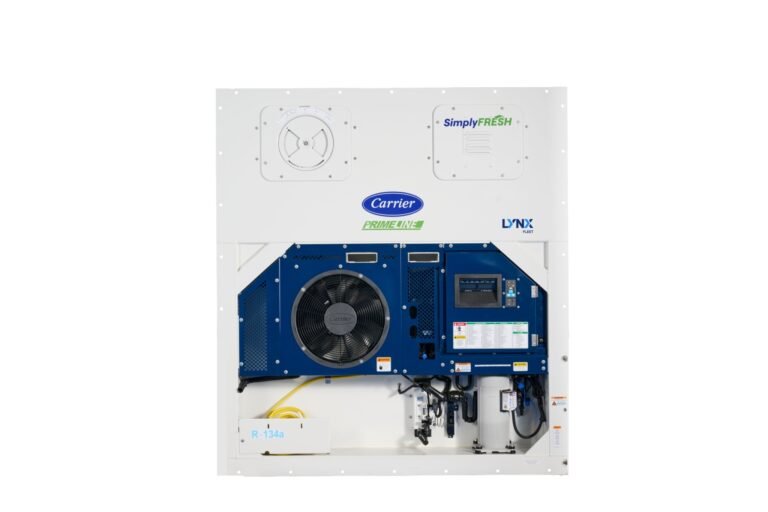
Rental specialist, Petit Forestier, has chosen Carrier Transicold’s ultra-slim NEOS 100 system as the refrigeration unit for five new all-electric Renault Kangoo vans.

The new car-derived refrigerated vans equipped with the all-electric NEOS 100 systems support Petit Forestier’s plans for commercially viable solutions to adhere to the UK’s tightening emissions legislation, as well as showcase the company’s approach to addressing environmental concerns within the industry.

“The all-electric NEOS refrigeration system is the ideal choice for helping us create a genuine zero-emissions electric vehicle with enough range to carry out most urban delivery operations,” said Pat Skelly, managing director, Petit Forestier. “The NEOS system also uses a refrigerant with a lower global warming potential (GWP), requiring a smaller charge and exceptional containment.

The roof-mounted, 12-volt NEOS 100 unit is simple to maintain. Its monoblock construction comes pre-charged from the factory with less than 1kg of R134a refrigerant, which has a GWP of 1,430 – which is a 50 per cent lower GWP than R452a and 174 per cent lower than R404a, the two main refrigerants used in the refrigerated transport industry.

The unit’s design avoids the need for assembly in the field and the use of open road compressors, which can both increase the risk of gas leakage in operation. The NEOS system also features an ultra-slim profile, helping to improve vehicle aerodynamics and thus range of use.

“Using a standalone power source for the NEOS units provides up to seven hours of cooling power – depending on the use and application of the vehicle – and a range of around 110 miles,” continues Skelly. “If we were relying on the vehicle batteries to drive both the van and the fridge, the range plummets to just 60 miles – which wouldn’t be sufficient for many applications.

“We want to be at the forefront of more eco-aware refrigerated transport,” Skelly said. “This is just one of a number of steps we’re taking to position Petit Forestier as early adopters of realistic alternatives to fossil fuels that will help tackle the toxic emissions in our cities. Carrier Transicold and Perpetual’s support in making this project a reality has been tremendous. They understand the challenges and want to help us make a real impact.

Get the daily refrigeration briefing

One email a day. Trusted by 3,000+ RACHP professionals.

More on Cold Chain

All on Cold Chain →

Insights

Secop's Solar Direct Drive (SDD) System Earns WHO PQS Approval – The Team Behind It
Article

Secop’s Solar Direct Drive (SDD) System Earns WHO PQS Approval – The Team Behind It

Partner's material In March 2026, Secop’s Solar Direct Drive Power Management Module was granted WHO PQS prequalification and officially listed in the WHO Catalogue of Prequalified Immunization Devices. The WHO IMD-PQS (Immunization Devices Performance, Quality and Safety programme) is the global benchmark for cold chain equipment used in immunisation. Being listed in its catalogue is

22 Jun 2026
Case Study - Effect of Louvers or diffusers on air flow distribution and cooling time on a meat log during Chill cycle
Tech Guide

Case Study – Effect of Louvers or diffusers on air flow distribution and cooling time on a meat log during Chill cycle

By Kushal Aurangabadkar An experimental analysis was conducted on a cooler space measuring 3.66 m × 6.096 m (12.0 ft × 20.0 ft), equipped with an ammonia refrigeration coil, five 30 cm (12 in.) fans, and five diffusers. The study measured airflow patterns, cooling rates, and heat transfer efficiency in meat storage by testing two configurations:

Kushal Aurangabadkar · 21 Jan 2026
Total Cost of Ownership (TCO) for Modular Refrigeration Systems in Life Sciences Distribution Centers
Tech Guide

Total Cost of Ownership (TCO) for Modular Refrigeration Systems in Life Sciences Distribution Centers

by Ramez Naguib, P.E. Introduction Life sciences distribution centers are under immense pressure to deliver consistent temperature control, comply with increasingly stringent regulations, and optimize operational efficiency. Traditional built-up refrigeration systems often prove cumbersome, costly, and slow to implement. In contrast, modular, factory-assembled refrigeration systems have emerged as a compelling alternative. Drawing on lessons from

Ramez Naguib · 14 Jan 2026
Everything on Cold Chain: 2,057 articles, 2 case studies, 23 insights

Most read this month

All news →