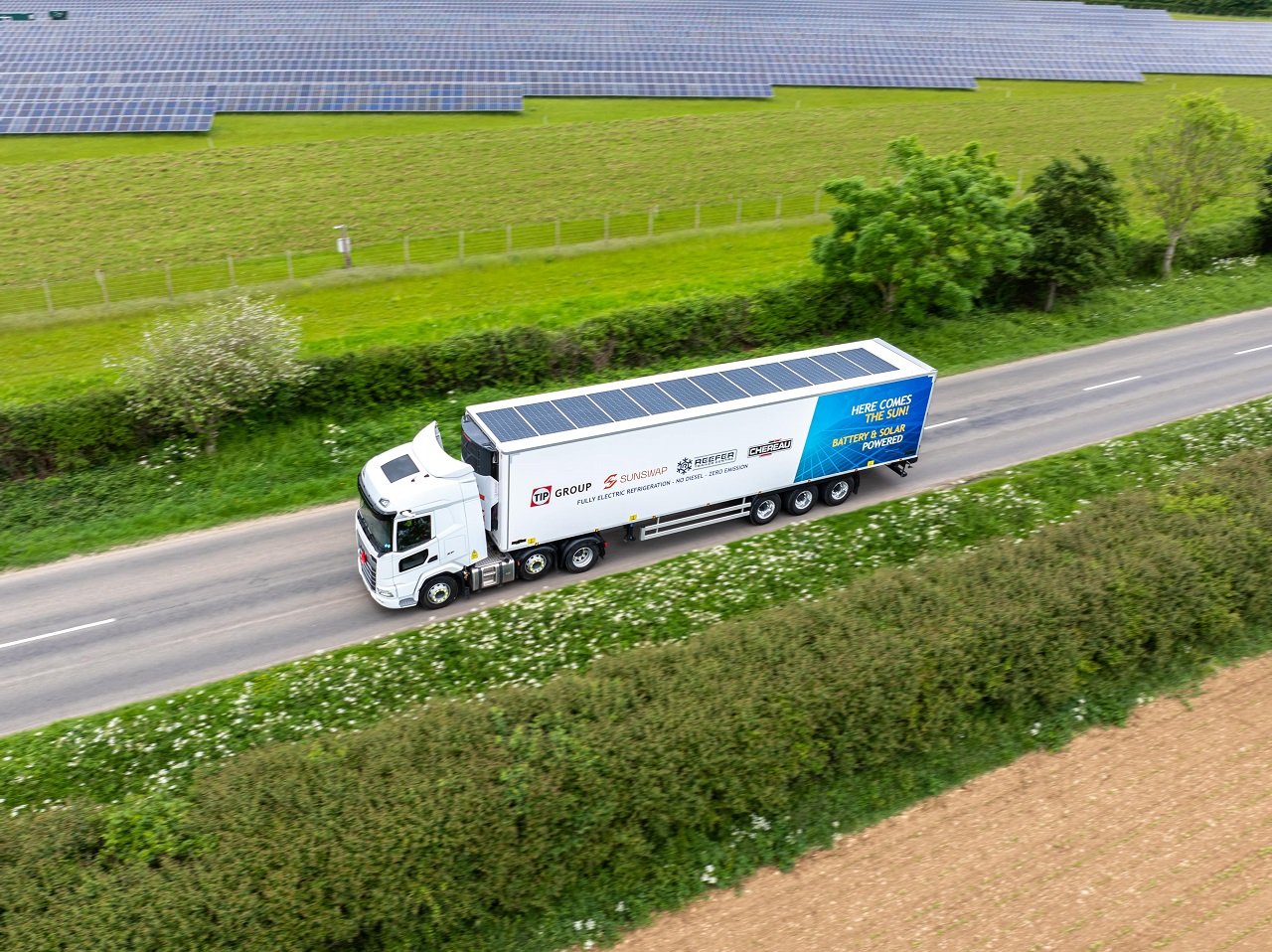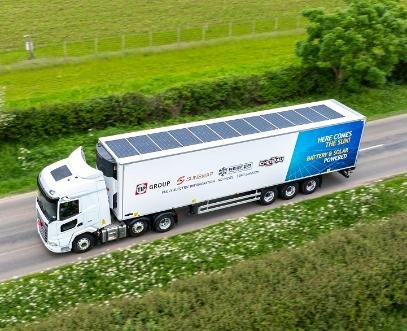
TIP has furthered its drive to decarbonisation with the 12-month trial in the UK of a zero-emission, battery and solar-powered transport refrigeration unit (TRU) fitted to one of its reefer trailers.
Named ‘Endurance’ and designed and manufactured by Sunswap, the UK-based ‘clean-tech’ business, this innovative development sees solar panels fitted to the roof of the trailer which, in combination with a first-of-its-kind modular battery and highly energy-efficient system, provides an emission free solution to power the trailer’s refrigeration unit.
Whilst the TRU is ‘trailer agnostic’, it is fitted to a Chereau manufactured reefer that has had its specification optimised for efficiency, courtesy of Chereau UK distributor Reefer Trailer Centre, in order to enhance the performance of the unique TRU technology. Adaptations include the installation of innovative Vacuum Insulation Panels (VIP), the use of HFO Foam and of half-width sliding bulkheads, for temperature-controlling a smaller area when transporting a partial load. A switch is also fitted to the rear door which turns off the evaporator when the door is opened so that energy is not lost, whilst a solid front evaporator protector prevents any waste or product getting into it, thus limiting its functionality.
The trailer will operate as part of the fleet of a TIP customer on UK roads over a significant period, with the objective being to establish that the zero emission TRU functions at least as effectively as if powered by diesel, without detriment to the transport operation it is assigned to. That includes no incremental operational ‘downtime’ being needed for re-charging purposes.
The TRU is connected to the cloud and capable of collecting thousands of data points in real-time to ensure fridge components are kept within optimised operating parameters to maximise performance and efficiency.
This intelligent use of data generated from the trailer’s operation, together with a unique approach to battery capacity, tailoring it to the operator’s journey requirements, alongside utilisation of solar panels, is expected to facilitate an uninterrupted operation. If required, mains re-charging between operations is available. Throughout the trial, TIP will be receiving regular ‘performance’ reports from Sunswap’s suite of analytics products.
Previous trials of the low voltage (a health and safety bonus), low maintenance system in Europe have demonstrated its zero emission capabilities as follows:
- 24 hours of operation at frozen temperatures on a single charge
- 2 days of continuous operation at multiple compartment temperatures
- 2-3 months of operation at chilled temperatures
Mike Furnival, managing director of TIP said: “We are always looking for solutions that allow our customers a clear path to decarbonisation of their transport operation, and we anticipate a successful trial of the Sunswap TRU system to contribute towards that. We are looking forward to monitoring the results.”
Alastair Gough, head of business development at Sunswap commented: “The trailer on trial is predicted to demonstrate that around 80% of the refrigeration unit’s power requirement can be drawn from the solar panels and that the trailer can be used as part of the triallist’s normal transport operation with no loss of efficiency, whilst producing zero tailpipe emission. Our experiences to date have indicated that the system can be operated at between 10 and 20% of the cost of diesel units.”
James Jenkins, Managing Director of the Reefer Trailer Centre had this to say: “At RTC and Chereau we are involved in all sorts of developing technologies in the refrigerated trailer sector. With so many options available now to customers for solutions to help reduce carbon footprint, we need to be involved with as many as we can be. Sunswap has certainly caught the attention of the industry and we are happy to be involved with them.”