Founded in 2005, Camfridge is the oldest known magnetic cooling company, and it has been testing a commercially viable solution that does not use gadolinium for several years. Now, it’s ready to scale its revolutionary Net Zero solution.
Neil Wilson, CEO of Camfridge, explores the opportunities and challenges of this highly disruptive technology in this exclusive interview with Refrigeration Industry.
How has magnetic cooling technology evolved over the years, and how can it help set the industry on a sustainable path free of environmentally harmful refrigerant gases while consuming less energy?
Refrigeration Industry (RI): Take us through Camfridge’s magnetic cooling journey – from where it started to where it is today. What sets you apart?
Neil Wilson (NW): The decarbonization of refrigeration and cooling as a whole was a challenge in 2005 when Camfridge was started and remains one today. Camfridge combines an interesting confluence of ideas – materials innovation, technology development, and product realization to create a growing and profitable business with a potentially significant impact on carbon reduction goals.
Starting Camfridge back in 2005 was ambitious. We are now the oldest magnetic cooling company, giving us a huge advantage in terms of experience and market knowledge, as well as depth and breadth in R&D. Additionally, our established supply chain, research organizations, and market partners will be hard to compete with.
There are three essential elements we identified early on: 1) magnetic refrigeration can only be successful if based on low-cost refrigerants that can be produced at scale; 2) it has to be compact to integrate with existing appliance designs; and 3), it must deliver superior energy efficiency and product longevity compared to existing technologies.
Initially, we invested considerable effort into computation models, which allowed us to focus on the specifications needed for the cooling components to deliver a successful solution. With a clear target, we worked with what we call third-generation alloys, which are low-cost iron-based refrigerant materials (and initially were very hard to work with), first developing high-performance regenerators (cooling components) and then an ultra-efficient fluid control system requiring little input power. From there, we were able to develop highly compact cooling systems.
Our intense focus on compactness comes from over a decade of working with appliance manufacturers who are looking for a solution that integrates into existing appliance designs. An original equipment manufacturer (OEM) introducing our new technology for the first time does not really want (at least at the outset) to develop a whole new product design and manufacturing line.
We have been running our cooling systems for several years now, continuously testing, improving, and refining our designs for enhanced performance and compactness. Alongside this, we have been developing scalable production processes for all our parts and simple low-cost solutions (that, for example, don’t involve expensive coatings) to ensure the longevity of our materials and components.
The end result is that we have a highly competitive solution, one we are testing with a number of OEMs, which will help end-users cut both the cost and carbon impact of cooling.
Ri: For what refrigeration applications is magnetic cooling suitable? When should it be considered?
NW: Magnetic refrigerant materials can be operated from well below -50°C (-58°F) to above +50°C(122°F). Magnetic cooling is a general way to move heat – from hot-cold or cold-hot – so it can be applied to a wide range of cooling or heating applications.
For now, it will appeal most to those users who want to reduce the carbon impact of cooling and cut the total cost of ownership (which includes energy and maintenance costs) of their cooling applications. On this basis, magnetic cooling will already deliver a lower carbon and cost-competitive solution, with a pay-back period of significantly less than three years.
The technology probably works most efficiently (and thus delivers the highest operating cost savings) in applications where the operating temperatures are reasonably well defined, i.e., for domestic and commercial (retail) cooling appliances, many industrial cooling processes, or ground source heat pumps.
Ri: What are the advantages/ benefits of using magnetic cooling in refrigeration?
NW: The advantages can be divided into those that contribute to superior environmental outcomes and those that offer a cost advantage.
Superior environmental outcomes:
-
The solid refrigerants used in magnetic cooling have a global warming potential (GWP) of zero. In contrast, all other refrigerants (with the exception of ammonia) have a GWP greater than 0, many with a GWP above even 1,000.
-
Magnetic cooling products are ready for the circular economy (a focus at Camfridge).
-
Lower carbon impact. At each stage of the product lifecycle – pre-production, production, use phase, and end-of-life – magnetic cooling reduces the carbon impact compared to the current vapor compression cooling.
Cost advantages:
-
Lower energy costs (energy bills are a huge factor currently).
-
Lower maintenance (no leaking refrigerants).
-
Deskilling of repair and maintenance: being free from harmful (and pressurized) refrigerant gases means specialist technicians with gas handling training are not required.
-
Competitive direct cost (once scaled).
Ri: What are the drawbacks/ potential disadvantages of magnetic cooling in refrigeration?
NW: It is a new technology, and because it takes time to build market traction, it also takes time to attract the necessary investment to scale the technology.
One concern that has been voiced is a dependency on Chinese supply chains for permanent magnets. In an ideal world, we should celebrate the cost efficiencies the Chinese have brought to the permanent magnet industry, but there are now broader strategic concerns.
The good news is that several new permanent magnet materials are being developed, including one that requires no Chinese input at all. In five years’ time, we’ll all be using even lower-cost, higher-performance permanent magnets that can be produced anywhere. This is very exciting.
Ri: What magnetic cooling products has your company developed, and how are they perceived in the market?
NW: We focus on working with OEMs – rather than end-users – and develop both domestic and commercial cooling appliances based on our technology for a number of early adopter OEMs.
The motivation of OEMs to work with us is really sustainability – their customers, particularly in the commercial space – are very much focused on reducing both the carbon impact and total cost of cooling.
Ri: Any innovation credited to your company?
NW: We have three granted patents – in Japan, Brazil, the European Union (EU), the United States (US), and China – which are key to making our solution work.
As a company, a core expertise is functionalizing low-cost magnetocaloric alloys while ensuring longevity and performance – in a scalable manner. This expertise has, in turn, enabled us to make the only magnetic solution that is compact and ready to integrate into existing appliances without requiring modification of existing designs. We have several years of technology lead over our competitors in this area.
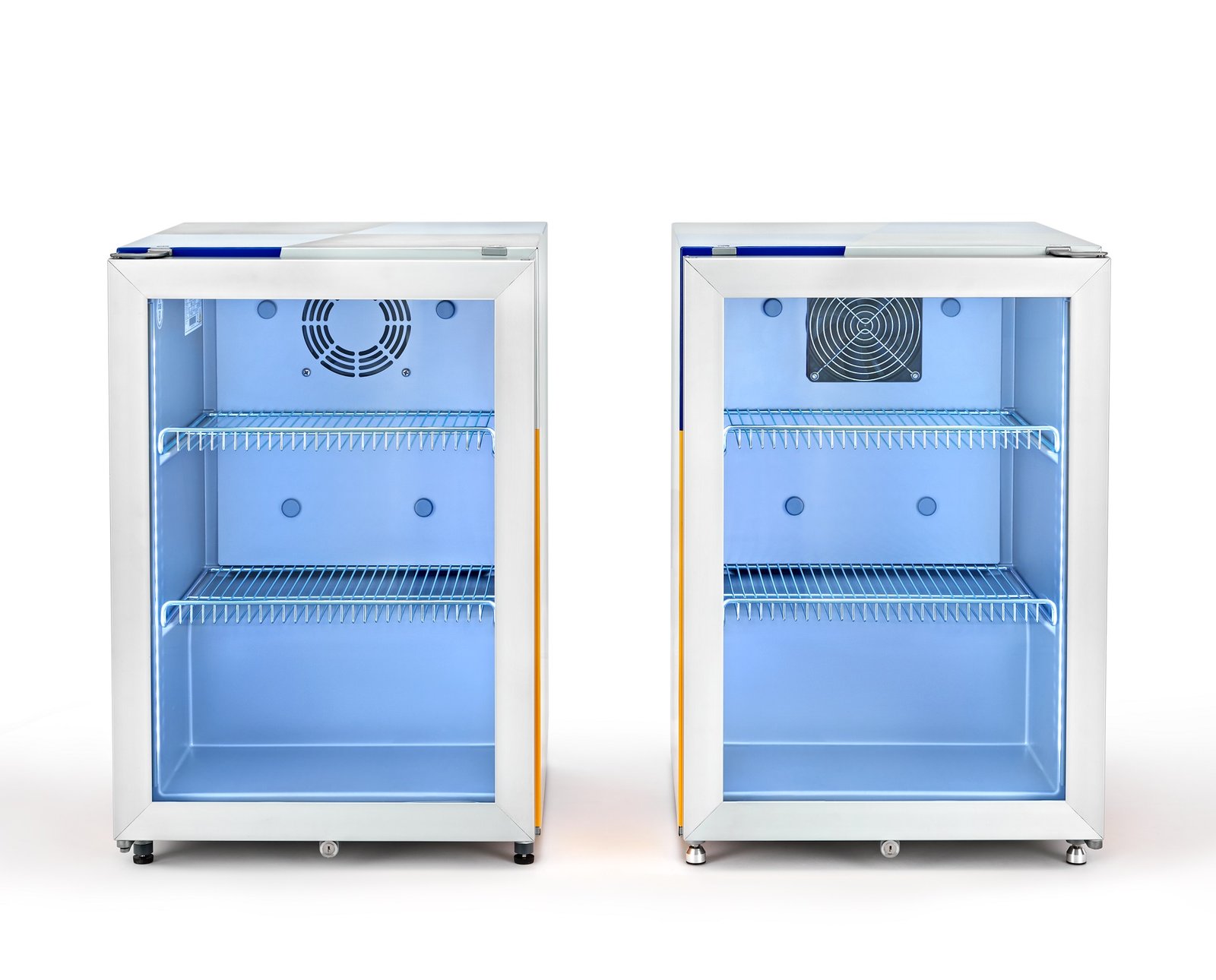
We recently made public a demonstration of how compact our solution was – by integrating our system into a small countertop beverage cooler. When looked at side-side, the two appliances – one magnetic the other conventional – are the same; exactly the same cooling volume. Only on the back view can you see a difference.
Magnetic cooling fridges as just as compact as conventional fridges now.
Ri: What should anyone looking for a magnetic cooling solution be aware of when making their choice?
NW: It is relatively easy to make a magnetic cooling system based around gadolinium – some companies (even now) put them in supermarkets, claiming this is a viable solution – but these devices have no commercial merit. They are too expensive and will never scale cost-effectively. At Camfridge, we have never used gadolinium and never will.
We work with a number of OEMs, delivering test systems for them that are based on our technology and processes. We are now working with these OEMs to begin scaling the production of our solution.
Ri: Any resistance to magnetic cooling in the market? If so, why do you think people are reluctant?
NW: I think magnetic cooling has been guilty of over-selling in the past, and as a result, some customers have become skeptical of the technology.
For example, a few years ago there was company in France called Cooltech Applications that claimed to have the first industrialized solution for magnetic cooling. They eventually went bankrupt, and it was clear why. Inside their black box system was 1,000s (even 10,000s) of Euros worth of gadolinium – all hand assembled. The reality was very far from the sales hype, and this turned off potential customers (and investors) for many years.
Now, though, we have a commercially viable solution, without gadolinium, that has been tested for several years and is ready to be scaled. Customers are getting excited again.
Ri: What advances have been made in magnetic cooling in the past 5-10 years?
NW: There have been no notable advances in magnetic refrigerant materials discovery – despite this being an active academic research field.
The real advances have been made in refrigerant materials engineering, functionalization and production methods i.e., the manufacture of low-cost refrigerant materials (shaped into low-pressure structures) that deliver efficient cooling and are capable of being produced at scale.
Ri: What R&D is currently being done around magnetic cooling? How do you expect this technology to change/ evolve in the future?
NW: Our focus now is on scaling production – to get a production product into the market (rather than prototypes) as soon as possible. Extending the operating envelope of the technology to lower and higher temperatures, high cooling powers, will happen naturally, but only once a first product is established in the market.
I also think the emergence of high-performance and non-Chinese permanent magnets is an exciting development that helps avoid any lingering concerns of supply chain concentration and could potentially allow magnetic cooling technology to be very low cost indeed.
Ri: Do you think magnetic cooling will become more popular in the future for refrigeration applications? Why/ why not? (What is driving this?)
NW: The International Energy Agency (IEA) estimates that 250 Gt (gigatons) of CO2 equivalent emissions from cooling need to be avoided by 2050 to achieve Net Zero; magnetic cooling will play a huge role in this transition. If you read the ESG reports of major refrigeration users, it is generally accepted that innovation is key to delivering net zero cooling. At Camfridge, we find that our innovative technology gets the most traction with those OEMs who supply customers with strong Net Zero goals.
Magnetic cooling is a highly disruptive technology, being the only new cooling solution in the last 150 years that can compete with gas compressors in terms of efficiency. It is also highly sustainable – being gas-free and circularly recyclable – helping set the industry on a sustainable path by eliminating environmentally harmful HFC and HFO refrigerant gases (even hydrocarbons) while consuming less energy.
A low-carbon and lower-cost cooling technology will do well, potentially exceptionally well.