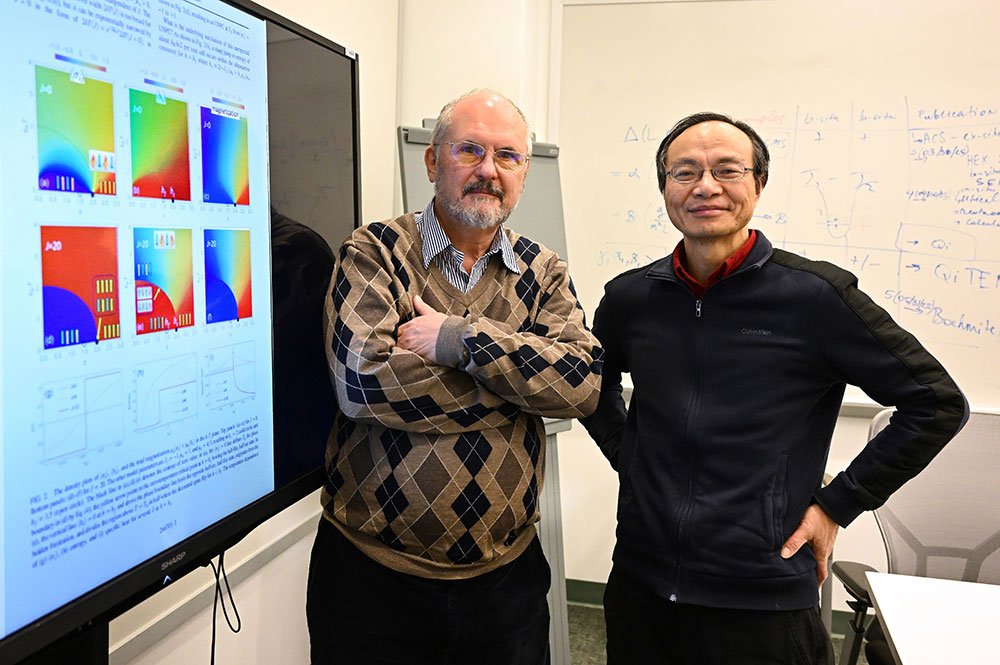
Two physicists at Brookhaven National Laboratory have identified a previously unknown phase of matter, described as “half ice, half fire,” in a theoretical model of a magnetic material. The finding could open new pathways in quantum technology and refrigeration applications.
The discovery, made by Weiguo Yin and Alexei Tsvelik, was published in the Physical Review Letters journal on December 31, 2024. It reveals a novel arrangement of electron spins – some highly ordered (“cold”) and others highly disordered (“hot”) – coexisting in a one-dimensional ferrimagnetic model.
This new “half ice, half fire” state complements a related phase, “half fire, half ice,” previously discovered by the same researchers. While both phases feature contrasting spin behavior within the same material, the newly identified version features a reversal in spin roles.
The researchers emphasize that the key significance lies in the sharp phase switching observed within a narrow temperature window. According to Yin, “Finding new states with exotic physical properties – and being able to understand and control the transitions between those states – are central problems in the fields of condensed matter physics and materials science.”
In ferrimagnetic materials like Sr₃CuIrO₆ – composed of strontium, copper, iridium, and oxygen – earlier research had shown disordered copper-site spins and ordered iridium-site spins under a critical magnetic field. The new phase swaps these behaviors, suggesting the potential for precise control of phase transitions.
This ultranarrow temperature-driven switching could offer functional advantages. The researchers suggest potential applications in magnetocaloric refrigeration, where a large change in magnetic entropy can be used to drive cooling cycles. It could also support the development of quantum information technologies by enabling stable, reversible switching between spin states.
“We suggest that our findings may open a new door to understanding and controlling phases and phase transitions in certain materials,” said Tsvelik.
Yin and Tsvelik now plan to extend their work to systems with quantum spins and explore interactions with lattice, charge, and orbital dynamics.
This research was funded by the U.S. Department of Energy Office of Science.