Commercial refrigeration refers to specialized cooling systems and equipment designed to store, transport, and display perishable goods and maintain them at specific temperature conditions. It is an essential component of various industries, particularly the food & beverage sector, pharmaceuticals, and healthcare. The end uses of commercial refrigeration systems include supermarkets & hypermarkets, convenience stores, bakeries, and hotels & restaurants. The major factors for the growth of the commercial refrigeration market include improving consumer lifestyle, growing food industry, rising demand for cold chain logistics, technological advancements in the refrigeration industry, and high demand for frozen & processed food worldwide.
Potential demand for carbon dioxide/ammonia cascade refrigeration systems, along with improvements in the efficiency of refrigeration systems using natural refrigerants, is expected to provide growth opportunities for the commercial refrigeration market. However, the stringent regulations against fluorocarbon refrigerants, such as hydrochlorofluorocarbons (HCFCs) and hydrofluorocarbons (HFCS), are expected to restrain the market’s growth.
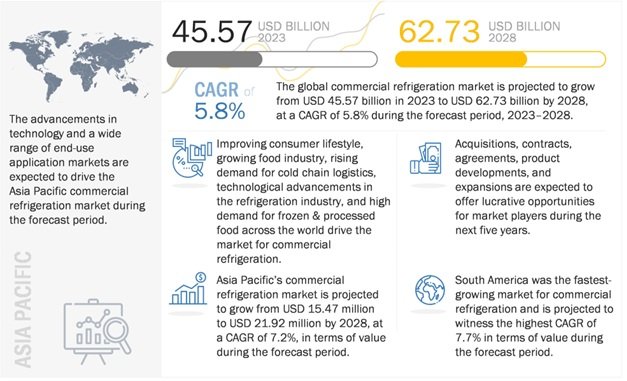
According to MarketsandMarkets the commercial refrigeration market is projected to reach USD 62.73 billion by 2028, at a CAGR of 5.8% during the forecast period.
INCREASING DEMAND FOR FROZEN & PROCESSED FOOD DRIVES COMMERCIAL REFRIGERATION MARKET
The market has been segmented based on product type, refrigerant type, application, end use, and region. Based on product type, the commercial refrigeration market is segmented into transportation refrigeration, refrigerator & freezer, beverage refrigeration, refrigerated display case, ice cream merchandiser, and refrigerated vending machine. The increasing demand for the refrigerator & freezer segment from supermarkets, hotels & restaurants in countries such as India, China, and Malaysia is driving the growth of the commercial refrigeration market. Based on applications, the commercial refrigeration market has been classified as food service, food & beverage retail, food & beverage production, food & beverage distribution, and others (food preservation, ice production, and catering services).
DRIVERS, RESTRAINTS, OPPORTUNITIES, AND CHALLENGES IN COMMERCIAL REFRIGERATION MARKET
Commercial refrigeration refers to the specialized field of refrigeration systems and equipment designed for commercial settings, such as restaurants, supermarkets, hypermarkets, convenience stores, hotels, bakeries, hospitals, and other food service establishments. These systems are essential for preserving and storing perishable goods, ensuring food safety, and meeting regulatory requirements. The increasing demand for processed food items and beverages and the growing use of natural refrigerants are additional factors contributing to the growth of commercial refrigeration. The natural refrigerants market will likely witness robust growth in the coming years. The demand for these refrigerants is driven by the expansion of the domestic, commercial, and chiller markets.
The market growth is expected to be driven by factors such as improving consumer lifestyle & flourishing food industry, rising demand for cold chain logistics, technological advancements in the refrigeration industry, and high demand for frozen & processed food worldwide. Potential demand for carbon dioxide/ ammonia cascade refrigeration systems and improvements in the efficiency of refrigeration systems with the use of natural refrigerants such as ammonia, carbon dioxide, hydrocarbons, water, and air, which exist naturally in the environment, is expected to lead to major opportunities for commercial refrigeration manufacturers, leading to the market growth. One of the major restraints in the market is the stringent regulations against using fluorocarbon refrigerants.
TECHNOLOGICAL ADVANCEMENTS IN REFRIGERATION INDUSTRY
Technological advancements in the commercial refrigeration market have significantly improved energy efficiency, environmental sustainability, performance, and control of cooling systems. These innovations are driven by the need to reduce operating costs, comp with environmental regulations, meet the evolving demands of businesses & consumers, and enhance the overall user experience. Here are some notable technological advancements in commercial refrigeration:
• Energy-Efficient Systems: Commercial refrigeration systems now incorporate advanced compressor technologies, such as variable speed compressors and inverter-driven compressors, which adjust their speed based on cooling demands. This results in better energy efficiency and reduced energy consumption.
Smart Controls and loT Integration: Internet of Things (IoT) technology allows for remote monitoring, control, and data analytics of commercial refrigeration systems. Smart sensors and connected devices enable real-time monitoring, predictive maintenance, and energy optimization.
• Energy Recovery: Some commercial refrigeration systems incorporate energy recovery systems that capture waste heat generated during the cooling process and repurpose it for heating water or other applications, improving overall energy efficiency.
• Eco-Friendly Refrigerants: Currently, most refrigerants available in the market have a high Global Warming Potential (GWP), and those releasing chlorine have led to the depletion of the ozone layer. Refrigerants with low GWP, such as ammonia and CO2, have been introduced; however, they have safety-related issues such as flammability, toxicity, pressure, and temperature limitations.
The shift toward environmentally friendly refrigerants with lower global warming potential (GWP) and reduced ozone depletion potential (ODP) is gaining momentum. The European Union and the US have formulated laws to reduce the current levels of CO2 emissions. In October 2014, the Environmental Protection Agency, under the Montreal Protocol, passed a rule that states the total HCFC production and consumption in the US should be completely phased out by 2030. As per EU F-Gas regulations, stationary refrigeration equipment that contains or whose function relies upon HFCs with GWP over 2,500 or more was banned from January 01, 2020. Commercially used multipack centralized refrigeration systems with a capacity of more than 40 Kilowatt (kW) that contain or rely on fluorinated greenhouse gases with more than 150 GWP were banned from January 01, 2022. Such rules and regulations have propelled the demand for eco-friendly refrigerants, which, in turn, contribute to the growth of the commercial refrigeration market.
ECOSYSTEM OF COMMERCIAL REFRIGERATION MARKET
The ecosystem of the commercial refrigeration market comprises raw material manufacturers & suppliers, commercial refrigeration manufacturers, and end-use industries that supply the finished products for various applications. Raw material suppliers provide commercial refrigeration manufacturers with metals, plastics, insulation materials, compressors, refrigerants, electronic components, and other necessary parts. Globally, industries employ different technologies to manufacture commercial refrigeration, which are majorly used in the food & beverages sector.