Esta página solo está disponible en inglés. Ir a la portada en español

×

Questa pagina è disponibile solo in inglese. Home page in italiano

×

Diese Seite ist nur auf Englisch verfügbar. Zur deutschen Startseite

×

Cette page est disponible uniquement en anglais. Aller à la page d'accueil en français

×

Rwanda Trains Stakeholders on Sustainable Cold-Chain and Cooling Solutions

Rwanda Trains Stakeholders on Sustainable Cold-Chain and Cooling Solutions

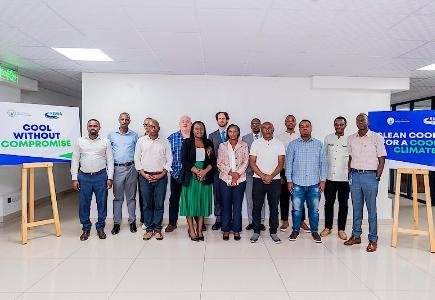
The Rwanda Environment Management Authority (REMA), in partnership with the United Nations Environment Programme’s United for Efficiency (U4E), has held a training workshop on sustainable cold-chain and cooling technologies. The event, organized under the Green Climate Fund (GCF) Readiness Project, aimed to build national capacity for deploying energy-efficient and climate-friendly refrigeration systems.

The workshop brought together 40 participants from government bodies, academia, and the private sector, including cold-chain operators, equipment suppliers, and entrepreneurs. The training focused on technical knowledge to support Rwanda’s transition to sustainable cooling, in line with plans to implement Minimum Energy Performance Standards (MEPS) and labelling for refrigerators and air conditioners.

Discussions also addressed complementary strategies such as public awareness campaigns and investment promotion, with goals to reduce emissions, lower energy costs, and improve food preservation, public health, and economic resilience.

Dr Edward Hammond from UNEP introduced refrigeration technologies and the importance of safe refrigerants, while Jean Paul Ntaganda from REMA presented the role of cooling in agriculture, health, and business. Dr Hammond also outlined Rwanda’s cold-chain vision through the SPOKE programme, which combines infrastructure with training and business models.

Participants contributed during plenary sessions, highlighting solutions to ensure Rwanda’s cold-chain is sustainable, cost-effective, and adapted to local needs.

“Cooling is vital, but it must also be efficient and climate-friendly. This workshop is paving the way for a future where Rwanda can benefit from cooling without compromising our environment,” said Beatha Akimpaye, Division Manager of Environmental Compliance and Enforcement at REMA.

Get the daily refrigeration briefing

One email a day. Trusted by 3,000+ RACHP professionals.

More on Cold Chain

All on Cold Chain →

Insights

Secop's Solar Direct Drive (SDD) System Earns WHO PQS Approval – The Team Behind It
Article

Secop’s Solar Direct Drive (SDD) System Earns WHO PQS Approval – The Team Behind It

Partner's material In March 2026, Secop’s Solar Direct Drive Power Management Module was granted WHO PQS prequalification and officially listed in the WHO Catalogue of Prequalified Immunization Devices. The WHO IMD-PQS (Immunization Devices Performance, Quality and Safety programme) is the global benchmark for cold chain equipment used in immunisation. Being listed in its catalogue is

22 Jun 2026
Case Study - Effect of Louvers or diffusers on air flow distribution and cooling time on a meat log during Chill cycle
Tech Guide

Case Study – Effect of Louvers or diffusers on air flow distribution and cooling time on a meat log during Chill cycle

By Kushal Aurangabadkar An experimental analysis was conducted on a cooler space measuring 3.66 m × 6.096 m (12.0 ft × 20.0 ft), equipped with an ammonia refrigeration coil, five 30 cm (12 in.) fans, and five diffusers. The study measured airflow patterns, cooling rates, and heat transfer efficiency in meat storage by testing two configurations:

Kushal Aurangabadkar · 21 Jan 2026
Total Cost of Ownership (TCO) for Modular Refrigeration Systems in Life Sciences Distribution Centers
Tech Guide

Total Cost of Ownership (TCO) for Modular Refrigeration Systems in Life Sciences Distribution Centers

by Ramez Naguib, P.E. Introduction Life sciences distribution centers are under immense pressure to deliver consistent temperature control, comply with increasingly stringent regulations, and optimize operational efficiency. Traditional built-up refrigeration systems often prove cumbersome, costly, and slow to implement. In contrast, modular, factory-assembled refrigeration systems have emerged as a compelling alternative. Drawing on lessons from

Ramez Naguib · 14 Jan 2026
Everything on Cold Chain: 2,056 articles, 2 case studies, 23 insights

Most read this month

All news →