Esta página solo está disponible en inglés. Ir a la portada en español

×

Questa pagina è disponibile solo in inglese. Home page in italiano

×

Diese Seite ist nur auf Englisch verfügbar. Zur deutschen Startseite

×

Cette page est disponible uniquement en anglais. Aller à la page d'accueil en français

×

Kenya Cold Chain Accelerator workshop highlights push for sustainable cooling

Kenya Cold Chain Accelerator workshop highlights push for sustainable cooling

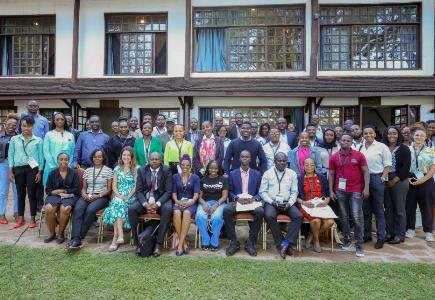
The Kenya Cold Chain Accelerator (KCCA), a partnership between Energy Saving Trust, Energy 4 Impact, and GOGLA, hosted an inception workshop in Nairobi this November to advance cold chain infrastructure development. The event brought together stakeholders from government, industry, and development sectors to promote sustainable, efficient, and accessible cold chain solutions.

Government representatives emphasized the importance of cold chain systems for food security, climate adaptation, job creation, and expanding market access for smallholder farmers. Sectors such as horticulture, dairy, meat, and fisheries are seen as central to Kenya’s economic and climate resilience goals.

KCCA’s approach includes supporting cold chain innovators, providing technical assistance and skills development, and promoting cross-sector policy dialogue. The aim is to establish a sustainable ecosystem that integrates enterprise support, policy reforms, and market intelligence.

Emerging business models such as Cooling-as-a-Service, leasing, and aggregator-led solutions are gaining traction, especially those based on solar refrigeration, thermal storage, and IoT monitoring. However, barriers remain, including high import duties—reported to increase equipment costs by up to 50%—regulatory inconsistencies, limited asset utilization due to seasonal demand, and a lack of performance data that hinders financing.

Cooperatives and producer organisations are seen as promising vehicles for scaling cold chain deployment due to their structure and financial capacity. Policy developments are also progressing, with efforts to expand Minimum Energy Performance Standards, promote natural refrigerants under the Kigali Amendment, integrate cooling into county-level plans, and scale technician training programs.

The workshop highlighted that sustained collaboration across public, private, and development sectors is necessary to overcome systemic challenges and build an integrated cold chain ecosystem in Kenya.


Source

Get the daily refrigeration briefing

One email a day. Trusted by 3,000+ RACHP professionals.

More on Cold Chain

All on Cold Chain →

Insights

Secop's Solar Direct Drive (SDD) System Earns WHO PQS Approval – The Team Behind It
Article

Secop’s Solar Direct Drive (SDD) System Earns WHO PQS Approval – The Team Behind It

Partner's material In March 2026, Secop’s Solar Direct Drive Power Management Module was granted WHO PQS prequalification and officially listed in the WHO Catalogue of Prequalified Immunization Devices. The WHO IMD-PQS (Immunization Devices Performance, Quality and Safety programme) is the global benchmark for cold chain equipment used in immunisation. Being listed in its catalogue is

22 Jun 2026
Case Study - Effect of Louvers or diffusers on air flow distribution and cooling time on a meat log during Chill cycle
Tech Guide

Case Study – Effect of Louvers or diffusers on air flow distribution and cooling time on a meat log during Chill cycle

By Kushal Aurangabadkar An experimental analysis was conducted on a cooler space measuring 3.66 m × 6.096 m (12.0 ft × 20.0 ft), equipped with an ammonia refrigeration coil, five 30 cm (12 in.) fans, and five diffusers. The study measured airflow patterns, cooling rates, and heat transfer efficiency in meat storage by testing two configurations:

Kushal Aurangabadkar · 21 Jan 2026
Total Cost of Ownership (TCO) for Modular Refrigeration Systems in Life Sciences Distribution Centers
Tech Guide

Total Cost of Ownership (TCO) for Modular Refrigeration Systems in Life Sciences Distribution Centers

by Ramez Naguib, P.E. Introduction Life sciences distribution centers are under immense pressure to deliver consistent temperature control, comply with increasingly stringent regulations, and optimize operational efficiency. Traditional built-up refrigeration systems often prove cumbersome, costly, and slow to implement. In contrast, modular, factory-assembled refrigeration systems have emerged as a compelling alternative. Drawing on lessons from

Ramez Naguib · 14 Jan 2026
Everything on Cold Chain: 2,056 articles, 2 case studies, 23 insights

Most read this month

All news →